

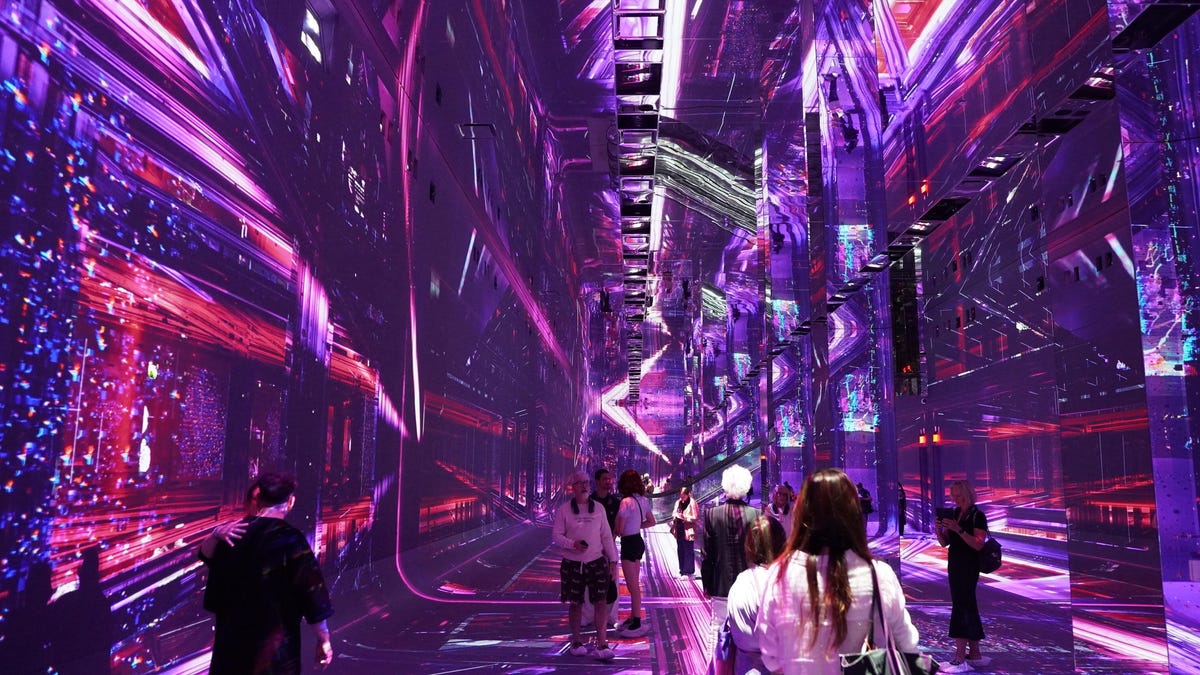
Whatever I was expecting from the world’s first AI museum isn’t what I saw at Dataland. The brand-new facility is a showcase for different ways to beautify data visualization using large language models — part artistic translation and part experiential exhibit that invites patrons to interact as they walk through its handful of rooms.
But in an age of generative AI models spitting out slop mimicry of human-made art, it’s incredibly easy to get the wrong idea about Dataland.
Days before its doors open on June 20, I visited the downtown Los Angeles space where Dataland is housing its modest but vibrant museum. It’s tucked into the Grand LA, the most artistic office park I’ve ever seen, with open-air spiral staircases and a view of the striking Frank Gehry-designed Walt Disney Concert Hall across the street. The doors open to an entryway detailing the debut exhibition, Machine Dreams: Rainforests. Then the exhibition begins: five specially built, windowless rooms of varying sizes, their sleek black floors reflecting swirling colors.
Dataland is the creation of Refik Anadol, a Turkish artist, programmer and researcher who’s been creating his version of AI art for a decade. His signature style is to use algorithms he’s programmed to translate raw data into wild, dynamic visuals — most commonly, orbs of shifting color that pulse like waves, a churning panoply of form and hue. The context of the data matters less than its conversion into a hypnotizing, ever-shifting display.
Anadol placed one such piece in the Museum of Modern Art in New York City a few years ago. He’s also created more experimental works layered over public spaces at the Guggenheim Museum Bilbao and Barcelona’s famous Gaudí-designed building Casa Batllo, among others. Dataland is a permanent installation showcasing his experiments in merging information and visuals. Or, as he puts it, “Data is my pigment.”
It might be one of the worst times to launch anything that merges art and AI. Any hint of using AI in traditionally creative work draws scrutiny and skepticism. Film and TV shows generated by AI have flopped, while gamers have swiftly rebuked any studios or publishers they’ve heard use AI in production. Today, there’s no consensus on how much AI is acceptable in artistic expression: Many believe using it anywhere in the production process taints the work with artificiality and insincerity. That’s because images generated by AI often resemble the art and styles they’re trained on, and can even be prompted to look just like they came out of Studio Ghibli or The Simpsons.
The museum Anadol designed with his team does none of that.
The museum’s works are not drawn on canvas and don’t imitate traditional art. Unlike the AI slop flooding the internet, they’re not churned out to compete with human-crafted works; they’re based on data. And their output is an experience, making the museum feel more like an immersive attraction than an art gallery. Think of Dataland as a supercharged version of the Van Gogh experience that recently toured the US, but that’s interested in giving attendees a show and having them inform the performance.
At the start of the tour, Anadol posed Dataland’s central question: Can artwork feel us back? And if so, what does that mean?
“This is an AI museum dedicated to human-machine collaboration,” Anadol said. “There’s a lot of hysteria, paranoia, fears and concerns [around AI.] We felt, how can we share the best of the best digital arts in a place architecturally built from scratch with this medium in mind — digital art, specifically, [and] AI art is a part of digital art. ”
Attendees will likely get hung up on the balance of the human and the machine in what they see — I certainly did. Anadol and the team behind the museum have given their LLM free rein to vary the visuals and sound while adhering to a broader preset sequence of themes.
“Art happens in the mind and the soul, and it requires significant work and research, thinking and imagining and creativity,” Anadol said. “There is no text here, there is no prompting here. The emotions of the audience, visitors, listening to the heart of the rainforest, and me, as well as of course artists, together create the artworks in real-time.”
Dataland’s uphill battle to present data-driven AI art
It might have been better if Anadol had billed his production as a Data Creation Museum, free of the baggage surrounding AI and the questions about exactly what role it plays in the works on display.
AI is intrinsic to creating the visuals I saw, but it’s born from specific datasets — in this exhibition’s case, info sourced from and images taken of 16 rainforests around the world. In our tour of the museum, Anadol stressed that everything we saw was built on “ethical data” — that is, ethically sourced data licensed from the Smithsonian and other repositories.
That doesn’t guarantee any information used wasn’t stolen at some point before it ended up in those collections, but provenance will continue to be a challenge for anyone working with licensed datasets, and ethical sourcing is far from a new issue for museums and galleries.
All the visuals were made with a proprietary large language model, which Anadol calls the “Large Nature Model,” built from rainforest images and available to the public for free. This LLM generates the museum’s imagery on the fly. Anadol says it runs in data centers in Oregon powered by sustainable energy.
Writ large, Dataland is a mix of old and new — walking through its rooms feels like stepping inside one of today’s Instagram-friendly immersive experiences. What isn’t obvious is how the jumble of data produced by museum visitors factors into the audiovisual experience, theoretically making every visit different. You’d have to go back and compare to understand what’s changed, because as you walk through the first time, there’s little to show how your presence is altering the art you’re seeing.
At $49 for admission, Dataland is more of a sumptuous curiosity than a can’t-miss destination, unless you’re ready to do some cognitive legwork — a visual feast that’s far more enriching when you stop to examine its ingredients. Walk through in the 60 to 75 minutes most visitors are expected to spend there and it’ll probably linger in your mind as an enjoyable multisensory jaunt. But think about the floods of data we consume and produce every day, and the museum becomes an intriguing springboard for translating and interpreting that data through processes like Anadol’s.
Delving into the AI museum: Seeing, feeling, smelling, eating
The museum begins with an intake room that introduces the exhibition. As Dataland opens — and likely through its first year — that exhibition is Machine Dreams: Rainforests, which uses data from 16 rainforests around the world to create a multisensory experience. Anadol expects to rotate exhibitions annually.
The first room sets the stage for the other four, with walls of LED displays that project a dynamic light show like the world’s most advanced screensaver. The wall screens were the only light in the room, reflected off the slick black floor meticulously kept clean to preserve the mirror effect. (I was asked to wear over-shoe coverings during my preview tour, though public attendees don’t have to).
After a short preview of the rooms ahead of us, we scanned a printed QR code (public attendees scan one via a mobile app) to unlock a box containing a pair of devices. The first is a simple wrist wearable to track your location and vitals (heart rate, skin temperature, etc.), generating the data that supposedly tweaks your experience. The second is a horseshoe-shaped plastic scent emitter that hangs around your neck and quietly releases smells based on the part of the exhibition you’re near. In my experience, it was barely noticeable, but that’s far better than being overwhelmed by scent.
The tour group took an escalator down to the Data Pavilion. It is by far the largest room in the museum and serves as the centerpiece and experiential anchor. Screens stretched 30-feet up the walls to the ceiling, and projectors seamlessly extend the visualizations to the floor and ceiling. Different “chapters” shifted the visuals from a rainbow spectrum of strings and dots to a cyberworld of chips resembling the inside of a server rack to a digitized forest. Anadol pointed out the lidar scanners in the ceiling that track everyone’s position; I watched as projected fireflies spread around my feet while light vines on the walls waved along to my movement.
“So when we enter the museum, and, of course, when I enter the gallery, the whole gallery is sensing us — our heartbeats, our emotions, our movements,” Anadol said.
I have no reason to doubt it, though I didn’t notice my data’s contributions to the experience. I was more impressed by the high-production visuals and sound than by contemplating the “real-time sand molecules personally composed for you,” as he described. Again, I have to figure out for myself which parts of the experience were tailored to me, and whether that changes my perception of them.
At a certain point, you move on from the audiovisual kaleidoscope of the Data Pavilion to the next room. It’s a long hall with a few exhibits, including a wall of dots representing all the data used in the museum — a constellation of information. There was a tray of chocolates made by a local chef who had crafted the flavors based on the rainforest data — or at least descriptive words Anadol selected to represent all the soil, plant life, animals and more. Each bonbon represented a taste profile for a strata of the environment; my favorite was flavored with mushrooms for the fungal floor of the forest.
What do you get out of an AI museum?
Dataland is impressive in its execution, and inconclusive in its takeaways. Simply taking it all in is enjoyable enough, letting the swirling colors and sound wash over you, with polished reflective floors and not a stray cable in sight to distract. You’re seeing data, but there’s no obvious lesson in how it’s translated.
The exhibit in the fourth room, the Infinity Room, is a great example. Dream of Ruwe Pinu, as it’s called, is a metaphorical journey inspired by a dream Anadol had about a bird during one of his trips to the Amazon. It begins in complete darkness before launching into an audiovisual experience that’s nearly blinding in its vibrancy. While the audio features a 1987 recording of the last male of a species of Hawaiian bird, the visuals coalesce into a hummingbird flying through a rainforest in high-resolution graphics. It felt like a kind of conventional escapism — and, at times, like I was watching a computer graphics stress test.
The museum’s final room, the AI Sanctuary, showed the tour group’s personal data summarized in an “emotion score” to gauge how excited, involved and moved we were by the exhibits. I scored lower than almost everyone else. (Read into that what you will.) After seeing our museum stats, the room shifted into one of Anadol’s signature paintings of light and color, which we were told was our collective tour group’s data, swirling in color and form.
It’s cool to see our body data translated into an abstract painting. But without any visible relationship between data values and motion, I was left visually whelmed but emotionally inert.
If you like, you can have your personal museum data converted into a paper disc, like a drink coaster, which you can view at a kiosk or take to the merch store to have your activity printed on a T-shirt. (Otherwise, the data is deleted; Dataland doesn’t store it.)
I was hoping for more insights into my personal activity cross-referenced with the exhibits — some relationship between the art and my own data beyond the metrics I could already track with a wearable or smartwatch. That’s a steep ask for a $49-and-up ticket. Perhaps a future exhibition at Dataland will get there; Anadol pointed to the chocolates as one example of the kinds of collaborations he and his team could explore.
“Sure, we have AI in there, but it’s a human-machine collaboration, and we are every single one of us experimenting with new ideas,” Anadol said. “Every year we’ll have another breakthrough, I’m guessing. So that’s just the beginning of version one, day one.”
If any space has the infrastructural capacity to explore new ways of creating digital art, it’s Dataland. Tucked in the hallways behind the museum’s public displays are backrooms filled with racks of GPUs — 150 Nvidia RTX Pro 6000 Blackwell industrial-grade graphics cards that retail for $13,000 or more apiece, which power the visualizations across the museum.
This absurd level of graphical horsepower is very promising for future exhibits, as is Anadol’s relationship with Nvidia, which he demonstrated onstage at GTC 2025 to introduce his AI art. (He showed me a message from Nvidia CEO Jensen Huang congratulating him on the opening of Dataland.) Further, the Large Nature Model itself runs on a Google server cluster in Oregon that uses sustainable energy, Anadol said.
There’s a lot that Dataland could become, and it’s opened at a time of great potential change. Anadol acknowledges that AI and technology are changing people’s lives and disciplines, which is cause for concern: “I’ve been using AI for 10 years, and even sometimes I feel that it’s too fast,” he said. But it’s here with us, transforming our lives.
“I always believe the future of inspiration, joy and hope,” Anadol said. “As an artist, I found my role in society is to tell the world what this technology is and show the world how to use it as best I can.”
Read the full article here