

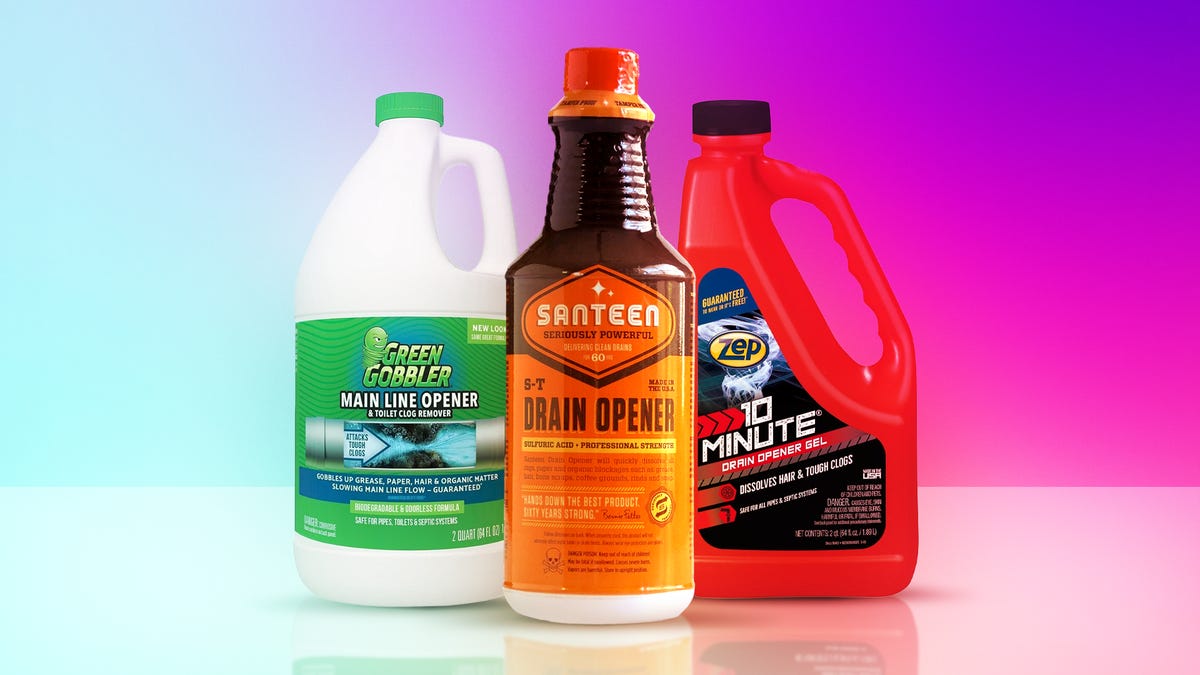
I leaned on my background as a chemical engineer to offer insights on the effectiveness of these controversial chemicals. In my experiment, I tested eight of the most commonly available chemical drain cleaners: six alkaline and two acidic. I performed dissolution tests to evaluate how well each of them could dissolve drain blockages. I had one goal: to determine which products, if any, would work effectively against the most common clogging materials.
For this rundown, I headed to CNET’s product testing lab in Louisville, Kentucky, to conduct a comprehensive batch distillation experiment with eight of the most commonly used chemical drain cleaners on the market. My primary objective was to determine the efficiency of each product in dissolving various types of clogging materials, including organic matter, grease, paper products and pet hair (the same pet hair we use for our robot vacuum tests, as a matter of fact). Throughout the experiment, I also noted the pH levels of the cleaning solutions when mixed with water and monitored any temperature changes. Furthermore, I considered the chemical composition and versatility of use of each product when comparing them to one another.
Categorizing the cleaners
Before conducting experiments with these substances, I separated them into acids and bases. As you may recall from high school chemistry, acids are compounds that donate a hydrogen ion (H+) when mixed with water and have a pH lower than 7. On the other hand, bases are compounds that accept those ions (or hydroxide, OH- ions) and have a pH higher than 7. Understanding this distinction is crucial, due to two important factors associated with these products: corrosivity and causticity.
Corrosivity refers to the potential of a chemical substance to cause rust and deterioration of the materials that make up your piping system. Causticity, on the other hand, relates to how a chemical substance reacts when it comes into contact with organic matter, specifically breaking down proteins and other organic molecules, which can lead to tissue destruction or chemical burns.
To determine the acidity or basicity of each compound, we measure their pH. In simple terms, the more acidic or basic a compound is, the greater its potential for corrosivity and causticity.
Acidic drain cleaners, particularly those with high acid concentrations like sulfuric acid drain cleaners, are more hazardous compared with their basic or alkaline counterparts. In chemistry, the order of addition does matter. Normally, you would gradually introduce an acid to water, slowly increasing the concentration of the acid. Never add water to an acid as this reaction is known to generate a significant amount of heat and release hazardous fumes. See for yourself in the GIF below (and don’t try this at home).
To ensure safety during the experiments, I took necessary precautions by wearing personal protective equipment, including safety goggles, gloves, long-sleeved clothing and a mask. The dissolution test was conducted in a well-ventilated laboratory area to minimize exposure to any hazardous fumes that may be released.
Dissolution test
To begin the experiment, I weighed specific amounts of the clogging materials into separate 1,000 ml beakers:
- 4 grams of hair
- 20 grams of organic matter (10 grams each of apple peels and carrot peels)
- 40 grams of lard for grease
- 14 grams of paper products (7 grams each of toilet paper and paper towels)
Using a graduated cylinder, I carefully measured and added 200 ml of each basic drain cleaner and 70 ml of each acidic drain cleaner to the respective beakers, stirring the mixtures with a glass rod and ensuring thorough mixing without spills. Following the instructions provided with each product, I allowed the solutions to sit for the recommended time, typically between 15 and 30 minutes.
A crucial step in my test was the inclusion of water, a component often overlooked in similar experiments found online. Chemical drain cleaners are designed to work in the presence of water, which facilitates the transportation of the cleaner to the clogs and evenly distributes the solution over their surfaces, enabling the dissolution process. After the designated time had elapsed, I added tap water to each beaker containing the cleaner solutions and clogging materials. For basic drain cleaners (pH > 7.0), I used 500 ml of hot water at 46 degrees C, while for acidic drain cleaners (pH < 7.0), I used 700 ml of cold water at 19 degrees C.
To allow sufficient time for the chemicals to work, I left the samples to sit overnight and resumed the evaluation the following morning. By this point, the samples had transformed into sludgy, slimy mixtures.
To proceed with the experiment, I employed a vacuum filtration process using a Buchner funnel connected to a 1,000ml filtering flask equipped with a pump. The contents of each beaker were carefully poured into the funnel while the pump was activated. Once most of the chemical drain cleaner had been drawn out of the funnel, I performed a water wash to remove any residual chemicals from the surface of the debris samples, ensuring that only wet solids remained in the Buchner funnel.
Our Buchner funnel, made of chemically resistant borosilicate glass, featured a perforated plate with 2ml openings, allowing only the tiniest particles to pass through. In my test logic, “if a substance, solid or liquid, could pass through the 2mm openings in the filter, it was highly unlikely to cause pipe clogging.”
Finally, I separated the samples and subjected them to a fan-drying process for a few hours to evaporate any remaining water from the wash. I recorded the final weight of each sample and compared it to its initial weight. The ratio of the final weight to the initial weight provided us with the dissolution efficiency of each drain cleaner product.
Read the full article here