

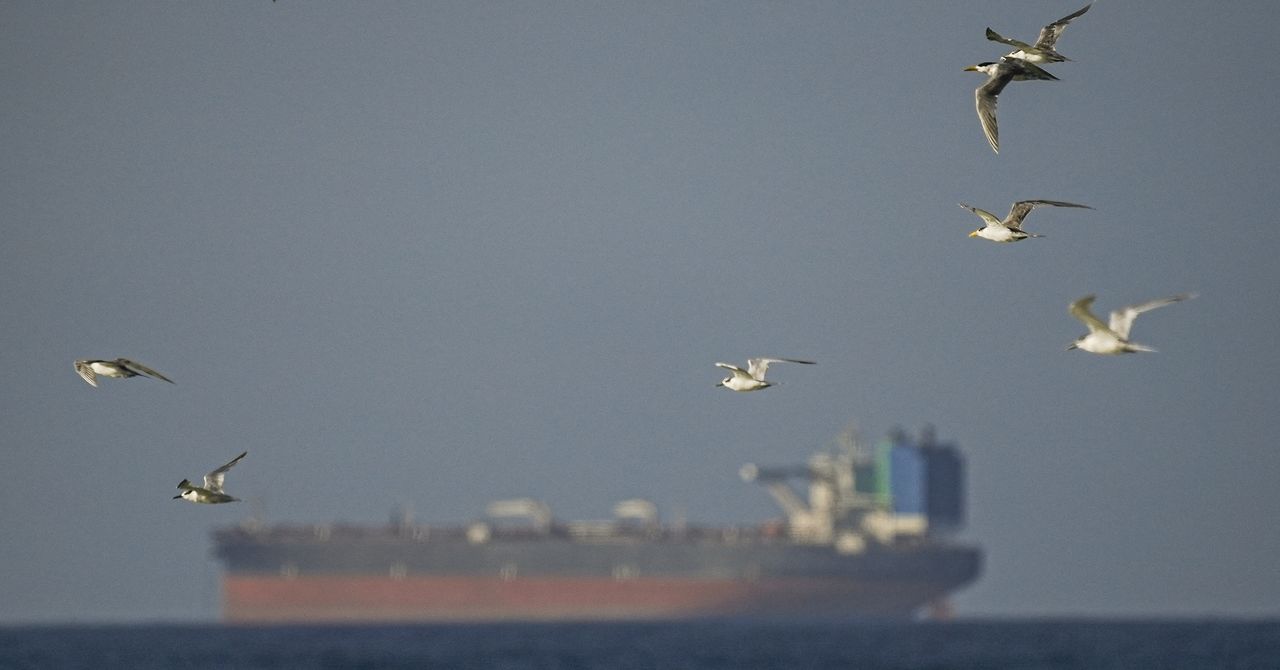
A month and a half into the war between Iran and the US and Israel, Michelle Wiese Bockmann has seen one constant: disappearing ships.
This is not unusual in the Strait of Hormuz, says Bockmann, a senior maritime intelligence analyst at Windward AI who has been tracking shipping across the globe for 30 years. For nearly a decade now, “shadow fleets” engaged in shady practices—say, violating international sanctions by transporting crude oil from Iran—have periodically turned off their transponders. These devices typically broadcast ships’ names, locations, routes, and IMO (International Maritime Organization) numbers. Those unique, seven-digit IMO identifiers allow trackers like Bockmann to trace the ships throughout their floating lifetimes.
Jamming and “spoofing” these transponder signals, either by interfering with their satellite signals or creating false ones to make the ships appear where or what they’re not, isn’t new. But the scale is. At one point last month, “well over half of the vessels in the strait had their signals jammed,” Bockmann says. Today, more than 800 vessels are in the Persian Gulf, according to Windward AI data.
Now she and other analysts have found new ways to follow them.
“I keep a very, very close eye on a large cohort of 500 or 600 tankers. Some of them I’ve been watching for years now,” says Bockman. “I think of them like recalcitrant children. When you find a ship and you uncover which one it is, it’s like, ‘Ah, I see you.’”
The cat-and-mouse data game has high stakes. Bockmann’s firm, Windward AI, works with marine insurers, oil traders, and other financial institutions with interests in or onboard one of hundreds of ships that typically (in times of relative peace) move through the Strait of Hormuz every month. About 20 percent of the petroleum consumed globally moves through the narrow waterway. Disruption there creates “absolute carnage and chaos,” Bockmann says.
Consequences more immediate and dire than long-term global recession also loom. Tankers that are not accurately broadcasting their locations can crash into others or run aground, upping the likelihood of catastrophic oil spills.
So trackers have been working hard. When Israel and the US attacked Iran in late February, Bockmann had to cut short a visit with her family in Australia. Back in London, she’s been working long days ever since.
Eyes in the Sky
Tracking disappearing ships makes use of several technologies, some of them newer than others. Samir Madani, the cofounder of TankerTrackers.com, has for years relied on satellite imagery from both commercial and public sources to give paying clients a better sense of when and where oil and other goods are moving in and out of the strait. But in April, US satellite firms announced they would limit high-resolution imagery of the region.
“We are dusting off all the old sources and tweaking them to perfection,” Madani told WIRED in a message. “We are buying [information] from other Western sources as well.” The firm’s data is valuable to other companies, he says, because two-thirds of tanker traffic moving through the Strait of Hormuz is by vessels with histories of violating sanctions.
Bockmann says her firm relies on several other sources to get a good idea of what’s going on in the strait. Electro-optical imagery uses electronic sensors to detect visible and near-infrared light data. Synthetic-aperture radar uses microwaves to create images even through clouds, rain, or darkness. Radio-frequency signals are used to transit data wirelessly (used in Wi-Fi, Bluetooth, and GPS). Stitch those together with databases that include ship registry information and even “human presence signals” from mobile devices onboard vessels, and the firm can get a better sense of what is going where. Generally, satellite imagery used to be very expensive to obtain, but prices are coming down, she says.
Read the full article here