

Pros
- Comfortable, secure fit with different-sized eartips and fins included
- Very good sound with much improved noise-canceling performance
- Great voice-calling performance
- Robust feature set
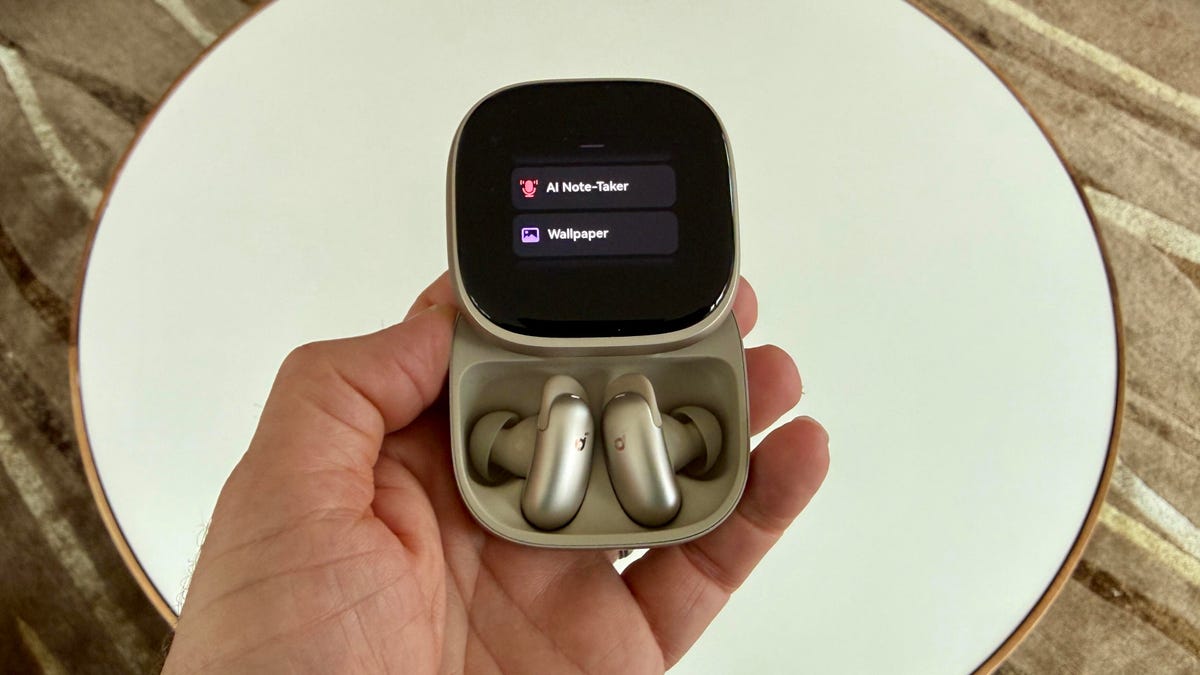
- Small touchscreen built into case
- Built-in voice commands
Cons
- Earbuds are a little beefy and stick out of your ears more than some lower-profile buds
- Charging case is a little heavy
- Touchscreen is a tad small
Pros
- Comfortable, secure fit with different-sized eartips and fins included
- Very good sound with much improved noise-canceling performance
- Great voice-calling performance
- Robust feature set
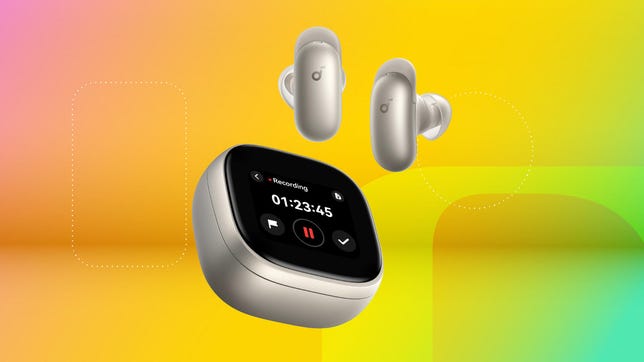
- An AMOLED touchscreen is built into the case along with a microphone
- Case doubles as AI notetaker
- Built-in voice commands
Cons
- Somewhat pricey
- Earbuds are a little beefy and stick out of your ears more than some lower-profile buds
- Case is a little heavy (it’s heavier than the Liberty 5 Pro’s case)
Over the years, Anker Soundcore audio products have attracted a loyal following largely because they are good lower-cost alternatives to pricier offerings from premium brands like Apple, Bose and Sony. That said, I’ve felt Anker’s earbuds have been a little disappointing the last few generations as they’ve failed to progress in a significant way and maybe even regressed in some cases. That’s finally changed with its new Liberty 5 Pro ($170) and flagship Liberty 5 Pro Max ($230) earbuds, both of which are powered by a new AI chip developed by Anker. Not only does that new chip improve performance across the board, but the buds’ voice-calling performance is truly top-notch.
Aside from their color options, the buds themselves are identical across both models. However, they have different charging cases. While both the Liberty 5 Pro and Liberty 5 Pro Max have a touchscreen built into their cases, the Max’s 1.8-inch AMOLED touchscreen is larger than the standard Pro’s, and its case doubles as a voice recorder (AI Notetaker) with a built-in microphone. Not everybody needs that extra feature, and the case for the Max is slightly bigger and heavier, too, so I’ve awarded a CNET Editors’ Choice to the more affordable Liberty 5 Pro. But the Liberty 5 Pro Max is also recommendable.
Read more: Best wireless earbuds of 2026
Anker Liberty 5 Pro and Liberty 5 Pro Max Design
The new models don’t look anything like Anker’s earlier Liberty 5 buds (around $100), which have a traditional stem design. They share some design traits with Bose’s QuietComfort Ultra (2nd Gen) earbuds and Sound by Bose models from Skullcandy and Baseus.
The included eartips are oval-shaped like Bose’s, and you also get fins (five sizes of tips and three sizes of fins are included) to help keep the buds securely in your ears. The designs of the eartips and fins aren’t quite as good as Bose’s (particularly the fins), but most users should get a comfortable, snug fit with a combination of the tips and fins. I used the XL tips with the medium fins and got a pretty tight seal, though I got a touch better seal-wise with some other tips I had in my collection from other earbuds.
I personally found the AirPods Pro 3 slightly more comfortable during longer listening sessions, and their case is smaller (and the buds are slightly easier to get in and out of it). But it’s a small difference, and some people may find they get a more secure fit with these Anker buds.
Like those Bose, Baseus and Skullcandy buds, the new Liberty 5 Pro models do stick out of your ears more than some buds that have a lower profile. In that regard, they’re a little bit of a throwback to the Liberty 2 Pro, though the Liberty 5 Pro’s design is more streamlined and rounded with a similar shape to the company’s Aerofit 2 open buds.
Again, both models have touchscreens in their cases. The 1.8-inch AMOLED touchscreen on the Liberty Pro 5 Max’s case covers the entire top of the case, while the 1-inch LCD touchscreen on the Liberty 5 Pro’s is embedded in the side of the case at the front. The Liberty Pro 5 Max’s case feels a little more premium, but it is heavier. Both have lids that are on tracks and slide open to expose the buds. The buds have an IP55 dust- and water-resistance rating, which means they can withstand a sustained spray of water and are dust-resistant.
The one small gripe I have is that because the earbuds’ cases are a bit heavy and have a fairly smooth finish, particularly the Pro Max’s case (which has a glossy screen on top), they can easily slide out of your pocket if you’re sitting on a couch or a deeper chair. Perhaps Anker will make accessory protective cases with some grip or a clip that allows you to fasten the case to your bag or a belt loop.
Anker Liberty 5 Pro and Pro Max features
Both models are equipped with Bluetooth 6.1 and offer a robust feature set. They have wearing-detection sensors that pause your music when you take a bud out of your ear and resume playback when you put it back in. Additionally, they have a feature called Easy Chat that’s similar to Sony’s Speak To Chat and Apple’s Conversation Awareness that automatically lowers the volume of the earbuds and “enhances human voices” if you start to have a conversation with someone, so you don’t have to take the buds out of your ears. You have to enable it in the app, but it’s a nice feature to have with noise-canceling earbuds.
There’s support for Dolby Atmos spatial audio, Bluetooth multipoint (up to three devices paired simultaneously), Apple Find My, plus an AI-powered audio upscaling feature along with adaptive and manual noise-canceling settings. You can activate a wind-noise reduction setting in the companion app for iOS and Android as well.
While the buds have touch controls, I mainly used the built-in voice commands that let you adjust volume, skip tracks forward and back, and answer and reject calls without using a wake word. Battery life may be adversely affected if you enable voice commands in the app, but I found they worked smoothly. The response time is just under a second, according to Anker. You just have to remember the correct commands.
Anker’s over-ear Space 2 headphones, which I reviewed earlier this year, have an “AI Chat” mode that’s essentially like having always-on Siri, letting you use voice commands to control playback or just ask for the weather report and other information. With the Space 2, this feature must be activated in the app, after which saying, “Hey, Anka,” can be used for voice commands or asking questions. However, with the Liberty 5 Pro and Pro Max, there isn’t a setting in the app. I just said, “Hey, Anka,” and it worked (I would not have known it was available if I hadn’t used it with the Space 2). I asked about the weather in New York and got a long answer that included the suggestion that I wear sunscreen, but also take an umbrella for a potential thunderstorm later in the day.
As for audio codecs, iPhone users get SBC and AAC. Android users can also use Sony’s high-quality LDAC to stream over Bluetooth, assuming their device supports it, as many do.
As I said, the big difference between the two models is the charging cases, and the Liberty 5 Pro Max has the ability to capture voice notes. You link the Pro Max’s “box” (charging case) to your account in the Soundcore app and then hit record on the charging case to capture audio to the case — recordings are stored on the case.
Recordings appear in the Saved Files section of the app. You can then create a full transcription of the recording and an “intelligent” summary (which can take a few minutes, depending on the recording’s length). Anker says 100-plus languages are supported for accurate transcription, and the buds also support live face-to-face translation in over 100 languages. The translations aren’t done locally on your phone, as with the AirPods Pro 3, so a Wi-Fi or cellular connection is required.
AI voice recorders have been proliferating in recent months (you might have seen an ad for one on Facebook or Instagram). Anker is shipping its Soundcore Work coin-size wearable Al notetaking/voice recorder for $129 with a $39-off coupon code. Presumably, some of the same technology found in the wearable recorder is in the Liberty 5 Pro Max.
Improved noise-canceling performance
Anker says the noise canceling is twice as good as it was for the Liberty 4 Pro, and I definitely noticed a bump in performance. If you get a tight seal, it’s very close to the level of what you get with Bose’s, Sony’s and Apple’s flagship noise-canceling earbuds, but it seems a touch less effective (both noise canceling and sound quality will degrade if you don’t have a tight seal).
I did my usual test, comparing how well the buds muffled the rumblings of my apartment’s HVAC unit. The AirPods Pro 3, Bose QuietComfort Ultra (2nd Gen) and Sony WF-1000XM6 all did a marginally better job reducing the noise from the unit, though, as I said, it was a close contest. On the streets, I noticed some higher frequencies and voices poking through the ANC, but I was pretty happy with the noise reduction and suspect that Anker will continue to make tweaks to the ANC through firmware updates.
Note that I tried both manual noise canceling with the ANC set to the highest level and adaptive noise canceling, which adjusts the noise canceling levels based on ambient sound. (Both buds use Anker’s new Adaptive ANC 4.0.)
As for the transparency mode, which lets sound into your ears, it also seems improved, with a more natural sound quality. No complaints there.
Anker Liberty 5 Pro, Pro Max sound quality
Both buds are equipped with 9.2mm diaphragm drivers and bass-enhancing tubes, Anker says. The default sound setting is Anker’s signature EQ, which is fine, but the buds’ sound quality can be further improved by playing with the EQ settings or using Anker’s HearID 5.0 feature, which creates a custom sound profile for your ears based on a hearing test. My custom profile ended up “balanced,” according to the app, with a slight bump in treble.
As I said, there’s also an AI-powered audio upscaling feature that’s similar to Sony’s new DSEE Ultimate “AI sound enhancement” for its new $650 1000X The Collexion headphones. You can activate it with some listening modes, but not when you’re using your custom EQ setting.
The sound may not quite satisfy some audiophiles, but it should please most people, and measures up well to what you get with other premium earbuds in the $200 to $250 price range, like the AirPods Pro 3 and Bose QuietComfort Ultra (2nd Gen). The sound is nicely detailed with punchy bass and fairly natural-sounding mids, where voices live.
Comparing them to Sony’s WF-1000XM6 earbuds, which cost around $330, I thought the XM6s had a little more bass energy with a slightly wider soundstage and bigger sound overall. I liked the tonal balance of the Sonys a little better (their sound is slightly richer overall), but they cost almost twice as much as the Liberty 5 Pro and only sound about 15% better.
A lot of premium true-wireless earbuds are starting to sound pretty similar as companies, including Anker, listen to competing models and aim to match or beat their sound quality. There are subtle differences in tonal quality (how accurate and natural they sound) and just how controlled the sound is (minimal to no distortion, no sibilance in the treble, tight bass), especially at higher volumes.
It’s hard to achieve the purity of sound you get from higher-end wired earbuds, but the Liberty 5 Pro and Liberty 5 Pro Max deliver exceedingly good sound for everyday earbuds.
Outstanding voice-calling performance
On the voice-calling front, Anker Soundcore earbuds have struggled to compete with earbuds like the AirPods Pro 2 and AirPods Pro 3 that feature strong background noise reduction coupled with good voice clarity. That is no longer the case, as both the Liberty 5 Pro and Liberty 5 Pro Max match and even exceed the AirPods Pro 3’s voice-calling performance.
When testing headphones and earbuds, I typically call fellow CNET editor Josh Goldman from the same spot in the noisy streets of New York near my apartment. He was truly impressed with both the level of noise reduction and the clarity of my voice. He heard virtually no background sound, and my voice warbled only very occasionally, just when I would start talking.
Other people I called confirmed that the voice-calling performance was top-notch. Anker says the Liberty 5 Pro has set a Guinness World Record for call clarity (the Liberty 5 Pro Max offers the same performance but apparently didn’t compete for the record). I’m not sure how that record was determined and under what conditions. All I can tell you is that the voice-calling performance is impressive and is one of the bigger selling points of the Liberty 5 Pro and Pro Max.
As for battery life, both pairs of earbuds offer up to 6.5 hours of playback with ANC on and up to 28 hours total with the charging case (at 50% volume). The AirPods Pro 3 are rated for up to 8 hours of battery life at moderate volume levels, but their total listening time with their case — up to 24 hours — is less than Anker’s total battery life rating.
Anker Liberty 5 Pro and Liberty 5 Pro Max final thoughts
Anker buds have always been comfortable to wear and have featured decent sound quality. But their noise-canceling and voice-calling performance has been a little middling. While the Liberty 5 Pro and Liberty 5 Pro Max’s design may not be a perfect fit for some people (by that I mean a perfect fit for your ears or your style), they’ve certainly leveled up their performance across the board. Some of that clearly has to do with the new Thus chip that Anker says has 150x more processing power than previous chips that have powered its earbuds.
Yes, they’re pricier than Anker’s more midrange and budget earbuds offerings, but the combination of very good sound, strong noise-canceling, a robust feature set and superb voice-calling performance puts them in the same league as many of the top true-wireless earbuds out there right now.
Read the full article here