

If you’re tired of worrying about the safety of various types of nonstick pans and not up to the challenge of seasoning and maintaining cast iron — or just find it too cumbersome — stainless-steel cookware is your best option in the kitchen. Stainless steel is versatile, earning it the honor of being the most widely used type of cookware among professional chefs, but it’s not without drawbacks.
Anyone who has ever tried to cook scrambled eggs or flapjacks on a stainless-steel skillet knows just how vigorously the surface can hold certain foods. When cleanup becomes as involved as the cooking task, it’s easy to write certain recipes off as “more trouble than they’re worth.”
Stainless steel earns its place in the kitchen when you want a deep sear on a chop or a pan sauce built on caramelized drippings — things a nonstick pan simply isn’t built for. “A nonstick surface minimizes sticking, but it also reduces the formation of fond and often produces a less robust crust,” says Bobby Griggs, vice president of American-made Heritage Steel.
But delicate, fast-cooking eggs can become all-crust when cooked on a stainless-steel surface. Having a basic understanding of what stainless steel is, why it’s sticky, and how to hack it to create a nonstick surface means you can actually use your stainless steel pans for any food, eggs included.
How stainless steel works and why it sticks
As a proponent of the form, Griggs delineates why the material creates such an instant and dramatic bond with various proteins. “Stainless steel naturally contains tiny peaks, valleys and pores at a microscopic level,” he explains. “When raw proteins are placed onto a relatively cool stainless steel surface, the protein molecules can bond to these microscopic irregularities. The pores and peaks essentially grab and hold onto the food and create sticking.” Those microscopic elements have serious muscle, as anyone who’s ever tried to flip a piece of fish or an over-easy egg can attest.
Eventually, proteins will denature due to chemical changes in both the pan and the protein itself as temperatures rise. The pan’s metal expands, creating a more uniform surface, while the protein undergoes a different transformation. “The amino acids that are weaker begin to break and unravel,” says Griggs. “The newly exposed amino acids create a new bond called coagulation, where the amino acids and sugars of the meat interact with the stainless steel surface and the heat to create the beautiful brown goodness we all love on a seared protein.” This transformation to browning, whether on the surface of a steak or a cake, is called the Maillard reaction.
Read more: Want Sparkling Clean Stainless Steel? These Cheap Pantry Staples Beat Soap Every Time
The browning also allows the bonds between the pan and the protein to break, so to speak. “Once sufficient browning has occurred, the crust becomes structurally stronger than the bond between the food and the stainless steel,” says Briggs. “At that point, the food naturally releases from the pan with little effort.”
Hacking stainless steel to create a nonstick property
It’s not enough to simply add an abundance of oil to a stainless steel pan and heat it simultaneously. To really get a grip on letting go of stainless steel, especially for something like eggs, you need to heat it up on its own first.
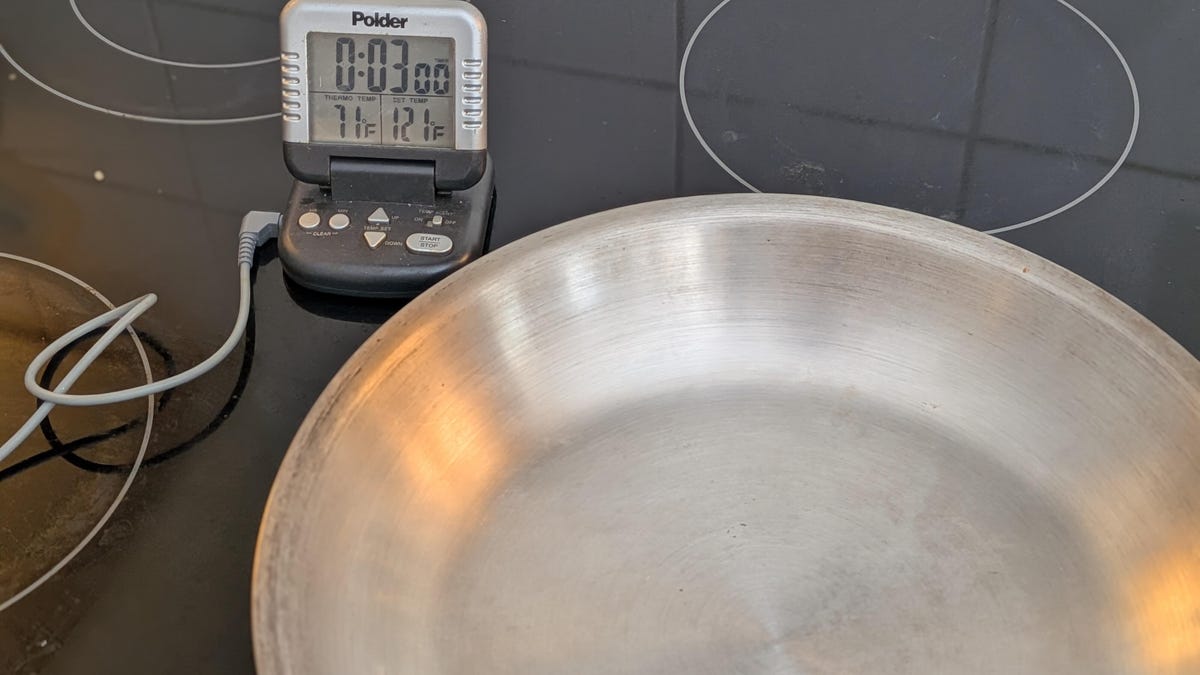
“When stainless steel is heated, the metal expands,” says Griggs. “As the pan reaches cooking temperature, the microscopic pores and surface imperfections become smaller and more uniform.” This is best achieved not by cranking up the heat until the pan quickly starts smoking, but by doing so gradually and subtly. Griggs recommends heating your stainless steel pan over medium-low heat and letting it sit for about 3 minutes.
Remember, this is before any cooking fat hits the pan. “Heating the pan slowly can help create an even more uniform surface as the pan expands,” he says. This is essentially why a flat-top grill is also basically non-stick, as it maintains heat and consistently reduces those pores.
Is your stainless steel pan ready? Test with water
Once the pan has preheated for the requisite time, test it with a few drops of water. “The water should bead and dance around the pan freely,” says Griggs. “This is called the Leidenfrost effect,” he says, also known as “film boiling.” When your pan is preheated appropriately, “this will create a cushion of vapor between the food and the pan as you introduce fat to the cooking process.”
Add cooking fat, the essential ingredient
Now it’s time to add the cooking fat. Since we’re working with medium heat, you can potentially add something like butter or olive oil, but anything with a higher smoke point, such as avocado or canola oil, will really make your life easier. “Your oil should be cold or room temperature,” says Griggs. “The oil will flow into the now-expanded microscopic surface irregularities and help create a barrier.”
The protein will also succeed better at room temperature, no matter what you’re trying to cook here. Pull your eggs out of the refrigerator ahead of time, just as you would for baking, or better yet, act as if you live in Europe and just leave them out so long as you plan to use them up quickly.
Once you add them to the prepared pan, “the exterior begins cooking immediately,” says Griggs, “and they experience the denaturation of weaker amino acid bonds and coagulation of newly freed bonds,” he says, giving you desirable crispy edges on your fried eggs, and, most importantly, the freedom to lift them out of the pan once done without structural failure.
Tips for cooking eggs and sticky foods using stainless steel
Lest you try this and start cursing mine or anyone else’s name for lack of success, this process does require getting nitpicky in several ways. Stainless steel is not as forgiving as nonstick.
First, this is best done in a serious stainless steel frying pan, ideally something heavy-bottomed and clad — meaning it’s made from multiple layers of different metals. Your basic dollar store pan is probably not going to cut it.
Second, test for the Leidenfrost effect several times. My initial attempts produced an effect that wouldn’t exactly qualify as water droplets “dancing” around the pan, but looked more like the water clung to the pan and immediately boiled off. (I blame my electric range, whose temperature controls don’t actually express the nuance of the five different levels it promises.) Cold water droplets “dancing” will legitimately bounce on the surface and remain as droplets for much longer than you would expect.
Third, if you’re dealing with fried eggs, the pan’s heat will start cooking the bottom instantly. To get an even cook, you might want to spoon off the excess oil or cover for 20 or more seconds to help the whites coagulate.
Finally, don’t expect the non-stick effect of stainless steel to be like that of ceramic or other non-stick surfaces. Like a steak, you want to let the “crust” form a bit, and you might need a spatula to loosen the egg, but done correctly, no egg will be left behind.
The steps for stick-free eggs in stainless steel, in summary
- Remove eggs from the refrigerator to come to room temperature
- Heat up your stainless steel pan over medium heat for about 3 minutes
- Test with water for the Leidenfrost effect: water should bead and jump around the pan
- Add a good amount of cold or room temperature cooking fat and allow to heat up
- Add eggs: scramble, flip, or scrape to omelet as desired, using a spatula to loosen once a slight crust has formed
- Remove eggs from the pan without swearing, and enjoy
Read the full article here