


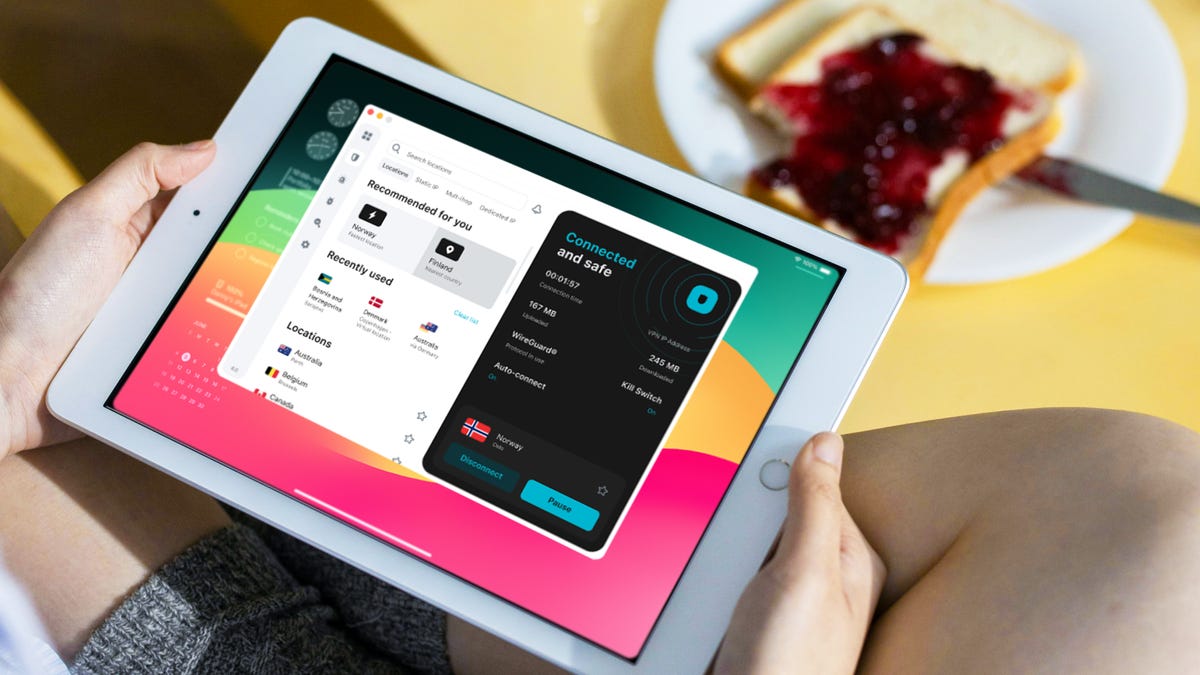
Not too long ago, the internet felt like a window on a larger world. These days, it’s more like a one-way mirror, with unseen data brokers and cloaked scammers watching your every move, waiting for the right mistake. And in the era of remote work, e-learning and cloud storage, users are more vulnerable than they’ve ever been.
It’s no surprise that VPNs are increasingly popular. With data breaches, identity theft and other security concerns, what was once a tool for the semi-paranoid is now a necessity. But as data scraping and scams have grown more advanced, so too have the tools and assets available to protect your data — not to mention, in an increasingly surveilled world, your privacy. But the question remains: How do you choose the right VPN for you?
Why your VPN choice matters
A standard VPN encrypts data by building a kind of virtual tunnel, a form of protection that masks data while “in transit.” This is the basic tool that all virtual private networks provide. But in a more sophisticated digital world, where even data outside the tunnel is vulnerable, users need more sophisticated layers of security. With cybersecurity providers like Surfshark, data and activity are multi-shielded at every stage of storage and transmission.
And because VPNs require virtual servers to connect to, the size of the VPN server network matters a lot, since larger networks offer more connection possibilities. Surfshark uses more than 4,500 servers in 100 countries worldwide, offering superior connectivity, speed and access to content. As CNET’s reviewer put it, “Surfshark has established itself over the years as a consistently speedy VPN that can easily handle just about any online activity, including data-heavy activities like streaming, gaming and torrenting.”
What sets Surfshark apart from other VPN providers?
With its comprehensive infrastructure and proprietary, custom-engineered connection protocol, Surfshark is not only built to keep your data safe, but built to make that data impossible to retain, store, track or monitor.
While lots of VPNs boast encryption, Surfshark relies on industry-leading standards like AES-256-GCM, ChaCha20 and AEGIS-256X2, the very same protections trusted by governments and large corporations to protect their most sensitive data. Rather than just offer a VPN, Surfshark offers a much more comprehensive approach to data protection, combining VPN protection, antivirus software, data leak monitoring and other privacy focused tools to give you the maximum peace of mind as you surf the web.
And by combining VPN protection, antivirus software, data leak monitoring and other privacy focused tools, Surfshark offers a comprehensive security suite for all users concerned about privacy and online safety.
How Surfshark protects your privacy
Built with privacy and security in mind from the very beginning, Surfshark was engineered to keep user data safe and secure. Privacy features include:
- Automated kill switch: At the first sign of VPN interruption, Surfshark immediately disconnects your device from the internet, keeping your IP and user data secure
- Multi Hop: By allowing you to optimize server pairs for double VPN connections, Surfshark makes it twice as difficult for outside actors to compromise your privacy
- No borders: By circumventing network restrictions, Surfshark allows for VPN protection even in locales with government-imposed censorship
- Rotating IP: By hanging your IP address every five to ten minutes without dropping the VPN connection, Surfshark adds an extra layer of security
- Everlink: Your VPN’s immune system, Everlink operates as a self-healing mechanism without dropping your connection
- Traffic obfuscation: Through the OpenVPN protocol, Surfshark automatically disguises your connection from other VPN traffic, helping users bypass localized network restrictions, including in heavily censored regions
- Proprietary protocol: With Dausos, Surfshark’s custom-built, in-house connection protocol, users are able to prioritize security and performance, achieving faster connections and more efficient hardware utilization without sacrificing encryption
How Surfshark protects your privacy
Surfshark takes its no-logs policy seriously, which means offering users full operational transparency. Through regular third-party audits from companies like Deloitte, Surfshark guarantees that its 100% RAM-only servers are wiped with every reboot, and no user data, logs or other sensitive details are retained. What’s more, Surfshark is based in the Netherlands, where there are no laws requiring retention or tracking of user data.
How much does Surfshark cost?
With Surfshark’s Starter plan, users now have access to VPN, alternative ID and an ad blocker for 85% off at $2.49 per month, with an extra three months at signup. For additional security, users can upgrade to Surfshark One for $2.79 per month and get three months extra. To learn more about pricing, check out Surfshark’s current offers.
Surfshark feature bundles
Depending on your privacy and security requirements, Surfshark offers three levels of services, with IP protection and ad blockers at even the most basic level.
How can a data removal service add a layer of security?
With data brokers worldwide collecting, aggregating and trading your personal details without your knowledge — and, in many cases, without your consent — data removal is an increasingly important tool for maintaining digital safety and privacy. Surfshark One+ users can take advantage of Incogni, an independent service that contacts various brokers and demands removal of your personal data. Unlike many other data removal services, Incogni is available in the US, the UK, the EU, Canada and Switzerland.
Unlike conventional servers, RAM-only servers bypass writing directly onto hard drives and run entirely on volatile memory, which ensures that all operational information is automatically wiped at every reboot, preventing long-term data storage or histories.
A no-logs policy is a cybersecurity provider’s guarantee that they will not track, store or log your online activity, IP address or browsing history. This guarantee is verified by regular independent external security audits by respected third-party firms, such as Deloitte.
By utilizing proprietary, in-house connection protocols, such as Surfshark’s Dausos, cybersecurity providers are able to optimize device and server resources, delivering connection speeds of up to 15% faster than standard industry protocols, all without weakening encryption stability.
By providing a proxy persona (including a name, address and email), as well as a proxy phone number (a virtual, US-based phone number for online forms, deliveries and digital sign-ups), is able to keep your personal details out of data brokers’ coffers, reducing robocalls, spam and the risk of identity theft.
With an integrated kill switch built into its infrastructure, Surfshark can protect your privacy by immediately severing your device’s internet access if the VPN suddenly drops. This adds an extra failsafe against exposing your real IP address or online activity, as well as potential unencrypted data leaks.
Yes. By allowing an unlimited number of devices simultaneously under a single subscription, Surfshark’s network architecture ensures continuous security for remote work setups, smartphones and smart home networks.
Read the full article here