



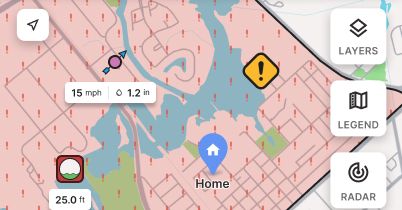
Watch Duty, the wildfire alert app, is introducing flood alerts to its popular disaster-awareness service. This is the second disaster type to be broadly included, after wildfires; it’s available as a free update. If you have the app, you can subscribe to alerts in specific counties, and if there is a flood, Watch Duty will send you a push notification with more information about where it is and where it is spreading.
The nonprofit started in 2021 with a focus on California’s wildfires. The app has since expanded to the entire US, where it uses a combination of paid employee “reporters” and many more volunteers who monitor emergency responder radio channels and translate that information about disaster zones to app users.
Watch Duty became a critical resource during the Palisades and Eaton fires in Los Angeles last year, providing real-time information about the fire’s movements that users came to rely on. In the year since, Watch Duty has capitalized on that increased recognition and brought in thousands of new users and partnerships, including one with Amazon’s Ring cameras that lets people share their Ring videos in Watch Duty if a fire is nearby.
Monitoring flooding takes a different approach than tracking wildfires. Floods tend to be more straightforward to monitor, because they usually have more predictable warning signs from official agencies. Barring a dam burst or other unexpected event, flood paths are easier to track.
“The difference with floods is we do have more warning,” says John Mills, Watch Duty’s CEO. “So frankly, it’s a little bit easier in some regards.”
Easier to track and report doesn’t mean floods are any less complicated than fires. Information about flooding comes from a variety of agencies in the US, like FEMA, the National Weather Service, the US Geological Survey, and the National Oceanic and Atmospheric Administration. The problem with that, Mills contends, is that it’s so much information from so many different sources that people have a hard time reconciling everything and getting a clear picture of what is an immediate concern in their vicinity. What he wants to do with Watch Duty is distill that information into a more straightforward outlook.
Courtesy of Watch Duty


Courtesy of Watch Duty
“You’re told to do something, but it’s too late,” Mills says. “It’s too little, it doesn’t work. With Watch Duty, you can start to piece together a bunch of information all on one screen to make an informed decision.”
Read the full article here


