


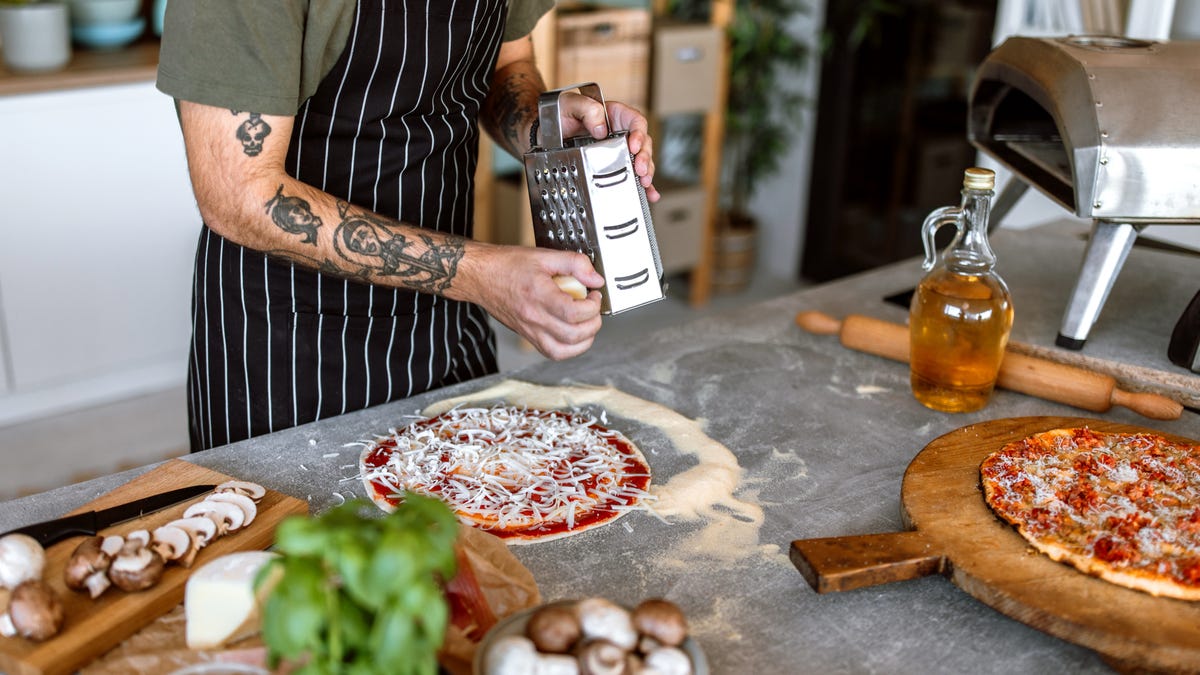
For pizza lovers, the proliferation of outdoor pizza ovens for home use — now available at a variety of prices — has been an answered prayer. Yes, a basic pizza stone is a handy tool and costs far less than a standalone pizza oven. But your typical indoor oven just can’t deliver the same kind of heat as the big ball of fire that is an outdoor pizza oven. Plus, who wants to try to get their oven into 500-degree territory in the summer, which is the ideal time for a backyard pizza party?
Speaking of budgets and great balls of fire, if you’ve recently purchased a pizza oven (or plan to buy one soon), it is worth examining whether you are using it to its fullest potential — and safely. If you were stoked about acquiring a pizza oven but feel decidedly unstoked about your average pizza results, we can point you to the solution. We talked to several pizza professionals who shared the eight most common mistakes people make with homemade pizza — the problems range from misusing the oven itself to how you handle the dough and toppings. Read through them to make sure your next pie is perfect.
1. Not following all safety precautions
You probably know better than to stick your hand inside something radiating intense heat, but following all safety precautions is key to successful pizza oven operation and to maintaining your appliance’s longevity. “Overall, outdoor pizza ovens are very safe, but caution and respect for the equipment are necessary,” said Christy Alia, founder of Women’s Pizza Month and ambassador for Gozney’s pizza ovens.
If you’re following your pizza oven’s instructions, you are already setting it on a sturdy, nonflammable surface and ensuring the gas valve is connected correctly. Other safety matters can affect your pizza game, though.
Wind orientation is important,” said Alia. “Unexpected gusts can cause the flame to flare up suddenly or extinguish altogether.” Make sure you’re aware of both wind direction and conditions before you set up for a big night of pizza-making, and reconsider if there’s a risk of strong gusts.
Also, make sure you’ve placed your oven in a well-ventilated area. According to Alia, not doing this can not only affect the success of your pie but also create “the potential for dangerous carbon monoxide buildup.”
2. Not adequately preheating the stone
In mere minutes, your pizza oven can reach temperatures far beyond what your indoor oven can achieve, which may lead you to believe you have adequately preheated it. While the air temperature within the chamber may be sufficient to melt cheese and char the edges of the crust, skipping the recommended 30 minutes or more of preheating sacrifices the quality of the bottom crust.
“You have to preheat the stone to avoid a blond crust,” says Chef Vinny Olivieri of the tristate area’s Uncle Giuseppe’s Marketplace. “The most important part about making pizza at home is handling your stone with the right temperature,” he said, which can be achieved by using an infrared temperature gun on the stone itself, or at the very least giving it a good amount of time to heat up.
“By not preheating the stone, you will cook the heck out of the top of the pie, and the bottom will be underdone, blond, and when you go to turn the pizza, you will most likely rip the crust,” said Olivieri.
Furthermore, “if you plan to make a second pizza, let the stone recover before baking it,” said Robert Garvey, founder and pizzaiolo of Robert’s Pizza & Dough Co. in Chicago. “The stone temperature drops as much as 50 degrees under each pizza.”
3. Using insubstantial pizza dough
Even in the midst of a pizza-craving frenzy, don’t be tempted to shortchange the pizza crust. You may be a fan of either buying or making quick-and-easy pizza doughs, which might be fine for an oven-baked, deep-dish pie, but you’re really going to want the real thing for your pie going in the pizza oven.
“While convenient, most store-bought doughs are optimized for shelf life first,” said baking expert Kristina Schlegel, founder of Make Bake. “Many include added sugars, oils and ingredients like ascorbic acid,” Schlegel said, “and as a result, they rarely rise the same way fresh dough does,” meaning you end up with a rubbery texture instead of the distinctive chew born of proper gluten development.
Additionally, “in a high-heat pizza oven those shortcuts become even more noticeable,” she said, “and the added sugars and oils can cause the crust to burn on the outside before the dough and toppings have fully cooked through.”
The good news is that a proper pizza dough isn’t hard to come by. “If you have a stand mixer, it’s really only about 5 to 7 minutes of hands-on time,” said Schlegel. “After that, it’s mostly about letting the dough rise properly. For pizza nights at home, I’ll usually either make the dough the night before for a cold rise in the fridge or around lunchtime for a warm rise in time for dinner.”
If building in rise time is basically never in your itinerary, you’re still going to want to forgo the supermarket dough. “I would recommend that you create a relationship with your local pizzeria,” said Olivieri, whose Uncle Giuseppe’s Marketplace outlets sell premade dough.
Read more: 7 Secrets to the Perfect Pizza Dough
4. Overloading with toppings
Enthusiasm over your new pizza oven might have you assembling a fully loaded masterpiece, only to discover that when you try to load it on the pizza delivery mechanism — in other words, the pizza peel — you quickly end up with a calzone rather than a pizza pie.
“Putting on too much sauce makes the dough too wet and floppy, too much cheese makes it soupy and too many toppings take away from the flavor of the dough, sauce and cheese,” said Garvey. “Pizza needs to be properly balanced,” he said, both in its flavors and the ratio of its components.
If you’re new to pizza oven operation, start with a simple Margherita pizza until you get the hang of it, and even after that, save your maximalist pizza tendencies for a deep dish.
5. Pizza peel malfunction or misuse
There’s a delicate relationship between the surface where you assemble the pizza and the peel that delivers it to the pizza oven. You might be tempted to build the pizza while the dough is sitting on the peel, readying it to go into the oven, but that is a rookie mistake. “Once you have your pizza assembled on the peel, the clock starts ticking,” said Serge Krikorian, executive chef of Vibrant Occasions Catering in Benton, Arkansas.
“If it sits too long, the dough will start absorbing moisture from the sauce and the toppings, and it can start to stick to the peel, which just creates a mess,” Krikorian said. “When you go to launch the pizza, it will fold or tear, or only your toppings will slide off into the oven.”
Set up a pizza-building assembly line to maximize efficiency. “Make sure you have everything ready just before you stretch the dough,” says Krikorian. “Assemble your pizza quickly, give the peel a little shake to make sure your pizza moves freely and get it into the oven,” he said. “A little bit of flour, semolina or cornmeal on the peel can help, but speed and preparation matter the most.”
6. Not rotating while cooking
The instructions for your pizza oven probably call for rotating the pie every 20 seconds or so, which might seem like overkill for something that cooks so fast. Trust us: It is not overkill, especially if you’ve been good about the crust and have gotten it to a nearly transparent level of thin.
“You need to rotate the pizza at least once halfway through the bake to ensure a balanced bake,” says Garvey. “You’re not moving it off its position in the oven; rather, you spin it in place,” he said, which results in an evenly baked crust and an equal meltiness of cheese and toppings, all with a perfect, symmetrical level of char.
Read more: I Tried Ooni’s New Rotating Pizza Stone Attachment
7. Walking away from the oven while cooking
Because a pizza oven is an exceptionally high-heat device, 30 seconds can be the difference between something edible and something inedible.
“A pizza oven is not a toaster that will pop up when it is done,” said Stephen Chavez, senior chef-instructor of Culinary Arts at the Institute of Culinary Education. “A pizza oven is usually very, very hot, and much like a broiler, that concentrated heat can cause it to burn very quickly,” he said. “Always keep an eye on your pizza or it can become a charred mess pretty quick,” and also present a safety hazard, circling back to point one above.
8. Incorrect cleaning
Yes, your pizza oven has to be cleaned, and no, not in any of the ways that you would clean most things. “It has to be cleaned after every use, otherwise you’ll be dealing with burnt flour or anything that falls over the side of the crust,” says Olivieri. “It’s all gonna impact the eating experience later,” he said, which defeats the purpose entirely of having a pizza oven for making great pizza. “Whatever you leave on the stone will translate to being left on the bottom of your crust when you next cook with it.”
When it comes to traditional cleaning methods, though? Fuggedaboutit.
“Soaking the pizza stone in water? Just knock it off,” said Olivieri. “Soap and water? Big mistake. Just brush it off once you get your oven cooled down,” he said. “If you want, use a wet rag or a brush and just brush off whatever residual residue is left over,” and you’ll be ready to fire it up again.
Read the full article here