


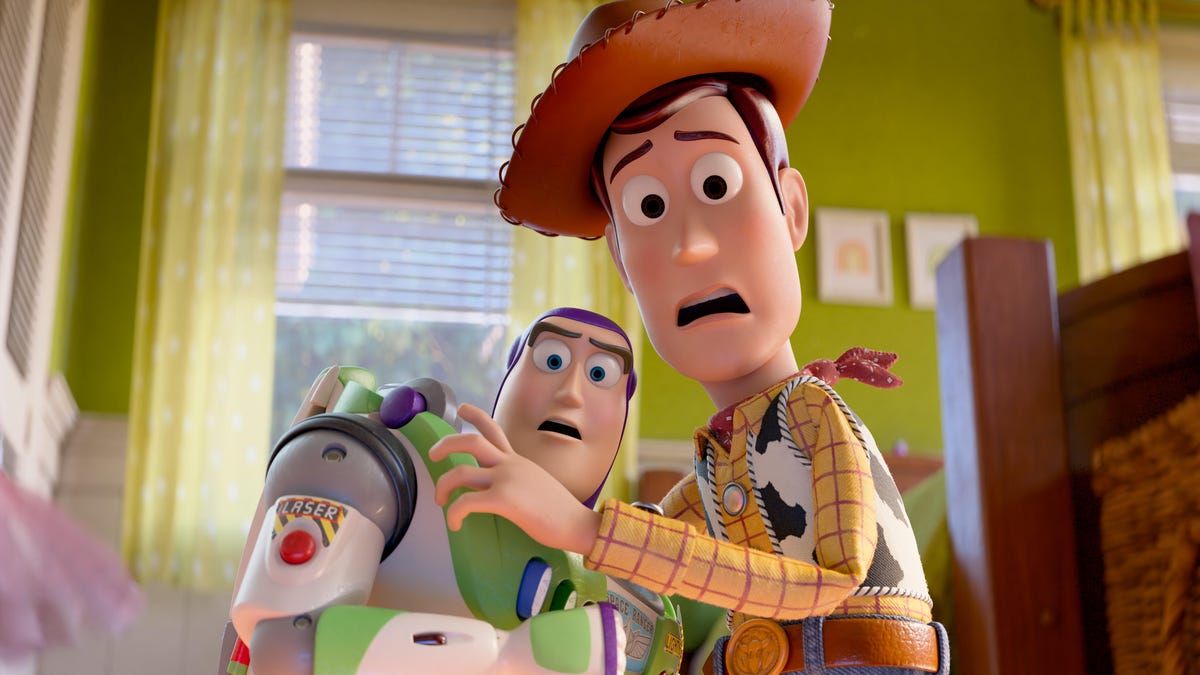
Pixar’s technology has advanced so much since Toy Story debuted in 1995 that, for Toy Story 5, the filmmakers purposely held back to preserve the franchise’s visual style.
“There’s a lot of restraint,” producer Lindsey Collins told me during an interview at Pixar Animation Studios in Emeryville, California. “We don’t want to all of a sudden feel like we’ve jumped so far ahead technologically that these don’t even feel like the same characters anymore or the same world.”
That didn’t stop the studio from enhancing its animation tools in other ways. In the latest sequel, Jessie, Buzz Lightyear and the rest of the toy gang face an existential threat when Bonnie gets a new tablet named Lilypad. It’s a timely narrative exploring how tech and creativity can coexist — a theme that’s not unfamiliar to Pixar, which has paired technological breakthroughs with emotionally driven storytelling for 40 years.
“We’re a technology company, so we’re not sitting here going, ‘Oh no, how dare you — tech?'” Collins said. Instead, Toy Story 5’s filmmakers delved into the nuances of how technology and gadgets shape our lives, highlighting both their benefits and drawbacks.
Each of Pixar’s films expands the studio’s technical capabilities, bringing increasingly ambitious worlds and characters to the screen — from the expressive skeletons of Coco to the hyperrealistic rainstorm in Toy Story 4. Toy Story 5 pushes the boundaries once again with visual improvements that lean more understated: sun-drenched pastures, stylized play sequences and even a brand-new hairstyle. The new techniques expand what’s possible on screen while preserving the franchise’s character designs and environments that have defined it for over three decades.
Bringing new characters, settings and styles to life
In Toy Story 5, we’re introduced to Blaze, a spunky, animal-loving human character. She has tight, curly hair — a look Pixar hadn’t done before. So the team got to work developing tools to make the vision a reality. That technology can now be used in any upcoming productions, Collins said, which could lead to more diverse characters.
Another highlight of Toy Story 5 is the stylized, watercolor-like play sequences that take us inside Bonnie’s imagination as she stages scenes with her toys. The sequences unfold like a dream, with soft edges and muted pastel tones. They were among my favorite moments in the movie, evoking a sense of whimsy and childlike wonder.
“We wanted to give it much more of a mind’s eye feel,” said Toy Story 5 co-director Kenna Harris. “That’s something that Pixar doesn’t have as much practice with.”
Despite the more simplified appearance, it took a lot of time and effort — and plenty of internal testing — to nail the unique animation style. Early in the filmmaking process, Toy Story 5 director Andrew Stanton recognized the need for a dedicated team focused on refining that aspect of production, Harris said.
Stanton also “wanted to treat a lot of our production as he’s treated his live-action productions,” Harris noted. That approach meant incorporating lighting much earlier in the animation process. A new lighting tool called Luna allowed animators to light multiple shots across different setups simultaneously, giving them a clearer sense of what a scene would look like rather than having to fill in those gaps later.
Toy Story 5 was also the first feature film to use Pixar’s latest rendering system, RenderMan XPU, which now combines both CPU and GPU processing. Artists can preview near-final versions of scenes much earlier in production, making it easier to refine any details.
(Reach for) the sky’s the limit
In its early days, Pixar often had to work around technological limitations, a constraint that sometimes inspired creative solutions. In the original Toy Story, for example, animators depicted rain as smudges on a window rather than individual droplets because the technology just wasn’t there yet — making the Toy Story 4 rainstorm all the more impressive.
Now, it’s less about what the studio can do and more about where it chooses to allocate its time and energy. In Toy Story 5, for instance, an army of hi-tech Buzz Lightyear toys relentlessly pursues their supposed Space Ranger mission, which at one point culminates in a horseback sequence.
“Fifty Buzz Lightyears on 50 horses is not a cheap scene, but it’s important to the film,” Collins said. “We’re excited about it, and it’s worth every penny, so let’s do it. Those are the kinds of conversations that increasingly are happening.”
Pixar’s animation prowess doesn’t just lie in its flashier sequences. Sometimes, the quieter details can have the biggest visual impact.
“Toy Story 4 took our photography to this level of, ‘It’s clear we can make it look photoreal,'” Harris reflected. “At the beginning of the development of [Toy Story 5], it was like, ‘Well, that’s not what we want to do for the sake of doing it, so what’s going to set this movie’s visuals apart?'”
One area filmmakers focused on was making the lighting look more visceral, especially in the scenes depicting the farm where Blaze lives. With rolling green pastures and golden hour sunsets, those scenes were certainly the most evocative, capturing the serenity and seclusion of being in nature.
“We’ve spent some time outdoors with the toys, but this film really sits in that world for a while,” Collins said. “We actually have the technology to do it now.”
For Pixar’s filmmakers, scenes like these highlight the advancements that have kept the studio at the forefront of computer animation.
“We really do get to celebrate how far we’ve come,” Harris said.
Looking ahead while staying rooted
As AI continues to reshape filmmaking and other industries, Pixar has remained open to exploring how the technology can play a role in future productions. One of the studio’s notable uses of machine learning is for removing visual noise and producing a sharper final image.
“Our DNA has always been as a tech company first,” Collins said. “There’s this really symbiotic dynamic between tech and creative, and that’s very much the same philosophy we’re approaching AI with. The purpose of tech is to help us on the creative side. It’s not to replace it, it’s not to take artists away. It’s to allow the artists’ jobs to be easier [and] get more creativity on the screen. And as long as it’s doing that, we’re all in.”
Yet amid conversations about new tools and emerging technologies, Collins pointed to a constant that’s defined Pixar for decades: artists and storytellers working side by side.
“We’re the last studio that has everybody in this building working together to make these films,” Collins said. “It’s the thing that we are the most proud of. And it’s the thing that under no circumstances would we ever, ever change.”
Toy Story 5 hits theaters on June 19.
Read the full article here