

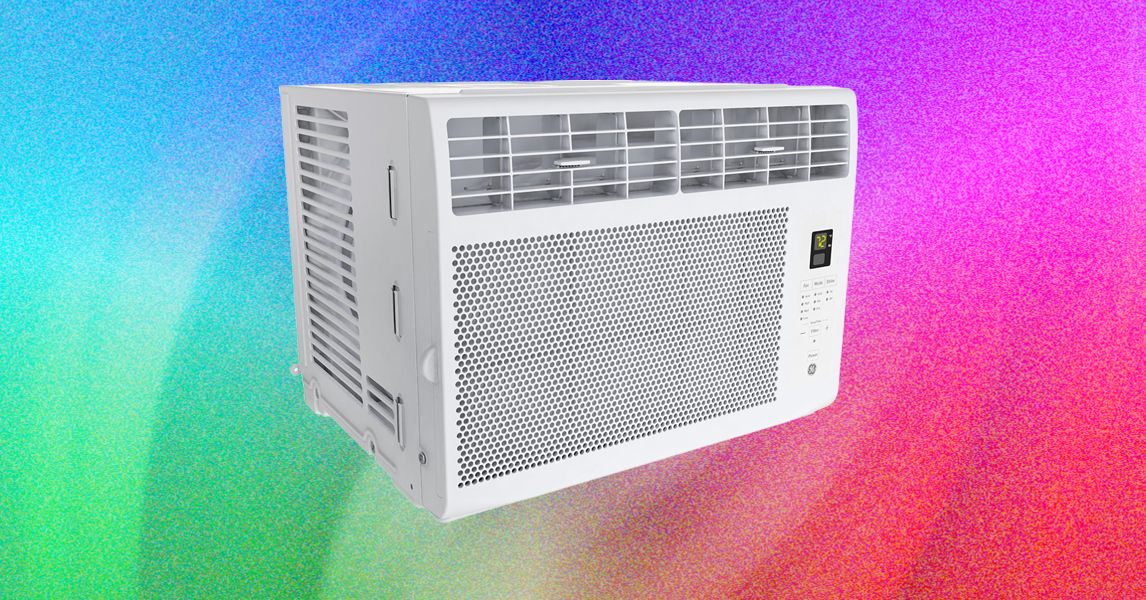
Other Models We Tested
LG 12,000 BTU Air Conditioner for $379: The LG 12,000 BTU Smart Window Air Conditioner offers efficient large-room cooling at a surprisingly low price. It weighs 90 pounds and requires professional installation with a bracket. Its 60-decibel operation places it squarely in the middle of the pack on noise. This said, WIRED reviewer Lisa Wood Shapiro found it blends into a room well with its white-on-white design, and that the filter replacement indicator light is useful. The app was laggy and difficult to use during Wood Shapiro’s testing, but there is a remote.
Friedrich Kuhl Air Conditioner for $1,228: This unit from Friedrich is among the most expensive we’ve tested, and one of the heaviest—in part because of a metal chassis designed to provide easy maintenance access and deter first-floor break-ins. This model allows adding a custom Friedrich FreshAire MERV 13 filter to clean the air as it cools. The screen is easy to read, and the device comes with a remote. An app lets you schedule the unit’s use over the course of the week, but note that connection with the smart app was a little janky, and paired only with 2.4 Ghz signals.
EcoFlow Wave 2 for $1,299 (but usually on sale for much less): Wood Shapiro tested the newest model, but previous models of the EcoFlow are often available at steep discounts. After happily testing the EcoFlow Wave 1 for more than a year in his wife’s office, WIRED senior editor Julian Chokkattu far preferred the EcoFlow Wave 2 (8/10, WIRED Recommends) because it’s both lighter and more cost-friendly, with a higher 5,100 BTU rating (up from 4,000). A heating mode rated at 6,100 BTU means you can keep using it in the winter to warm up. The company says it’s best for rooms up to 107 square feet. You do need to place it near a window to have one of the included ducts connected to the vent to take hot exhaust from the back of the unit out of the room. What makes this unit versatile is its alternate power sources. You can use a standard AC outlet, but you can also buy an add-on battery to keep it working when you don’t have access to electricity, or hook it up to solar panels.
Zero Breeze Mark II for $999: With its 2,300 BTU, the Zero Breeze (7/10, WIRED Review) won’t have the same cooling power as the EcoFlow Wave, but it’s much lighter at 17 pounds. This bundle includes a battery that makes the whole thing weigh about 30 pounds, but you’ll get four hours of use without needing to be near a wall outlet. Like the EcoFlow, you get a few vent pipes to direct exhaust away and direct cool air to a specific area, but unlike the EcoFlow, you can’t charge the battery and use the AC at the same time.
Zero Breeze Mark III for $1,399: As WIRED reviewer Chris Null notes (7/10, WIRED Review), the Mark III is both larger than the Mark II and quite a bit heavier, now 22 pounds. Add on the 1,022-Wh battery pack and you’ll pack on another 14 pounds, though that frees you from having to be near a power outlet. New for the Mark III is the fact that batteries can now be stacked and charged in sequence, each daisy-chained to the next (though at $600+ per battery, this can get pricey fast). Each Mark III battery also has extra outputs that can be used for other devices—one USB-C port, one USB-A port, and a 12-volt DC socket. However, the Mark II battery had all of the above plus a second USB-A port. No word on why this was removed. However, the new version is a bigger, punchier unit by most standards and a worthwhile buy for outdoors enthusiasts
Frequently Asked Questions
What Size Air Conditioner Do I Need?
Look for the BTU, or British thermal units. In the case of air conditioners, BTUs per hour measures how much heat the compressor can remove from a room. It’s a quick and easy way to figure out whether an AC unit is powerful enough to cool your space.
The BTU rating also helps you avoid using too powerful a unit, which will cool too quickly without dehumidifying, possibly leading to mold formation in the room and within the device.
To find the right power air conditioner for your room, you’ll want to find the square footage of your room by multiplying its length and its width. The US Department of Energy’s guidelines call for a minimum of 20 BTUs for every square foot of space. But this figure also assumes optimal conditions and good efficiency. For a 150-square-foot room, more typical recommendations are to opt for a 5,000 BTU AC unit. If the room is especially sunny, high-ceilinged, or has poor insulation, you may even want a 6,000 to 7,000 BTU unit for that space.
When in doubt, your best bet is to use a BTU calculator. For a truly precise estimate, here’s a complex whole-house BTU calculator that takes into account building layout and construction, plus your location and climate. For a fast and dirty rule-of-thumb BTU calculator, try here.
Check the combined energy-efficiency ratio (CEER) rating. The specs on any air conditioner you buy should list a CEER rating, which is one of the best ways of checking the energy efficiency of a unit. You’ll usually see a number between 9 and 15. The higher the number, the less you’ll pay when the electricity bill comes around. A cheap window AC unit will save you money at first, but you may end up shelling out more in the long run. The US Energy Star program has a website that lets you browse AC units based on their CEER ratings.
Check local laws. Some cities, like New York, require installing brackets to support your window AC. A simple one like this model should do the trick, though we haven’t tried it out. You may also need to head to a hardware store for some plywood to make sure your window sill sits flat, but this depends on the type of windows you have and the AC model you buy. Get a friend to help you out with installation. These units can be heavy and difficult to hold, and the last thing you want is to drop one out the window.
Measure your window. Before you buy, read up on the supported window types and sizes for the AC unit you’re looking at, and measure your window to be safe. Make sure to seal any gaps as best you can with the included foam. (You can always buy more if you need it.)
Power up with unlimited access to WIRED. Get best-in-class reporting that’s too important to ignore. Includes unlimited digital access and exclusive subscriber-only content. Subscribe today.
Read the full article here