

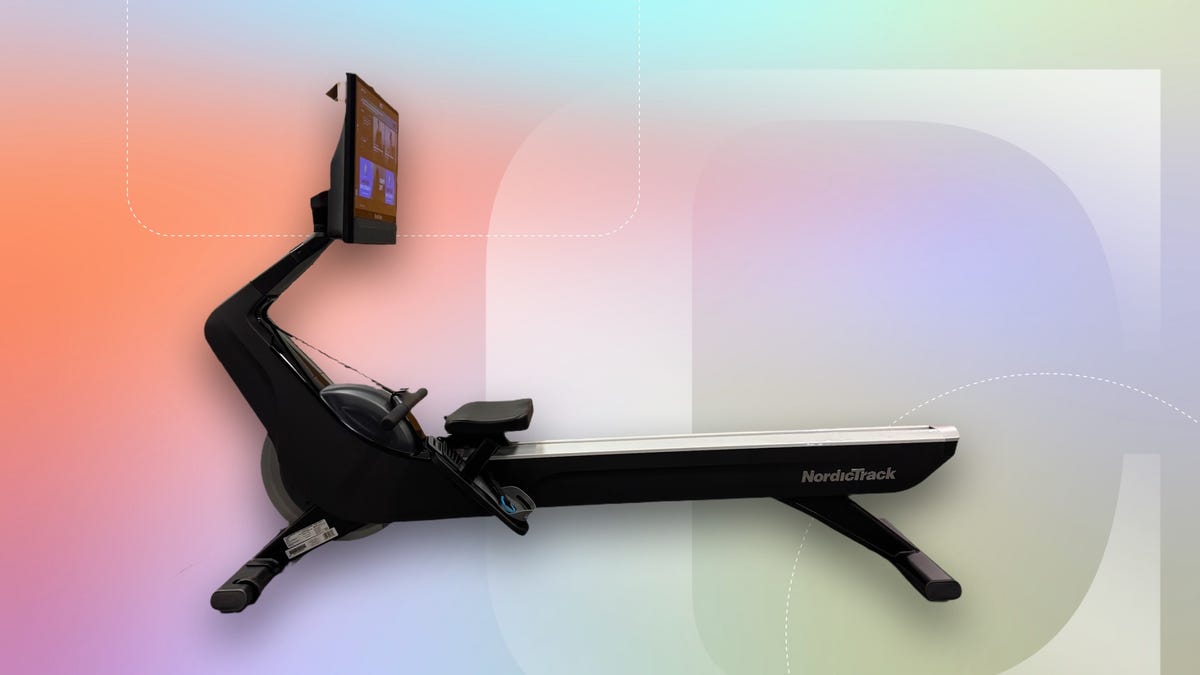
To get the most out of your rowing workouts, it’s important to practice good technique. It’s helpful to have a rowing instructor or trainer familiar with the machine to teach you the correct way to row.
Catch, drive, finish, recovery: The catch, drive, finish and recovery are the four key steps you need to know for rowing. Peloton rowing instructor Alex Karwoski said your starting position should look like this: “Starting from the fully compressed position — your arms should be outstretched, body pivoted forward at a slight angle, and knees close to your chest.” From here, push with your legs to drive the seat and handle away from the screen.
“For the first third to half of the drive, our legs are doing the majority of the work while our arms and body are braced and holding the pressure,” Karwoski explained. Then, as the shins reach about 45 degrees to the floor, the body swing begins.
Karwoski said the key to the body swing is to think about “adding momentum” to the handle. The legs start moving the internal flywheel, and this is where the legs and body can work in conjunction to further accelerate the flywheel.
“Finally, our arms get involved right at the end of the stroke, and we pull the handle all the way into the chest,” Karwoski said. Once all of that is completed, you start the recovery phase of the stroke, which is just the opposite. The arms move away from the body first, then the body pivots forward, and the legs compress to return to the catch.
Don’t misuse the damper: The drag factor is usually featured as a damper handle on a traditional rower. On smart rowers, it’s included within the software.
“Most people assume that moving this from, for example, the three to the 10 makes the machine harder, but what it really does is simply increase the rate at which the flywheel slows down and thereby causes the stroke to feel heavier because now it is as if you’re rowing through molasses rather than water,” Karwoski said.
Don’t confuse the “drag factor” with “speed level” or “intensity.”
Know the output: The main unit being measured when you row is the output. When you row, each stroke takes a certain amount of time, so the work being measured is the force applied to move the flywheel.
“From the output, we can derive the split, which is determined by how long it would take you to row 500 meters at your given output and distance,” Karwoski said. Another metric to consider is the stroke rate, which is the number of strokes you would make if you maintained your current rhythm for one minute.
“I encourage people to focus on output because that is the big number usually right in the middle of the screen,” Karwoski said. Keep in mind that different rowing machines have different metrics that are highlighted, but ultimately, it’s about how much force you use to move the flywheel.
Rowing precautions: As with any physical activity, it’s important to get your doctor’s clearance if you have underlying health issues or are pregnant.
“If you’re returning from an injury — and that injury doesn’t prohibit you from sitting on a rowing machine — the rowing motion can be a gentler way to restart your cardiovascular fitness,” said Peloton rowing instructor Katie Wang. This is a good way to get the benefits of a cardio workout without worrying about joint or knee injury.
Read the full article here