

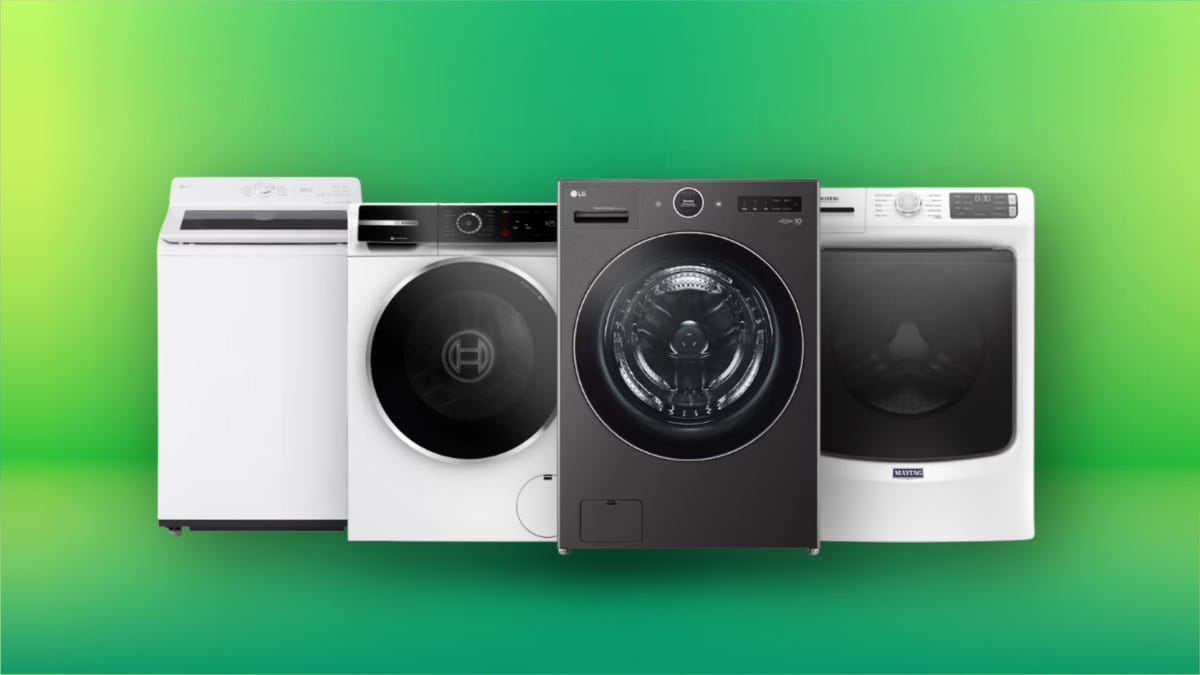
Our washing machine tests are a mix of online customer-review data and limited hands-on testing. Because we’re unable to test every washer in our top rankings, the brands’ reputations and overall reliability take center stage. In this way, the scoring doesn’t place too much favoritism on tested products, especially when untested products have compelling features and rock-solid reputations.
Testing methodology
Conducting large appliance testing relies heavily on logistics. Manufacturers directly provided most of the washing machines we tested — a process that took roughly four months. The lone exception is the all-in-one LG WM6998HBA, which is owned by a member of the CNET staff. With all of the test washing machines in place, we dedicated at least a month to testing.
We followed a simple rubric to track our experiences with each product in five categories:
- Installation
- Size and capacity
- User controls
- Noise
- Cleaning performance (stain removal, fabric care, spin cycle, notable features)
Installation
Most of our testers had professional installers visit to remove the old washing machines and install the test units. There were no issues with Electrolux, LG, Maytag or Whirlpool. In some cases, such as with the Electrolux 700 Series, the installers took the time to walk the tester through the machine’s features.
However, Bridget Carey, our GE tester, ran into issues. Here’s what happened in her words: “A warning to anyone getting their washer installed on a second floor. Professional installers, such as the team at GE who installed my washer, will refuse to install your washer if the drip pan is damaged or not properly sealed to the floor drain pipe, which catches excess water in case of a machine malfunction.”
In this case, she was able to replace the drip pan with a spare she had on hand. Still, it’s worth noting that you should inspect your drip pan before your new machine arrives to avoid having to postpone installation.
Size and capacity
Our testers all reported that each washer fit in the laundry room and had more than enough capacity to keep up with their families’ washing needs. That said, our Electrolux tester noted that the swinging front door created an obstacle because it opened the wrong way. Fortunately, Electrolux’s door is reversible for easier access.
While no one else had issues, our GE tester emphasized the importance of measuring the space to ensure there’s sufficient clearance for the door. You can usually find door clearance in the user manual, which is more helpful for this task than the normal dimensions on most product pages.
User controls
All of the tested washing machines use a combination of touchpad buttons and a dial for user controls, often showing the status on a small display. We found no major issues with the controls, and most testers reported that they were easy to figure out.
In fact, every tester found something to love about the interface:
- Electrolux ELFW7738AW: “For any cycle, it provides a countdown, so you know when to expect it to end. My former washer had something similar, but it was never correct, or it showed me how long until the current cycle (e.g., wash, spin) was to end—not the total cycle.”
- GE GFW550SSNWW: “I enjoy a good clicky knob when I’m setting my laundry, which it brings for selecting your main cycle, be it delicates or bulky bedding. Fine-tuning other settings, like indicating how soiled it is or changing the spin, gives you a satisfying beep and shows up in an illuminated word grid, so there’s no mystery for time and intensity of the wash cycle.”
- LG WM6998HBA: “I absolutely love the interface. It feels incredibly slick, from the sharp pixels to the satisfying dings when you move from one cycle to another.”
- LG WT8200CW: “I find it quicker to choose cycles and more obvious how to set them than with previous models. The display is clear and easy to use.”
- Maytag MHW5630HW: “The interface is straightforward and doesn’t cause any problems. Has been easy to use and operate. The appearance is elegant.”
- Whirlpool WFW4720RW: “Nothing frustrated or confused me in any way.”
One possible point of conflict arose because the GE tester was unable to find a clear setting for small loads. Upon investigation, the user manual suggests using the Quick Wash setting for such situations.
Noise
Noise is an important consideration for washing machines, so we asked each participant to listen for general loudness, unusual noises, and the effectiveness of chimes that signal the end of a cycle. We didn’t use sound meters on the general loudness front, so our anecdotal observations are strictly subjective.
That said, every washer was either quieter than average or roughly what a tester has experienced with other machines. As you might expect, the all-in-one LG WM6998HBA was a bit louder when in drying mode, with some minor shaking. Otherwise, none of the testers experienced issues with excessive noise and vibration.
We also noted the effectiveness of each machine’s end-of-cycle chime, which testers found pleasant but not obnoxious in each case. Once again, the all-in-one LG WM6998HBA’s default chime volume is a little quiet—at least the volume is adjustable.
Cleaning performance
Stain removal: Unlike other testing categories, which relied on general observations, our stain removal test used the same starting conditions for each machine:
- Detergent: A single Tide 3-in-1 Laundry Pod
- Cycle: Standard hot water wash cycle
- Fabric swatches: Two small swatches of white 100% cotton fabric, one with a quarter-sized stain of ketchup and another with a stain of red wine
Each stain sat for 60 minutes before scraping excess ketchup off. After a quick reference photo, we immediately washed the swatches and let them dry completely before taking another picture of the result. When comparing the results, all of the washing machines passed with flying colors.
While some swatches—Electrolux and GE—retained a trace of the stains, bear in mind that we didn’t use any pretreatment cycles or specialized stain-removal products. We’re confident that most people’s stain removal methods would produce excellent results. Outside our structured stain removal tests, these two units succeeded at removing tricky stains like red marker from a child’s sheets (Electrolux) and puppy urine (GE).
Fabric care: None of the machines produced noticeable wear on the fabric.
Spin cycle: Testers for Electrolux, LG, Maytag and Whirlpool universally raved about how their clothes were much drier after the spin cycle compared to previous machines.
In GE’s case, the quick cycle didn’t rinse the clothing well enough, leaving a soapy residue. Our solution was selecting the “Extra Rinse” option, which adds another 10 minutes. It also failed to fully drain water after small loads (other load sizes were fine), leading to an extra spin cycle.
Notable features: We left special features to the discretion of each tester, but here are some highlights:
- Electrolux ELFW7738AW: “I especially like the 15-minute quick wash cycle choice. In the past, most washers would label something as ‘quick wash,’ but I would never really know exactly how long it would take. Now I do, and it washes great. The quick wash option is great for a quick refresh of clothing or for just a few items.”
- GE GFW550SSNWW: “If you close your washer door after a wash cycle, the machine will beep to remind you to open the door again and let it vent. I’ve found that feature handy for ensuring everyone in the house remembers to keep the door open to air it out. (And if it’s less prone to mold, it puts me more at ease with owning a front-loading machine.)”
- LG WM6998HBA: “I’ve connected to the smart app. I don’t use it often, but occasionally, when I know there is a big load in that I assume won’t be fully dry after one cycle, I’ll remote trigger a second dry-only cycle from upstairs.”
- Maytag MHW5630HW: “Our machine has an automatic dispenser, which seems to work quite well so far. We’ve had our machine for just over a month and use it on a weekly basis. Both our children are very active, and it seems as if we are washing clothes constantly!”
Evaluating washing machines online
Similar to our recent comparison of the best dishwashers, this review is based on over 15,000 data points. This huge sample size gives me a high-level view of how major brands compare on price, features and customer satisfaction. We thoroughly reviewed this information to identify notable models and features, ultimately narrowing it down to the 11 models included in our final evaluation. Here’s an overview of what we collected:
- 7,972 Energy Star data consisting of washer features and performance metrics for 343 qualifying models across 44 brands (as of June 2025)
- 7,514 online product page data consisting of customer star ratings and specifications, which we collected from 508 pages across 5 retailers. These pages represent 267 models from 16 brands (as of June 2025)
Please note that this data is from June 2025 — taking about a week to compile and analyze. Prices and reviews have shifted since the data phase, but we’re unable to update the dataset without starting from scratch.
Unlike our dishwasher comparison, we did not collect data from manufacturer pages — except for the 11 models in our final lineup. These finalists represent nine brands and should provide a solid baseline for your next washer. This way, you can choose a different model from your preferred brand that meets your needs and budget. We chose a mix of top-loaders and front-loaders, with some combined washer/dryer units.
Evaluating Energy Star data for washing machines
Energy efficiency compared
| Electrolux | Maytag | Whirlpool | LG | Bosch | LG (combo) | GE | |
|---|---|---|---|---|---|---|---|
| Annual Energy Use | 74 kWh/yr. | 128 kWh/yr. | 140 kWh/yr. | 120 kWh/yr. | 118 kWh/yr. | 99 kWh/yr. | 158 kWh/yr. |
| Average Yearly Water Use | 3,452 gallons/yr | 4,267 gallons/yr | 4,248 gallons/yr | 6,330 gallons/yr | 2,426 gallons/yr | 4,235 gallons/yr | 4,239 gallons/yr |
| Energy Star | Yes (most efficient) | Yes | Yes | Yes | Yes (most efficient) | Yes | Yes |
For energy efficiency, we exclusively rely on data from Energy Star, which remains the gold standard. This is also the easiest dataset to use and collect, because you can quickly download it from EnergyStar.gov. Each of our top 6 picks—and 9 of 11 products overall—qualifies for an Energy Star Rating.
Notably, the electricity and water standards are looser for top-loading washers and compact washers than front-load washing machines. Energy Star last updated its Clothes Washers Key Product Criteria in April 2021, and none of the current slate of certified washers was released before late 2014.
Electricity usage
Washing machines that meet the Energy Star Most Efficient 2025 Criteria (PDF) received special attention. This includes our top pick, Electrolux ELFW7738AW, as well as our compact washer winner, Bosch 500 Series WGB24600UC. Samsung and LG technically offer many more Energy Star Most Efficient models, but none of these made our final list. Still, they’re worth looking into if you’re a fan of either brand.
We list electricity usage for our top picks in terms of kilowatt-hours per year (kWh/yr) because it’s easier for people to understand than the system Energy Star uses: Integrated Modified Energy Factor (IMEF). This system is better for comparing machines with different capacities, which affects electricity and water usage. That said, products with a higher IMEF rating are generally the most efficient with electricity.
Front-loaders must score a minimum of IMEF 2.76 to qualify for a standard Energy Star rating — top-loaders and compact washers must be at least IMEF 2.07 and IMEF 2.06, respectively. This makes the Bosch 500 Series’ IMEF 2.72 rating impressive. Some LG top-loaders also meet the IMEF 2.76 standard.
However, those pale in comparison to the Electrolux ELFW7738AW. It’s the most efficient washing machine on the market (IMEF 3.2), a major factor in its claim to our top spot. While LG offers two models with the same rating, both feature a larger drum capacity, meaning they use more energy and water on a full load than Electrolux.
Water usage
To qualify for an Energy Star rating, washing machines must also demonstrate water efficiency, as represented by the Integrated Water Factor (IWF). Unlike the IMEF, a lower number is better. Once again, the Electrolux ELFW7738AW dominates the market at IWF 2.6 — for comparison, the base Energy Star level is IWF 3.2 for front loaders (IWF 3.0 for Most Efficient status).
Notably, top- and front-loaders have the same IWF requirements for Most Efficient in terms of water usage. There’s some leeway for top-loaders for the minimum level (IWF 4.3), but several LG models come in at IWF 3.2.
Unlike our dishwasher evaluations, water usage significantly impacts washing machine rankings, as these appliances use substantially more water than dishwashers. This is a key factor in our decision to stack our top picks exclusively with Energy Star-certified machines. Additionally, it serves as a useful reference for estimating potential utility costs associated with your new washer.
Read the full article here