


Pros
- Punchy picture quality
- One of the best antireflective screens yet
- Bright, and excellent for gaming
Cons
- HDR colors are inaccurate
- No Ambient mode despite ability to display art
Every year, TV manufacturers try to impress the superiority of their new models upon us (this TV is so many percentile points better than the previous one!). In this same way, both the LG G6 and the Samsung S95H promised a lot for 2026, and despite more modest gains in picture quality than they claimed, these are still great OLED TVs. Though they are closely matched, there’s one particular Samsung feature that has attracted a lot of interest.
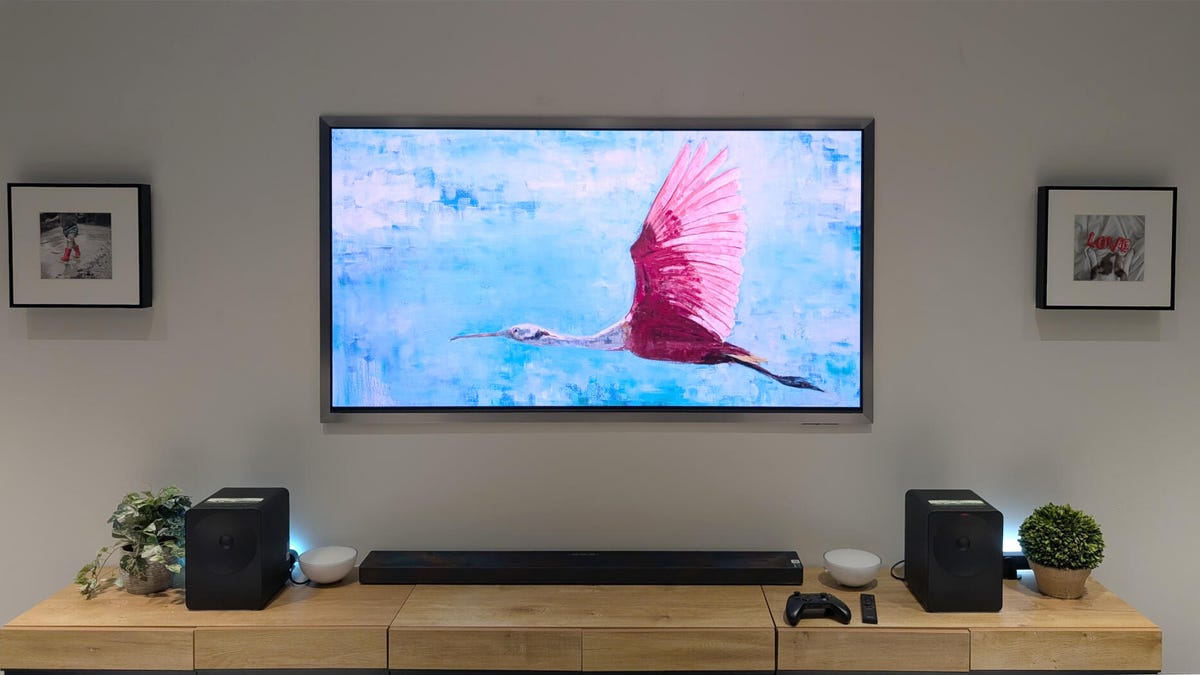
One of the most intriguing features of the S95H is its ability to act like a Frame TV (but not quite) by displaying static artwork — something that hasn’t been possible with OLED technology before. However, I found it’s not capable of the same Ambient mode, and so it’s a much more manual process.
Of the two, the LG has more accurate color, and I prefer its antireflective coating, as it maintains black levels in a lit room. Yet, the LG has some issues with shadow detail, making greys appear lighter than they should. The Samsung, meanwhile, is a blast if you’re a gamer (more on that further down). That said, you will get a better deal by buying last year’s TV, and the rival LG G5 is similar to the S95H, but is also $1,000 cheaper. While the Samsung OLED’s ability to display art may be an interesting quirk, the Frame Pro is a more attractive option if a gallery mode is what you want most.
Also read: Best TVs of 2026
Samsung S95H OLED TV sizes, series comparison
I performed a hands-on evaluation of the 65-inch Samsung S95H, but this review also applies to the other screen sizes in the series. All sizes have similar specs and should provide similar picture quality.
Design and remote
If you’ve been familiar with Samsung’s flagship TVs of the past few years, you’ll remember the external connection boxes — either wireless or connected by a thin cable. Well, that’s all gone, and it’s been replaced by the most controversial part of the new design. The TV is surrounded by a 1-inch-thick metal surround that looks like it should be replaceable, a la The Frame, but sadly it isn’t. I didn’t pull it apart to test this, but Samsung representatives told me that this frame is what now houses the old connect box circuitry.
While the separate box kept the previous model supremely thin, at 0.4 inches deep, the S95H is over twice as thick at 1 inch. Though it’s not visible head-on, if you duck to the side, you’ll see that there is actually a space between the screen and the bezel, occupied by Sony PlayStation-like vents. OLEDs get hot — especially when they get as bright as the S95H — and this is a neat way to prevent your new screen from poaching in its own juices.
One welcome upgrade from last year is the provision of an easy-to-assemble stand. These two tool-less, click-in legs took less time to assemble than washing your hands did during the pandemic (“Happy birthday to you…”).
Samsung has pared down its chunky, colorful remote of the past to the bare minimum: a wafer-shaped clicker powered by a solar panel on the back. It’s fairly easy to use, though its lack of functionality won’t please power users. For instance, if you use your TV as an input switch, then you need to navigate to the Connected Devices menu option at the top to change inputs. I still prefer remotes that have a dedicated input button.
The screen is the star
For the past few years, LG has released iterations of its brightness-enhancing technology called “four stack,” which overlaps several OLED screens. Meanwhile, while Samsung’s 2026 S95H has seen a big jump in its brightness, a 30% increase in brightness year-over-year, its screen makeup hasn’t appeared to have changed from QDOLED or Quantum Dot OLED.
The reasons to buy this screen vary, but alongside the artwork feature, the antireflective coating is impressive and lets almost nothing through. If you have a pesky, distracting light source behind you that you can’t tame any other way, this TV is an attractive solution. But the S95H is not the only Samsung TV that does this; the S90H now has a modified version, and the Frame TVs have sported their own coatings for many years.
Speaking of the Frame, this Samsung is the first OLED TV to be able to display static art for extended amounts of time. According to the company, “Samsung OLED TVs incorporate multiple image retention mitigation technologies — including pixel shift and pixel refresh — designed to help reduce the risk of burn-in during normal viewing conditions. These technologies dynamically manage pixel usage to distribute wear more evenly across the panel over time.”
To test the new art mode, I left the most high-contrast image running for the better part of a day: a black-and-white Moomin image from the gallery. In ordinary circumstances, the TV would show retention of this kind of image almost immediately, but switching to a white or all-grey image showed no retention at all. Impressive. It’s just a pity there’s no ambient mode to display an image when you turn off the TV.
Smart TV gets an AI makeover
Being this is 2026, this television has a horde of AI-flavored technologies — some more useful than others. Though Samsung doesn’t have World Cup affiliations, the TV does have an AI Soccer Mode. This mode makes the ball less fuzzy during movement and the field more green. Is this something football fans need, though? The S95H also sports the NQ4 AI Gen3 processor for image processing and upscaling, as well as Amazon Alexa built in.
Unlike most high-end TVs, the S95H doesn’t have Dolby Vision HDR, and while I don’t think this is a big deal, completists may look to LG, Sony or even Panasonic instead. Connectivity is now all housed on the TV and includes:
- Four HDMI 2.1 inputs 4K 165Hz
- Three USB-A ports, one USB-C port
- Optical digital audio output
- Wi-Fi 6E
- Bluetooth 5.3
- Ethernet
I’ve been no fan of the smart TV systems of either Samsung or rival LG in recent years, but Samsung has taken steps in 2026 to streamline the experience. While the screen naturally leans into everything AI, it is cleaner and better organized than ever.
From left to right, the redesigned menu now starts with an information cluster that includes your profile, connected devices (especially useful for changing inputs) and settings. The other menu options to the right are probably less useful, depending on which way the wind is blowing, with For you, Live, Games, Art (AI and artwork store), Daily and Apps.
Like the Samsung S95F before it, the latest TV brings gesture control for owners of a Samsung Galaxy Watch. I didn’t test it this time around, but if the experience is the same as before, I can’t imagine many people using it more than once — a remote is much better.
High-end OLED comparison: LG G6 vs. LG G5 vs. Samsung S95H vs. Samsung S90H vs. Hisense U7
I started my tests of these five TVs with the 4K UHD Blu-ray movie It, and as Georgie hesitated at the top of the stairs to the basement, I felt the S95’s rival, the LG G6, displayed too much shadow detail. The open space beside him, with all its wooden beams, was very green on the G6, and this was compared with the G5, which had too little detail, while the S95H had about the right amount.
The same thing happened when I played the ruined city scene from the movie 1917, which starts in almost complete darkness. The G6 was too bright, and while I could appreciate the shadow detail, the S95H had a more balanced mix of shadow and pure black. The G5 behaved similarly to the Samsung here and showed that the older TV still knows how to mix with the ‘young kids.’
I then switched to a streaming copy of the latest Superman movie, and during the opening scenes of snow and ice, I found that the Samsung S95H, G5 and G6 looked very similar in terms of near-white detail. Yet some of the finer areas in the Fortress of Solitude looked a little greener on the Samsung — the first inkling that its HDR colors may differ from those on the other screens. Yet, it was also on this title that I noticed some green discoloration on the G6 when viewed from the side.
I also ran the S95H through some test footage from the Spears and Munsil test disc, and I found the most profound differences in color reproduction between the two high-end 2026 TVs. The oranges in the Munsil test disc, in particular, tended toward yellow on the Samsung, whereas they were nearly identical on the two LGs and Samsung S90H. Interestingly, the S95H was the only one that couldn’t display the orange sun, which appears toward the end of the test. In general, though, the Samsung S95H behaved similarly to the G5 except on red, which looked a little desaturated. The G6 was a bit more vibrant than the other two, especially with blues and oranges.
Lastly, on the 24p judder test, the S95H was smoother than the LG G6, which had very slight judder effects by comparison, but both were acceptable.
Bright room
Light output in nits
| TV | Brightest mode (HDR) | Accurate mode (HDR) | Brightest mode (SDR) | Accurate mode (SDR) |
|---|---|---|---|---|
| Samsung S95H | 2712 | 2636 | 512 | 133 |
| Samsung S90H | 1483 | 1451 | 333 | 229 |
| LG G6 | 2511 | 2232 | 1070 | 530 |
| TCL X11K | 3743 | 2302 | — | — |
| TCL QM9K | 4520 | 2520 | 3930 | 262 |
| Samsung S90F | 1466 | 1466 | 633 | 305 |
| Samsung S95F | 2150 | 2150 | 391 | 297 |
| Hisense U8Q | 4080 | 4070 | 4107 | 43 |
| LG G5 | 2,813 | 2,297 | 1030 | 412 |
| LG C5 | 1,434 | 1,187 | 480 | 288 |
Samsung has led the industry for several years in antireflective coatings. Every iteration of the S95 has shown some improvements, and the ‘H’ version is the best yet at rejecting all but the brightest lights. Even if you shine your phone’s flash directly on the screen, you’ll only get a ghostly glow, and no other TV I’ve seen in 2026 does this as well. The S90H has a modified version of this tech, but when I ran the same test, I saw a red tint in the S90’s reflection that the S95 didn’t have. But not everyone has a light shining directly on their screen, and so they don’t need this level of antiglare.
The downside to Samsung’s technology is that black is very slightly gray in a lit room. If you want a TV that you can watch in a lit room and enjoy a more dynamic image, then the LG G6’s coating preserves black levels. While the G5 was pretty good at antiglare, the G6 is truly the best at this kind of coating I have seen. It will still show direct light sources; you’ll still make out the shape of a reflected light bulb, for instance, but ambient light performance is better.
One last word about watching TV on the S95H: Even in Filmmaker Mode, the TV will adjust your brightness (and color) based on your room’s ambient light. If you care about picture quality, turn this off by going to Settings > Power and Energy Saving > Brightness Optimization. The picture then won’t change on the vagaries of an onboard light sensor, and you’ll get the performance you paid for.
Gaming
I played a variety of different games on all of the assembled 2026 TVs — the S95H, LG G6, Samsung S90H and Hisense U7 — and found that the Samsung S95H was the most fun of the bunch. It was bright, responsive (with a low 9.33ms lag in 4K) and able to illuminate all of the shadowy parts of a map where an enemy may be waiting in ambush.
You may find the default settings a little too lurid, though, and you can reduce the color control in Settings > Advanced Features > Game Mode Settings > Game Mode.
Uniformity and viewing angle
While the new G6 has an unusual off-angle problem where everything turns a slight shade of green, there is no such problem with the S95H. Even when standing to the side to inspect its aforementioned vents, I saw no issues with screen discoloration when viewing the Samsung S95H.
Picture settings and testing notes
While the TV is indeed brighter than last year’s, testing at 2,800 nits, the color results are a lot worse when it comes to HDR. When tested with luminance error included, both the Colormatch and Color Checker errors were higher than any other TVs I’ve seen in a while, at 17 and 12, respectively (ideally, they should be less than 3). The error without luminance included was at expected levels, but luminance readings take into account how accurate each color is at the expected brightness, and are arguably a better indicator of performance. These variations may have led to the visible color differences in program material, where oranges were yellow, or when the sun in the test material disappeared completely.
Samsung S95H TV test measurements
| Test | Result | Score |
|---|---|---|
| 1080p tests | ||
| Black luminance (0%) | 0.008 | Good |
| Peak white luminance (SDR) | 512 | Good |
| Avg. gamma (10-100%) | 2.34 | Average |
| Avg. grayscale error (10-100%) | 3.51 | Average |
| Dark gray error (30%) | 4.37 | Average |
| Bright gray error (80%) | 3.04 | Average |
| Avg. color checker error | 1.75 | Good |
| Avg. saturation sweeps error | 1.80 | Good |
| Avg. color error | 1.68 | Good |
| 1080p/24 Cadence (IAL) | Pass | Good |
| Input lag (Game mode) | 10.27 | Good |
| HDR10 tests | ||
| Black luminance (0%) | 0.000 | Good |
| Peak white luminance (10% win) | 2742 | Good |
| Gamut % UHDA/P3 (CIE 1976) | 99.99 | Good |
| ColorMatch HDR error | 17.38 | Poor |
| Avg. color checker error | 12.83 | Poor |
| Input lag (Game mode, 4K HDR) | 9.73 | Good |
| Gamut % BT.2020 (CIE 1976) | 89.38 | Good |
Portrait Displays Calman calibration software was used in this review.
Read more: How We Test TVs
Read the full article here