

Wildfires are currently burning in Minnesota and Canada, according to AP News, and could expose millions of people in the Midwest and Northeast US to dangerous levels of air pollution. Minnesota officials have warned residents that large wildfires could burn for months, exacerbated by heat and drought conditions.
Wildfire season typically occurs during the summer and fall, peaking from early July to early September. In addition to destroying everything in its path, a wildfire releases a mixture of pollutants that can affect communities thousands of miles away.
A wildfire isn’t the only thing that can affect outdoor air quality. According to the American Lung Association, power plants, fuel-burning transportation, climate change, other natural disasters and emissions from powering our homes and industrial operations all play a part.
As of 2026, the ALA reports that 44% of Americans (152.3 million people) live in areas with unhealthy air pollution levels.
Whether you’re dealing with wildfire smoke or a smoggy day has you wondering about your outdoor air quality, there is a way to monitor it. It’s called the US Air Quality Index, or AQI.
The AQI tells you how clean your air is
The AQI is the EPA’s tool for communicating air quality, and it’s likely available in your smartphone’s weather app below the weather forecast. You may even receive notifications when the air quality in your area is poor. But there’s also a dedicated government website for the AQI called AirNow.
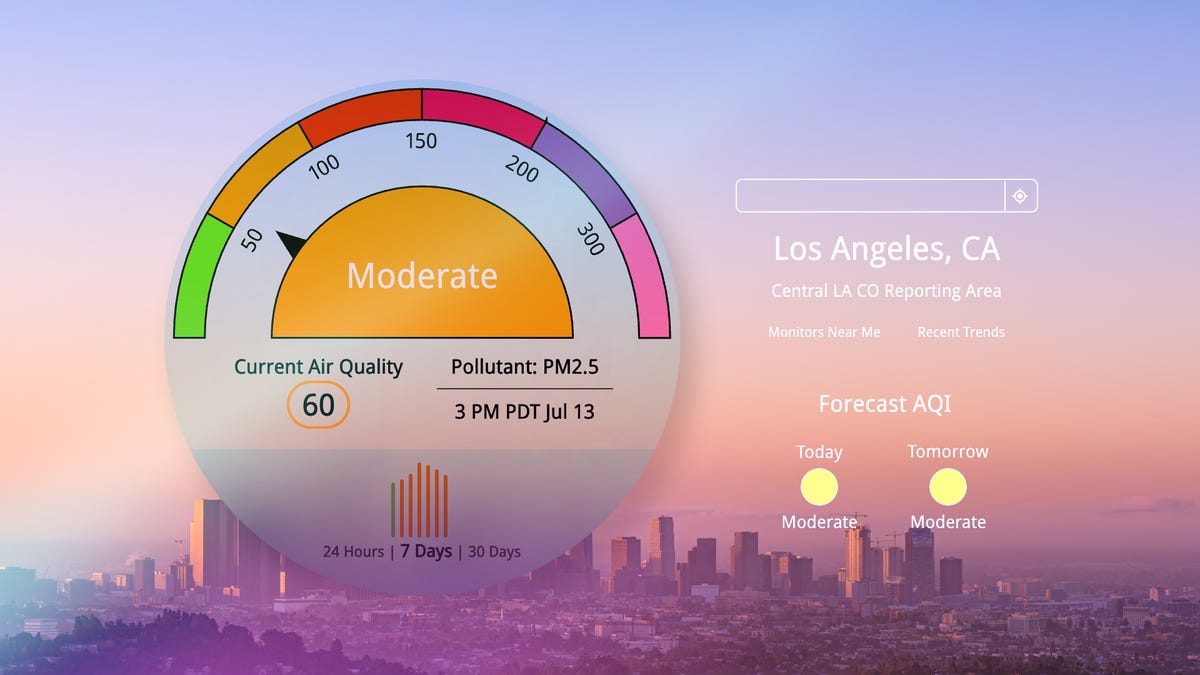
On the AirNow homepage, you can enter your ZIP code, city or state to view the current AQI, which displays a color-coded scale of six categories from zero to 500. There, you can see the AQI for today and tomorrow, the primary pollutant in your area and air quality trends across 24 hours, seven days or 30 days.
The AQI covers five major pollutants regulated by the Clean Air Act: particle pollution, ozone (smog), carbon monoxide, nitrogen dioxide and sulfur dioxide. The EPA tracks these pollutants using monitors across the US.
Cities with populations over 350,000 are required to report the daily AQI, while others do so as a public service. The time frame covered depends on the pollutant. For ozone AQI, it’s over the course of 8 hours, while particle pollution is over 24 hours.
The six AQI categories to know
Along with a number from zero to 500, you’ll see one of six colors for your AQI. This is what each means, specifically for ozone and particle pollution, which pose the greatest threat to human health in the US:
Green (0 to 50): Level of concern is “good,” meaning air quality is satisfactory with little to no pollution risk.
Yellow (51 to 100): Moderate level of concern. Although air quality is acceptable, people who are unusually sensitive to air pollution may be at risk.
Orange (101 to 150): While the general public is less likely to be affected, this category of air pollution can be unhealthy for sensitive groups.
Red (151 to 200): Labeled “unhealthy,” the general public may experience health effects. Sensitive groups are more likely to deal with serious health effects.
Purple (201 to 300): This level of pollution is considered very unhealthy, and the risk of adverse health effects increases for everyone.
Maroon (301 and up): The level of concern is hazardous, and everyone is more likely to be affected by the air pollution.
Sensitive groups can include people with underlying heart or lung diseases (such as chronic obstructive pulmonary disease and asthma), children and teens (as their lungs are still developing), older adults, pregnant people and outdoor workers.
What should you do when the air quality is poor?
If you check the AQI and notice that the air quality in your area is unhealthy, here’s what you should do based on the category, for both ozone and particle pollution:
Yellow/moderate: Unusually sensitive people should limit time outside and avoid intense outdoor activities. If you do go outside and start coughing or having shortness of breath, take a break.
Orange/unhealthy for sensitive groups: Sensitive groups should follow the above “yellow” advice, but take more breaks. If you have asthma, have your medication ready and follow your action plan. If you have heart disease, contact your doctor if you have shortness of breath, heart palpitations or unusual fatigue.
Red/unhealthy: Sensitive groups should avoid long or intense outdoor activities or schedule them indoors or in the morning, when ozone levels are lower, since ozone increases with sunlight. If you have asthma, follow your action plan and have medication ready.
Everyone else should reduce long or intense outdoor activities and take more breaks. Consider scheduling outdoor time in the morning.
Purple/very unhealthy: Sensitive groups should avoid all outdoor physical activity. If you don’t have an air conditioner and it’s extremely hot, relocate to an indoor area with AC, such as a local library or cooling center.
Everyone else should avoid long or intense outdoor activities and consider rescheduling or moving indoors.
Maroon/hazardous: Everyone should avoid outdoor physical activity. If it’s extremely hot, move to an indoor location with air conditioning. If you have asthma, follow your action plan and keep your medication on hand.
Should you wear a face mask?
If you have to go outside, the ALA recommends wearing a well-fitted N95 or KN95 mask — not a cloth or dust mask — when air quality is poor.
How to improve indoor air quality
If you’re able, stay inside but keep your windows and doors closed to prevent outdoor air pollution from entering. If it’s extremely hot, run your air conditioner on its recirculate setting (if available) so no outdoor air gets pulled inside. Or go to a location with air conditioning, like a local library or cooling center. Avoid using exhaust fans that open outdoors.
To prevent poor indoor air quality, run your HEPA air purifier to filter out indoor pollutants. An air quality monitor can also help you determine whether poor indoor air quality is a concern on days when the AQI is high.
Read the full article here