

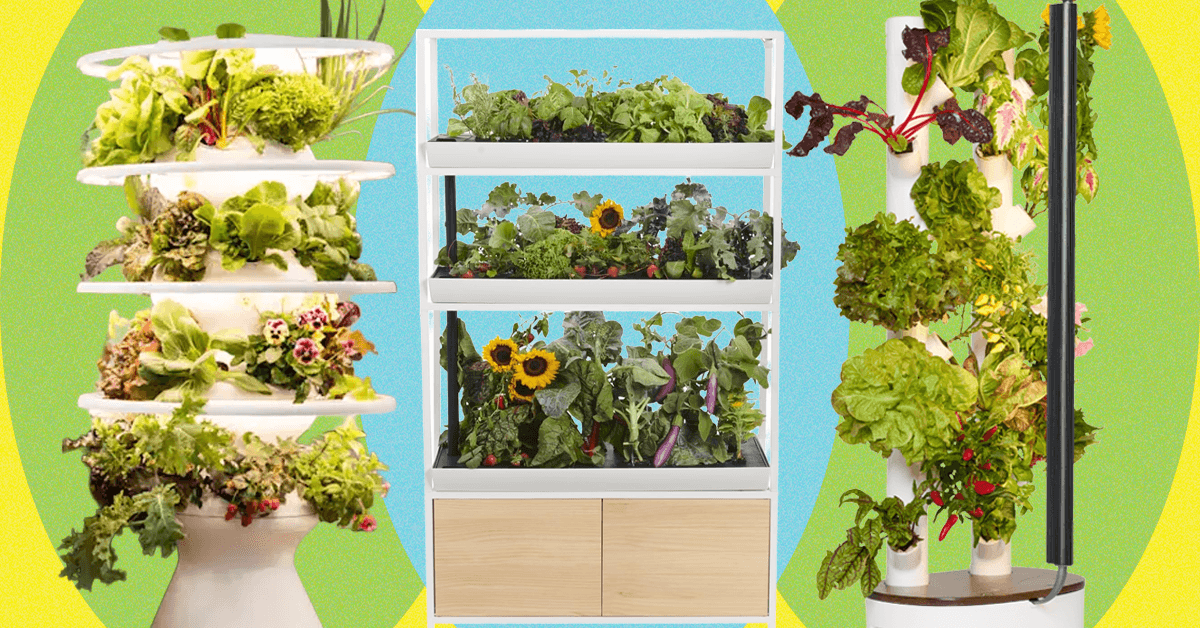
Honorable Mentions
Click and Grow Smart Garden for $125: Click & Grow Smart Garden’s seed pods come in a Nespresso-evoking plastic three-pack with a tear-off cover. (A three-pack of pods starts at around $15.) Put a nutrient-packed “smart soil” seed pod in one of the Click & Grow’s cups with the wicking bottom, fill the reservoir, and that’s it. It was one of the simplest watering systems I tried: a wick at the bottom of the cup brings water up to the pods, and the roots stay in the cups. A little bobber on one end tells you when the water level is low and needs a top-off simply by floating lower than the growing surface. It’s also small, so you can plop it on a shelf or countertop. (Note that the 9, pictured above, is currently out of stock, but you can sign up to be notified when it’s available.) At the same time, this was also one of the slowest-growing gardens I tested—it took weeks to get even one lettuce leaf. One of my lettuce pods didn’t even sprout at all. Still, this isn’t a terrible option for busy people who are interested in growing something like flowers, where yields aren’t a concern.
Modern Sprout Garden Jars for $20: These cute Mason jars are as simple as it gets: Rinse the included gravel, then add seeds and water. They’re guaranteed to sprout in five to ten days and make a fun hostess gift with a tea towel and/or a bottle of olive oil. However, they are definitely more for looks than harvests—I have had the basil, cilantro, and rosemary versions on my windowsill for a little over a year, and I’ve only seen a few usable leaves.
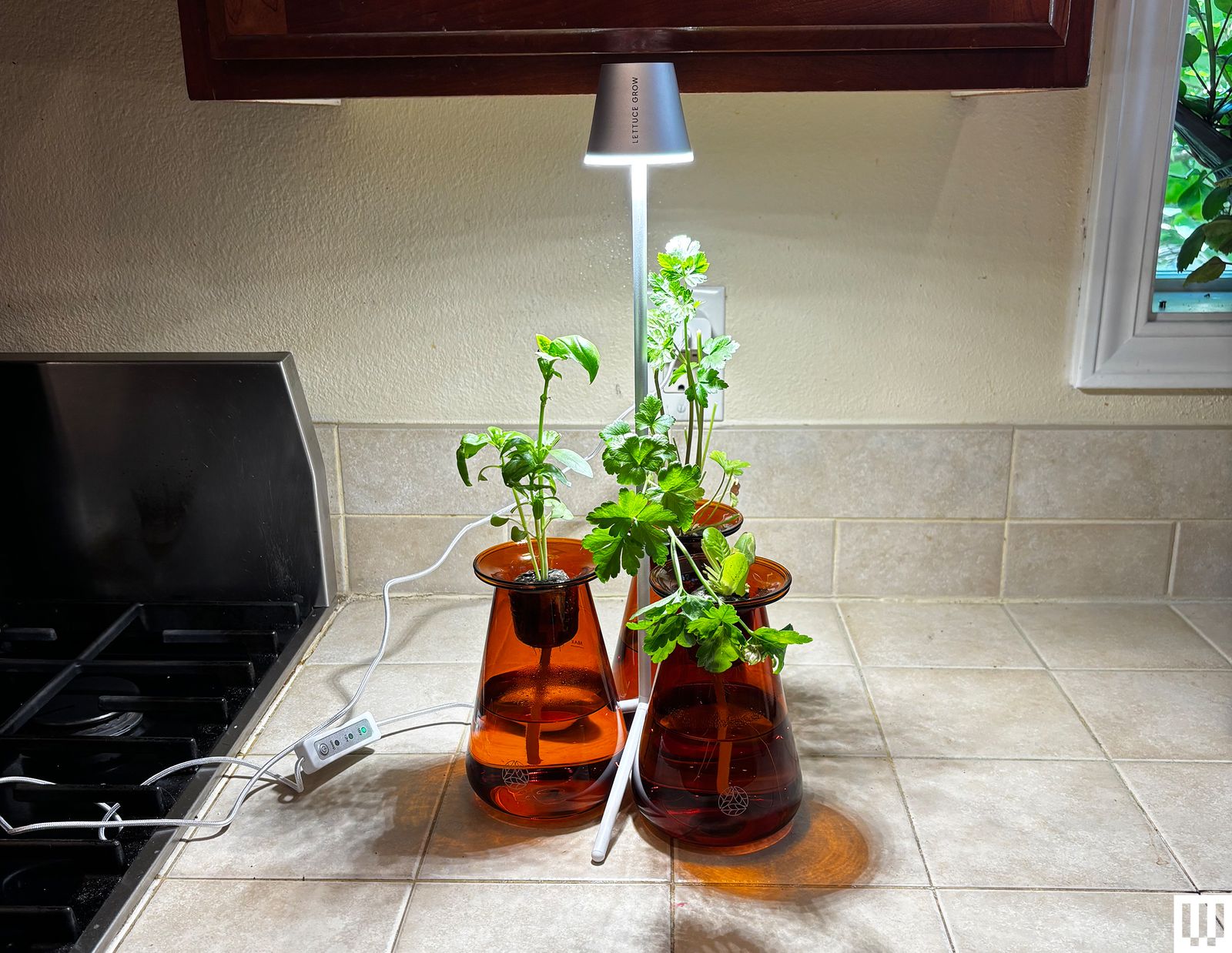
Lettuce Grow Counterstand Set for $149: New from the makers of the flashy Lettuce Grow Farmstand (8/10 WIRED Recommends), this simple, no-pump setup consists of three amber beakers that look straight out of a high school chemistry lab, plus an 18-inch LED lamp that runs on a 16- or 18-hour timer. It relies on the Kratky method of hydroponics, invented by horticulturist Dr. Bernard Kratky, where the plant sits in a cup above a nutrient-enriched water source. In the Counterstand’s case, a wick draws water up to the seedling until its roots can grow into the water. Included with your order are three credits for live seedlings of your choice—I picked parsley, basil, and butter lettuce. This setup is stylish, but the yields are tiny for the counter space it takes up—maybe a small handful of leaves a week.
Vego EZ Microgreens Planter (2-pack) for $60: This system for growing nutrient-packed microgreens for salads, smoothies, and sandwiches isn’t smart, but it is nifty enough to warrant a mention. Just fill each half-gallon reservoir (made of food-safe plastic) with water, and then cover it with the optional humidity dome. From there, bamboo-fiber capillary grow mats on top will absorb water to germinate your microgreen seeds (not included). Set it near a sunny window, use a grow light, or add Vego’s 10 x 20 dome with a built-in grow light ($80), which fits over both planters. I placed my planters on a Ferry-Morse pop-up plant stand with a grow light from LetPot and had consistent success across multiple grows.
Not Recommended

Photograph: Lisa Wood Shapiro
Plantaform Smart Indoor Garden for $900: Plantaform is “the world’s first smart indoor garden that uses fog to grow plants,” according to the company’s press release, and it has definitely garnered attention, winning an Innovation Award at CES 2025. The “fogponics” technology, ostensibly building on NASA-developed aeroponics, delivers water and nutrients to plants’ roots via an ultrafine mist. We were certainly captivated by the futuristic look of the egg-shaped planter. But when WIRED contributor Lisa Wood Shapiro tested it to grow lettuce, she found that you can’t combine different types of plants (i.e., you can only grow lettuce at one time, or tomatoes, or herbs), and the machine also degraded her indoor air quality, as tested with an air quality monitor. Users are to add an included fertilizer mix to the water, with the resulting concoction being what’s aerosolized in the container, which, as Wood Shapiro found, was not airtight. She suggests limiting the Plantaform’s use to a basement or another space where air quality isn’t as much of a concern. But it’s probably best to hold off on this one until Plantaform can work out some more kinks.
LetPot Smart Seed Starter for $84: There are many grow-light–enabled seed starters on the market, but LetPot’s Smart Seed Starter has more features than most, including a sensor for soil temperature and EC and a 24-watt heating pad underneath. A plastic lid with adjustable vents on either end sits on top. I love the concept, but sadly, quality control is lacking. On my test unit, the power adapter makes a high-pitched sound when the lights are on, the EC sensor only works intermittently, and auto-mode erases whenever it’s unplugged. After about six months of regular use, the light stopped staying on, and to get the unit to cooperate, I had to unplug and replug it repeatedly.
FAQs
In the simplest terms, hydroponic gardening means growing plants without roots in soil. Sometimes plants are suspended in water, like in the Rise or Gardyn; sometimes they’re in pods attached to a wick, like in the Click & Grow; and sometimes water is sprayed or misted onto their roots, like in the Lettuce Grow. Usually, this process works alongside an artificial light source, either indoors or in an outdoor enclosure.
What Are the Benefits of Hydroponics?
In addition to the obvious plus of cleaner produce without mud, dirt, or synthetic pesticides, hydroponic systems use much less water than conventional growing methods, since all the water used is either recirculated or taken up by the plants. Some farmers also say they get higher yields from hydroponic systems, as the variables of weather, light, and nutrients are far easier to control. And, because of these variables, farmers are also able to grow varieties of plants in just about any season or region. And there are no weeds!
What Kinds of Things Can I Grow in a Hydroponic Garden?
Just about anything you can think of! I asked FX Rouxel, creator of Gardyn, if there was anything you couldn’t grow in these systems, other than ground-dwelling plants like peanuts or potatoes. “All the things that have big roots,” he said—like carrots, parsnips, and so on. “Otherwise, mostly things that are too big, like apples or lemons.” So, there you have it: No long roots, no trees. But anything else is fair game to try.
What Are the Downsides of Hydroponic Systems?
First of all, it’s no secret hydroponic systems cost more than just planting some seeds outside in the dirt. Then you’ve got to worry about power outages, pump maintenance, algae, and just general maintenance. And if you’re not careful, water can harbor some nasty stuff, even if that’s just fertilizer, as WIRED contributor Lisa Wood Shapiro found when she reviewed the Plantaform. Some also claim that hydroponically grown herbs, greens, and vegetables have less flavor than their soil-grown counterparts, but I personally have not noticed a difference. I’ve grown perfectly flavorful snap peas, cauliflower, shell beans, salad greens, and even strawberries in just nutrient-infused water. In fact, one of the best cucumbers I’ve ever had in my life came from my Gardyn Studio, of all places.
Will I Save Money by Growing My Own Vegetables?
In short, no. The ready-made systems simply remove a great deal of hassle and guesswork from the process, and usually look pretty cool in the process. It’s also nice to have warranty and tech support in the event something goes wrong, and as is often the case with anything filled with water, when something does go wrong, it goes really wrong. (Speaking of, be sure to check out our guide to the Best Water Leak Detectors.)
How Much Can I Really Grow in These Things?
It largely depends on what you’re growing and how many individual plants can fit in your system. My yields have ranged from a handful of lettuce leaves in the Click & Grow to huge bagfuls of salad greens per day in the Rise—more than my family could possibly eat. As a rule, lettuces and other greens tend to grow faster, while fruiting plants like tomatoes and peppers grow slower and sometimes need pollination to produce. (For instance, with strawberries I have to use a small paintbrush to brush the flowers each morning.)
Where Can I Put Them in My House?
Most of these systems take up only a square foot or two, so space isn’t as much of a consideration as lights and pump noise. Lights for these gardens typically need to be on around 16 hours a day, and they are bright, so if this schedule would be disruptive, you may want to place them away from a bedroom or any other room where darkness is needed. On a related note, many of these gardens, like the Lettuce Grow and Gardyn, have loud pump cycles, while Rise’s pump runs continuously. I wouldn’t recommend placing a garden with a noisy pump cycle near a TV or office, where the noise could be disruptive during certain times of the day. If any noise is a concern, for instance, when living on the top floor of an apartment, you may want to consider a totally silent garden like the Auk or Click & Grow.
How Much Do They Cost to Keep Going?
Gardens with subscriptions and/or proprietary pods, like Gardyn and Click & Grow, are obviously going to be more expensive over the long run than a truly DIY system like the LetPot. On the one hand, with proprietary pods, you won’t have to source seeds or sponges; you can be assured the seeds are appropriate for that system and hydroponics in general, and if something doesn’t germinate, you will be able to get a replacement or refund. But on the other hand, this is a recurring cost that will reduce any savings you gain from growing your own food or flowers. As for power, systems with a continuously running pump, like Rise, are going to cost more than ones with no pump, like the Auk. However, I haven’t noticed a significant bump in my electricity bill while testing these gardens, except for one period where I had seven (yes, seven) going at one time.
I unboxed, assembled, and set up each garden exactly as described in the provided instructions, using the seeds, pods, or seedlings that came with the garden. I paid attention to ease of setup, ease of use, maintenance needs, how much space each system required, and how well (or not well) the plants did and why. I noted what was or was not included with each system, and allowed all of the plants to grow to the harvest stage, paying attention to bolting, yields, and general health. I’m a full-time working parent, so I also paid attention to maintenance needs, light schedules, and any general hassles that came up and annoyed me.
How I Chose Which Gardens to Test
I am genuinely passionate about indoor gardening and have an eye on what’s going on in the landscape: what’s new, what’s hot, what’s working for people, what’s not working. I’m always on the lookout for interesting new devices that I personally think are cool and that I believe WIRED readers would appreciate. Affiliate status does not factor into my decision about what to test and write about. If you have a unique, tech-forward indoor garden you like that I haven’t featured, please let me know in the comments.
How Do I Acquire Gardens to Review?
Most of the gardens I receive to test are samples provided by the companies, with no guarantee of coverage or expectation of what that coverage will look like. Some of the gardens are kept by WIRED in order to perform extended testing, while others are donated locally.
Power up with unlimited access to WIRED. Get best-in-class reporting and exclusive subscriber content that’s too important to ignore. Subscribe Today.
Read the full article here