

I’m a lab technician at CNET Testing Labs in Louisville, Kentucky. I’ve tested nearly 40 portable power stations this year, and that’s not including the hundreds of other products I’ve tested for CNET. When I first started as a lab technician two years ago, I’d never used a portable power station. The idea of a portable power station being mobile was entirely foreign to me, and I certainly didn’t expect to become so intimately involved in evaluating their performance. To be honest, I thought of them as oversized batteries, and had no idea of how severely misinformed on how incredible and important these units actually are.
In an era of increasing energy prices, frequent power outages, wildfires and other natural disasters, owning a portable power station is more critical than ever. Like home battery backups, both store electricity for later use, but each serves a different purpose. Home battery backups are permanently installed and are designed to keep your home operating during a power outage. A portable power station, on the other hand, offers the flexibility of taking your power source anywhere and doesn’t require a major installation or the high upfront cost of a home battery backup system.
Since power needs and budgets vary widely, selecting the right station requires careful consideration of what you need to run and how much energy capacity you are willing to invest in. Choosing the right portable power station depends entirely on your energy needs and budget. But I can assure you that our lab data reveals you don’t need to spend a lot of money to get a high-performing portable power station.
How we test portable power stations at CNET
Before testing a portable power station, there are some basic steps I follow. I first unbox the unit and inspect it for any damage or defects, taking note of the brand and model number. Then I open a laptop using HOBOware, an application for operating, configuring and analyzing data from a HOBOware data logger.
I connect the HOBOware logger to the laptop using the provided USB cable and open the launch window. From there, I select the parameters used for our discharge and charge tests. This monitoring software is helpful because it records factors such as voltage, current, power output and total energy used, measured in watt-hours (or Wh). Once the HOBOware logger is set up, I’m ready to begin testing measurements.
The testing procedure for power stations was created by Gianmarco Chumbe, CNET’s product testing manager. Chumbe wrote the standard operating procedure I use to conduct these tests, using two core questions to evaluate each unit’s capabilities:
- What’s the energy cost of charging up a power station to 100%?
- How much energy can a power station actually provide from a full charge?
To answer these questions, we test each unit and compare the manufacturer’s claim to real-world performance.
Discharge test
To perform this test, I connect each power station to a standard load (Hyphotonflux, 480W, 100–277 VAC, 50/60Hz) via a HOBOware logger, which records the unit’s energy output until the battery is fully depleted. After the test is finished, we add up all one-minute energy measurements (in watt-hours) to determine the total energy supplied to the load. This shows us the unit’s usable capacity compared to the manufacturer’s claim. This is important because a unit’s usable capacity varies across brands and models, so the advertised capacity may not match the usable capacity we measure in our lab, meaning you may not get the capacity you expected.
Charge test
For a charge test, each power station is connected to a standard 120V AC wall outlet, and the total energy (Wh) intake needed to fully charge the unit from empty is recorded. A watt-hour — or Wh — is a unit of energy equal to one watt of power sustained for one hour. We use the cumulative energy and timestamps to estimate how long it takes to reach a 50%, 80%, and 100% charge.
After both tests are complete, I compare the energy used to charge the battery (charge test) and the energy you actually get back out of it (discharge test) to find the unit’s round-trip efficiency.
Round-trip efficiency
Imagine you’re filling up a pot of water using a pitcher. You pour 10 cups of water into the pot, but some spills on the floor, some splashes out and a little leaks while you’re carrying it over. By the time you’re done, the pot only contains 8.5 cups of water, or 85% of the water in that pot.
Applying this analogy to power station batteries, you can charge a unit using 1,000Wh from a wall outlet. When you discharge it, you get about 850Wh of usable energy or 85% round-trip efficiency. The missing 150Wh is lost as heat during charging and power conversion. Below is the round-trip efficiency formula we use.
Round-trip efficiency (or RTE) is the percentage of the charging energy that is returned during discharge. It is calculated by dividing discharge watt-hours (Wh) by charged watt-hours (Wh). A higher percentage means more usable energy per charge and lower running costs over the unit’s lifespan. In turn, this helps us answer Chumbe’s core questions of how much energy you’ll actually have available and what that charging energy will cost you.
Disaster-preparedness stress test
Power stations can be useful in an emergency, but how they hold up is another question. They’re great for keeping essential electronics running, such as phones, tablets, laptops, Wi-Fi routers and fans, but how well can a power station run a high-power appliance like a refrigerator?
We gathered all large and extra-large power stations to see how these units would perform in a real emergency, such as a power outage. Each unit was used to power a full-sized refrigerator (Whirlpool, 60Hz, single-phase, 118V, full-load 7.2A) until the battery was completely drained. We measured how long each unit kept the refrigerator running and reported the results in hours and days. Since this test reflects real-world use rather than a controlled laboratory measurement of battery capacity, efficiency ratings (RTE) are only reported from our standard testing procedure.
How we rate and score portable power stations
We categorized PPS by their battery capacity, spanning from small to extra-large units:
- Small <600Wh
- Medium 600-1299Wh
- Large 1300-2199Wh
- Extra-large >2200Wh
Our overall scores are based on lab testing, with each portable power station evaluated using the following weighted criteria:
- Round-trip efficiency (40%): Measures how much usable energy the battery returns compared to the electricity required to recharge it.
- Value (40%): Compares verified usable battery capacity against retail price to determine overall value.
- Charge time (20%): Measures how long it takes to recharge the battery from 0% to 100% using a standard wall outlet.
In addition to the weighted score, units can earn bonus points for standout performance:
- Design bonus (+0.5 pts): Awarded to products with innovative designs that solve a meaningful portability or space-saving challenge.
- Features bonus (+0.5 pts): Given for unique, class-leading features that provide significant real-world benefits beyond standard functionality.
- Refrigerator runtime bonus (+0.5 to +1.0 pts): Awarded to large and extra-large models based on verified refrigerator runtime during our emergency preparedness test, serving as a tiebreaker for exceptional real-world performance.
Awarding the top performers
There are a number of awards we may bestow on top performers. The best portable power stations are our top-tier choices for most people, with a range of options for different situations. CNET’s Editors’ Choice Award represents the best of the best products we’ve tested, chosen by our editors who are closest to the products and editors’ strongest recommendations.
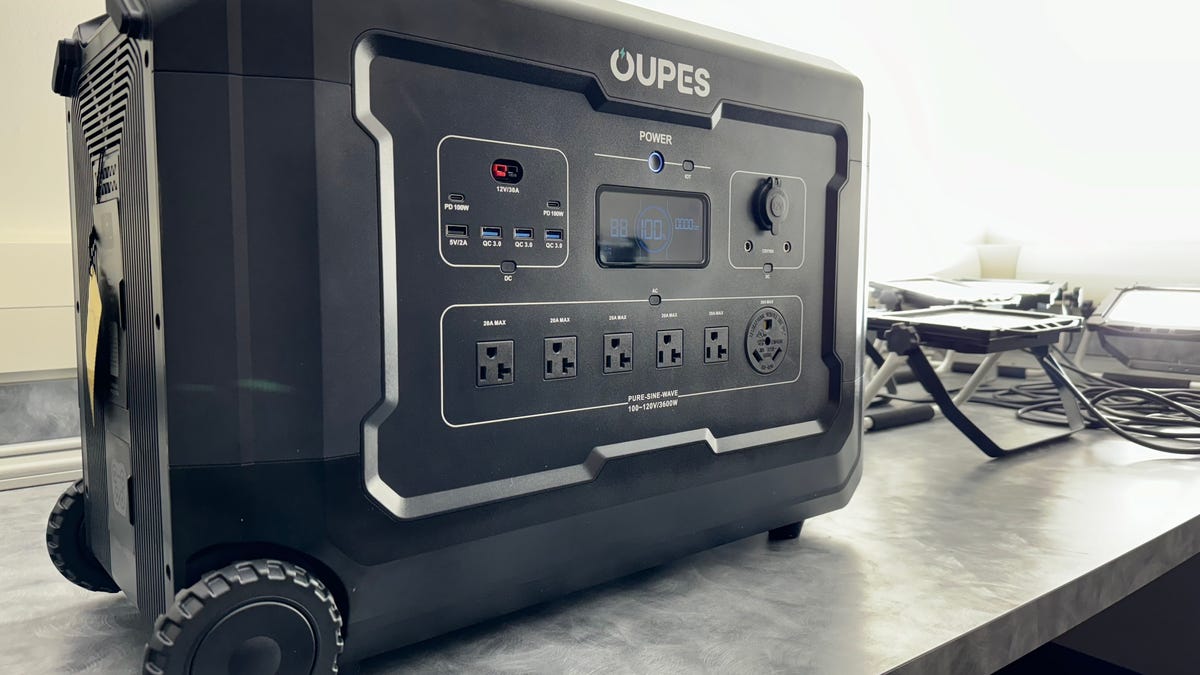
We also give a Lab Award to a single product that achieves the highest performance on a specific, repeatable metric or benchmark that is meaningful to consumers. For example, the Oupes Mega 1 Lite won the Lab Award for fastest charging.
These are the power stations that earned a 2026 Lab Award:
- Most Efficient Small Unit (<600Wh): UDPower AC0600
- Most Efficient Medium Unit (600-1299Wh): Bluetti Elite 100 V2 Bio-Based
- Most Efficient Large Unit (1300-2199Wh): Bluetti Elite 200
- Most Efficient X-Large Unit (>2200Wh): Jackery HomePower 3600 Plus
- Fastest Charging: Oupes Mega 1 Lite
These are the power stations that earned our 2026 Editors’ Choice Award. These may overlap with our lab awards, but not necessarily. These awards are given to those power stations our editors feel offer a mix of great performance, features or value that makes them stand out.
Our current Editors’ Choice winners in 2026:
- Bluetti Elite 100 V2 Bio-Based
- Jackery HomePower 3600 Plus
- Bluetti Elite 30 V2
Read the full article here