





Key takeaways:
- The way portable and window AC units operate is the most significant factor that determines their cooling capabilities.
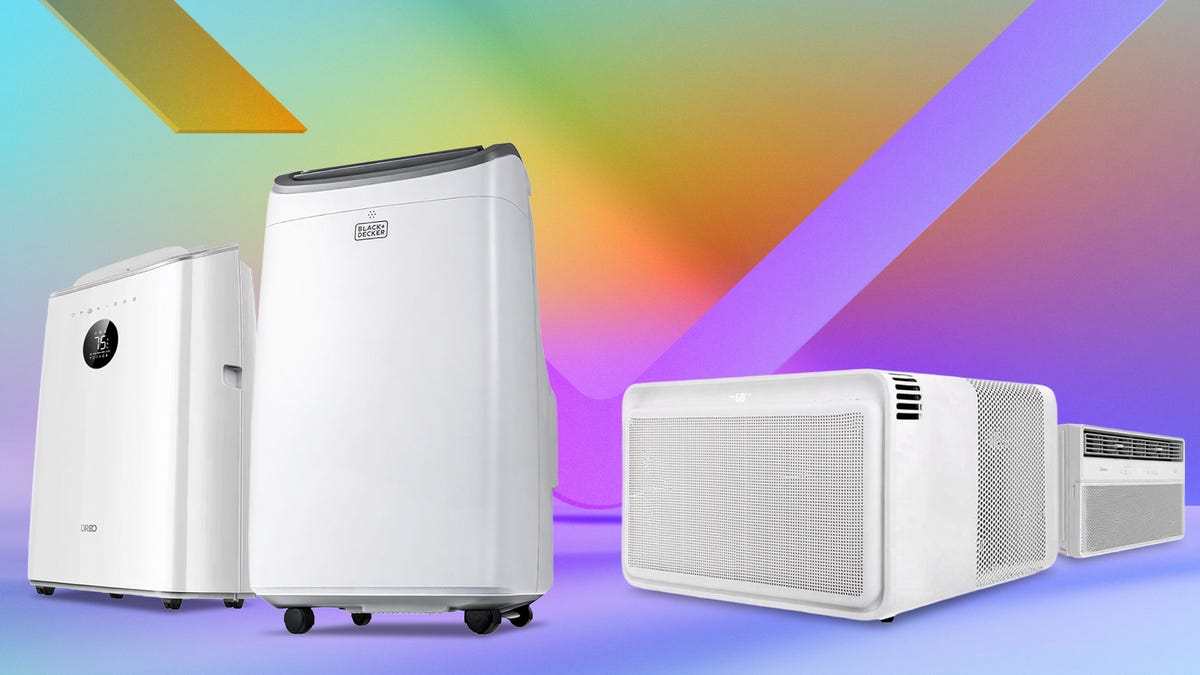
- The Windmill was the top-performing window AC unit in our tests, while the Black & Decker BPP08WTB was the best-performing small portable AC unit, and the Dreo AC516S was the best-performing large portable AC unit.
- Higher BTU (British Thermal Units) did not always translate to better cooling capabilities in our tests.
When I stepped into my first New York apartment, I was surprised at how warm it was. Sure, it was only May, but I expected at least a little air conditioning. I scanned the tiny apartment, thinking that there were only so many places a thermostat could be hiding, but then it dawned on me: there was no central air.
I guess that’s what I get for signing a lease sight unseen.
With that, I had to find an air conditioning unit stat. Given that the space was so small, and I didn’t want another bulky appliance taking up precious floor space, I opted for a window AC unit instead of a portable unit, hoping it would do the job. With luck (and the right-sized unit) on my side, it did. Through multiple sweltering summer days, it chugged along, keeping the apartment cool.
If you’re in a similar position, you’ve probably already found numerous air conditioners in both window and portable styles. Portable ACs are often favored if you don’t want to block out natural light from the window or don’t have the correct-sized window, but how do the two styles actually compare? And is one better than the other?
We put both window and portable ACs through our hands-on lab testing to find out.
How window AC units operate: Cool air in, hot air out
Window units are installed in a window, with the majority of the device outside the home. This configuration is actually what makes them operate more efficiently than a portable unit.
Essentially, a window unit recirculates indoor air, cooling it and blowing it back into the room while venting the heat outside rather than recirculating it.
“You want the window unit to bifurcate [separate the airflow] so that the exhaust air stream is outside of the building,” says Bryan Adams, CNET’s senior lab engineer and former HVAC configuration manager.
How portable units operate: An air imbalance
Portable units are entirely contained within the room they cool. Similarly to window units, they pull in warm air, cool it and vent heat outdoors. However, portable units use an exhaust hose attached to the unit inside the home and vented through a window, which means some air that was just cooled may be pulled outside. This process can create a slight negative air pressure in the room and less cooling efficiency.
“When air pressure is a little lower, other air is going to come in and fill that space,” Adams says. “If you’re in a room, the easiest place for other air to get in is from outside.”
When warm outdoor air enters the room to correct the pressure imbalance, it “further decreases the cooling efficiency and [the portable unit] has to work even harder to catch up,” Adams adds.
Adams says the exhaust tubes are also generally “extremely poorly insulated,” which can cause the hose to become hot and leak back into the room.
However, portable units do typically beat window units in one area: convenience.
“A portable unit is way easier to set up, and it’s much easier if you want to take it between rooms on a regular basis or travel with it somewhere,” Adams says.
They’re also often the best option if you have a small window that cannot support a traditional window unit.
Those factors are “enough of a reason for them to have a place in the market,” Adams says, “but when it comes to performance, it’s not close.”
CNET’s AC unit lab test results
When testing air conditioning units, we broke them into three categories: window units, large portable units (over 8,000 BTU) and small portable units (8,000 BTU or lower). We conducted the same test on each unit at our lab in Louisville, Kentucky.
We heated an enclosed room to 90 degrees Fahrenheit, then turned on one AC unit at a time to see how quickly it could cool the room to 68 degrees Fahrenheit and whether it could maintain that temperature during the 2.5-hour test.
The Windmill was the top-performing AC unit in our tests, outperforming all other window and portable units. It dropped from 90 to 72 degrees Fahrenheit the fastest and maintained a temperature between 65 and 71 degrees Fahrenheit the longest.
The Dreo AC516S was the best-performing large portable AC unit over 8,000 BTU, taking 52 minutes to cool from 90 to 72 degrees Fahrenheit, and the Black & Decker BPP08WTB was the best-performing small portable AC unit, taking 66 minutes.
Although the Dreo portable unit cooled faster initially, window units reached the target temperature faster and cooled more efficiently overall.
Is a window or portable air conditioning unit better?
In general, our tests showed that portable units struggled to match the performance of window units. Even models with significantly higher BTU ratings than our top window unit, the 8,000-BTU Windmill, could not cool the room to 68 degrees as quickly or efficiently.
When comparing the Windmill, our best-performing window AC unit, with the 14,000-BTU Dreo AC516S, our top-performing large portable unit, the Dreo model took only 11 minutes to cool the room from 90 degrees to 80 degrees Fahrenheit, while the Windmill took nearly twice as long, at 20 minutes. However, the Windmill reached 72 degrees Fahrenheit 2 minutes faster than the Dreo model and maintained a temperature between 65 and 71 degrees Fahrenheit for 62.91% of the 2.5-hour testing period, compared with 60.93% for Dreo.
These results show that although the Dreo has a significantly higher BTU rating (14,000 compared to Windmill’s 8,000), it still did not perform as well overall as the window unit.
To take the comparison between window and portable units further, we can look at the Windmill alongside the Black & Decker BPP08WTB, another 8,000 BTU model. The Black & Decker unit took 16 minutes longer than the Windmill to reach 72 degrees Fahrenheit.
Adams says window models typically outperform portable units because of how they operate. Plus, the fact that a portable unit is entirely indoors.
“There’s only one place a portable air conditioner can pull air. It’s in the room,” Adams says. “Therefore, instead of using outdoor air, it has to pull some of the air that it just finished cooling back into the unit in order to vent heat outside of the building. So that, on its own, is the single biggest inefficiency of a portable air conditioner.”
Portable units are “across the board, less efficient than window units,” Adams adds.
CNET’s buying advice
If you have a window that supports it, we highly recommend window AC units over portable units, based on our lab testing and personal experience with both.
The top-performing window AC units from our tests are:
- The Windmill: 8,000 BTU, 50 minutes to cool from 90 degrees to 72 degrees Fahrenheit
- LG Dual Inverter: 12,000 BTU, 52 minutes to cool from 90 degrees to 72 degrees Fahrenheit
- LG LW8024R: 8,000 BTU, 69 minutes to cool from 90 degrees to 72 degrees Fahrenheit
However, portable units offer more flexibility and are easier to install, and some can still cool a room effectively.
The top-performing portable AC units from our tests are:
- Black & Decker BPP08WTB: 8,000 BTU, 66 minutes to cool from 90 degrees to 72 degrees Fahrenheit
- Dreo AC516S: 14,000 BTU, 52 minutes to cool from 90 degrees to 72 degrees Fahrenheit
Another detail to consider when purchasing an air conditioning unit is choosing one that is the correct size for your space. An 8,000 BTU model can generally cover up to 350 square feet, while a 14,000 BTU model can handle 500 to 700 square feet, but this is dependent on multiple factors, including sun exposure, the type of room and ceiling height. If you’re cooling multiple rooms, you may need additional units.
How to choose the right BTU
An undersized unit may struggle to properly cool a room and could run continuously, which would increase energy use. An oversized unit, on the other hand, would cool the space too quickly and result in higher utility costs, so it’s important to choose a properly sized unit.
If you’re unsure what size you need, an online BTU calculator can help. These tools take into account the size and type of the room, ceiling height, installation, sun exposure and climate to estimate the ideal BTU rating needed.
Read the full article here