

I knew that homeownership would have its ups and downs or as some might say, “the good, the bad and the ugly,” but as my husband and I sat in our lender’s office on a cold February day, I didn’t expect there to be downright scary aspects to it, too.
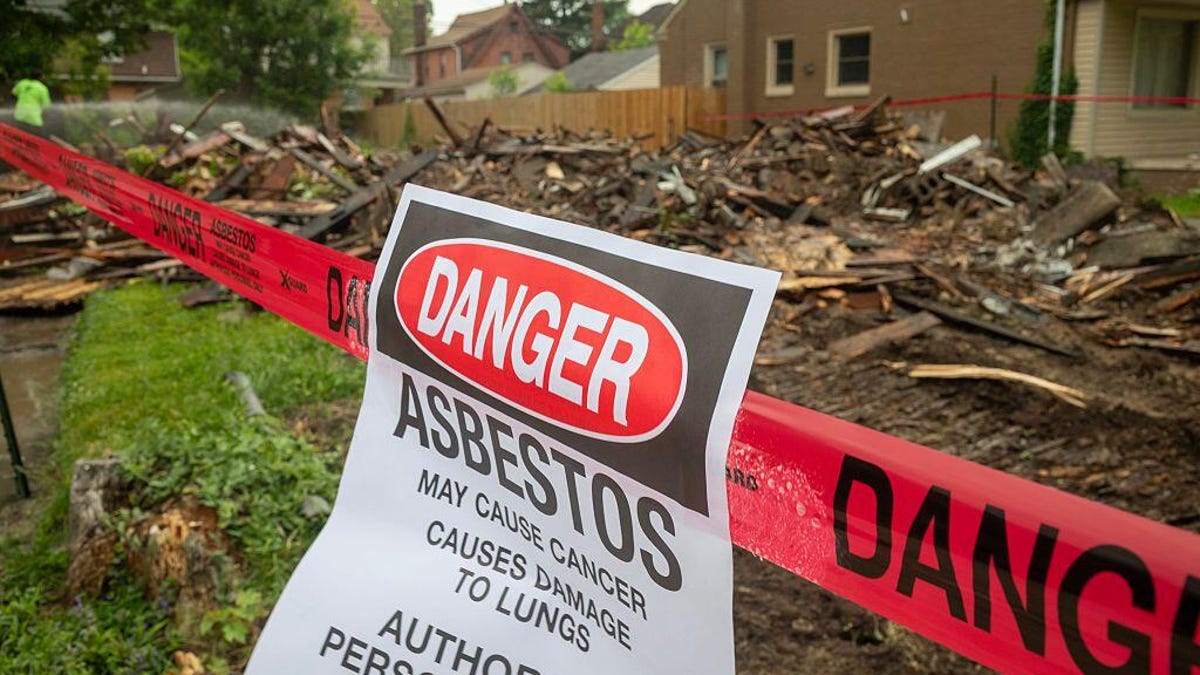
About a month into living in our humble abode, I discovered something that shook me: asbestos-containing materials, made up of microscopic, indestructible fibers that pose serious health risks if disturbed and inhaled, according to the Agency for Toxic Substances and Disease Registry (ATSDR).
Because our ceiling texture tested negative for asbestos during our home inspection, there was no tile (a common source of asbestos) in the home and I have an air purifier that I regularly run, I thought we were in the clear. Oh, was I wrong. Not to alarm anyone, but this stuff can be anywhere, and contrary to what I’d hoped, an air purifier isn’t the end-all, be-all of asbestos remediation.
What started as a vent cleaning turned into hours of researching, worrying and moments of stating out loud, “I wish I stayed a renter.” Ignorance is bliss after all.
During the stressful journey to homeownership, I’ve learned quite a few things about asbestos, and I think anyone who lives in a home built before 1985 (or sometimes even later if you’re outside of the US) would like to know.
Here’s everything to know about asbestos in your home, including what role air purifiers play.
What is asbestos?
Asbestos is a naturally occurring mineral fiber that was widely used in commercial and residential buildings between the early 1900s and 1980s. The EPA-accredited Asbestos Institute explains that usage peaked during the housing boom after World War II, from the 1940s to the ’70s, due to its fire resistance and affordability.
In older homes, asbestos can often be found in ceiling and floor tiles, tile glue, joint compound used in drywall, ceiling textures (like popcorn ceilings), house siding and shingles, around ducts and in vermiculite attic insulation, among other materials, the ATSDR states.
Dr. Nick Newman, medical director of the Pediatric Environmental Health and Lead Clinic at Cincinnati Children’s Hospital, tells CNET that the tiny size of asbestos fibers is what makes them easily inhaled. When inhaled over a long period of time, exposure can result in lung cancer, mesothelioma or asbestosis, which is a rare, non-cancerous lung disease, according to the EPA.
After inhaling the fibers, “the immune system sees them, and they’re like, ‘Who are you? You are not supposed to be here … I’m going to get rid of you,'” Newman explains. “And the asbestos fiber is like, ‘But I’m indestructible.’ So what happens is a lot of these fibers are long enough that when the little cells try to grab them, they just poke through the side.”
As more cells try to clear the fibers, chronic inflammation and DNA changes can occur. “It makes it more likely that you’re going to have abnormal cells in the lung that could become cancerous,” Newman says.
The majority of asbestos-related illnesses are a result of workplace exposure, studies show. This type of exposure results in large amounts of fibers being inhaled over time.
When left intact and undisturbed, asbestos doesn’t typically shed fibers. “Just because there is asbestos in a home doesn’t necessarily mean that it’s accessible to you,” Newman says. “It’s particularly bad when there’s some kind of renovation going on or anything like that where it’s being disturbed.”
In the US, the final ban on asbestos didn’t fully take effect until 2024, but asbestos use in homes dropped significantly in the mid-1980s as the health effects became better understood.
Do air purifiers catch asbestos fibers?
Because asbestos fibers are light and microscopic (think tens of thousands of times thinner than a grain of rice), they are invisible to the naked eye and can remain airborne when disturbed.
Because of this, you may think that an air purifier could help clear those tiny fibers from your home’s air, especially since CNET’s lab testing of air purifiers showed that you can rely on them for clearing particles like pollen, dust, pet dander, viruses, bacteria and smoke.
But, given the tiny size of asbestos fibers, it’s a little more tricky. Although Newman says an air purifier could help to a degree, as long as it is equipped with a true HEPA filter that captures up to 99.97% of airborne particles, it should not be relied on as a solution for asbestos contamination.
However, if you’re searching for an air purifier for allergies, to prevent illness or to remove pollutants from your home’s air, CNET recommends the Shark HP232 and the Coway Airmega 400, which showed impressive results in our lab testing for capturing both large and small particles.
“(An air purifier) is not going to suck (the fibers) off the floor, necessarily, but in the air,” Newman says. “HEPA filtration will capture most of those particles.”
The bottom line is that while an air purifier can help to a small degree, it’s not a foolproof way to prevent asbestos exposure.
“You could start there,” Newman says. “But if you know that there’s (asbestos-containing material) there, you’re going to have to figure out how to contain it. It’s always better to stop the exposure than try to reduce it.” For that, you’ll want to call in a professional asbestos abatement service.
“Crap, I renovated an old home. Now what?”
Don’t panic. Now, I know that’s rich coming from someone who did just that after finding asbestos in my home, but there are a lot of scientific numbers that may be able to ease your mind.
To put things into perspective, cigarette smokers are 15 to 30 times more likely to get lung cancer when compared to those who don’t smoke, according to the US Centers for Disease Control and Prevention. Non-smokers exposed to asbestos are roughly three to five times more likely to get lung cancer.
“We may not be able to prevent every asbestos exposure, but I can prevent myself from smoking,” Newman says.
He adds that these numbers do not typically translate to one single exposure.
“(For) a short-term, low-dose exposure, it’s going to be really hard to measure that effect,” Newman says. “I don’t think people have to lose their minds over that.”
However, that doesn’t mean asbestos isn’t an issue. If you think you disturbed asbestos-containing materials during a renovation, you should stop the project and get the material tested to be on the safe side. If it comes back positive, you can contact a certified asbestos-abatement company for proper removal or containment (often called encapsulation).
Newman also urges against trying to handle asbestos abatement on your own. “It’s definitely not a DIY thing at all,” he says.
Why did the asbestos ban take so long?
Bans don’t happen overnight, and banning asbestos in the US proved to be especially tricky.
In the ’70s, the EPA began banning certain asbestos-containing materials, with most products being fully banned in 1989. However, that ruling was overturned in 1991, and chrysotile asbestos (the most common type of asbestos) was still used in the US until it was banned by the Biden Administration in 2024.
Although asbestos was not used in common housing materials in 2024, it was still used in other items such as automotive brakes and brake pads. Some countries, including Russia and China, still use asbestos.
However, banning materials is not new. Similarly, lead is another example of something that was banned in stages in the US and more recently, Red Dye No. 3. Although the ban of the food coloring was announced in 2024, companies that use the dye in food and ingested drugs have until 2027 or 2028, respectively, to remove it from products.
As research continues and science improves, you can expect to see more bans enacted. There’s one type of substance that Newman has been studying: flame retardants, which are often used in electronics, building materials, furniture and more. He says they could possibly have an even more negative effect on children’s IQ than lead.
“I think the problem is (flame retardants) don’t break down, and they find their way back into recycled items and stuff like that,” Newman explains. “So I think we probably need to be a little bit more cognizant of this … That would be one that I think stays way under the radar.”
Read the full article here