






I’ve filmed with my DJI Osmo Pocket 3 all over the world, including up in the frozen Arctic, so I was excited to test out the latest version, the Osmo Pocket 4. The camera doesn’t make a lot of changes to what’s already a superb vlogging setup, but there are some key upgrades, from better dynamic range to a suite of new filmic color profiles.
I’ve been using the camera for a few days, and I’m pleased with what I’ve seen so far. But before I get to the details, I must address the elephant in the room: It won’t be officially on sale in the US when it launches. It’s a murky situation; while DJI’s drones have been banned for sale in the US, the company’s other products are subject to FCC regulations that, at the very least, delay their launch.
DJI’s Osmo Nano, for example, still isn’t sold directly via DJI’s online store, but you can pick it up in major retailers like Best Buy and B&H Photo. For the Pocket 4, DJI states it “will not be available in the US market as the application for authorization is still pending.” The word “pending” suggests that the situation could change, but as of right now, it might be tough to get hold of for US shoppers. And, even if you do get your hands on one, service and support could prove tricky.
In the UK, the Pocket 4 will start at £445, and a Creator Combo (including an attachable fill light, wireless mic and battery handle) will set you back £549. For reference, those UK prices translate to $604 and $745, respectively.
DJI Osmo Pocket 4: What’s new
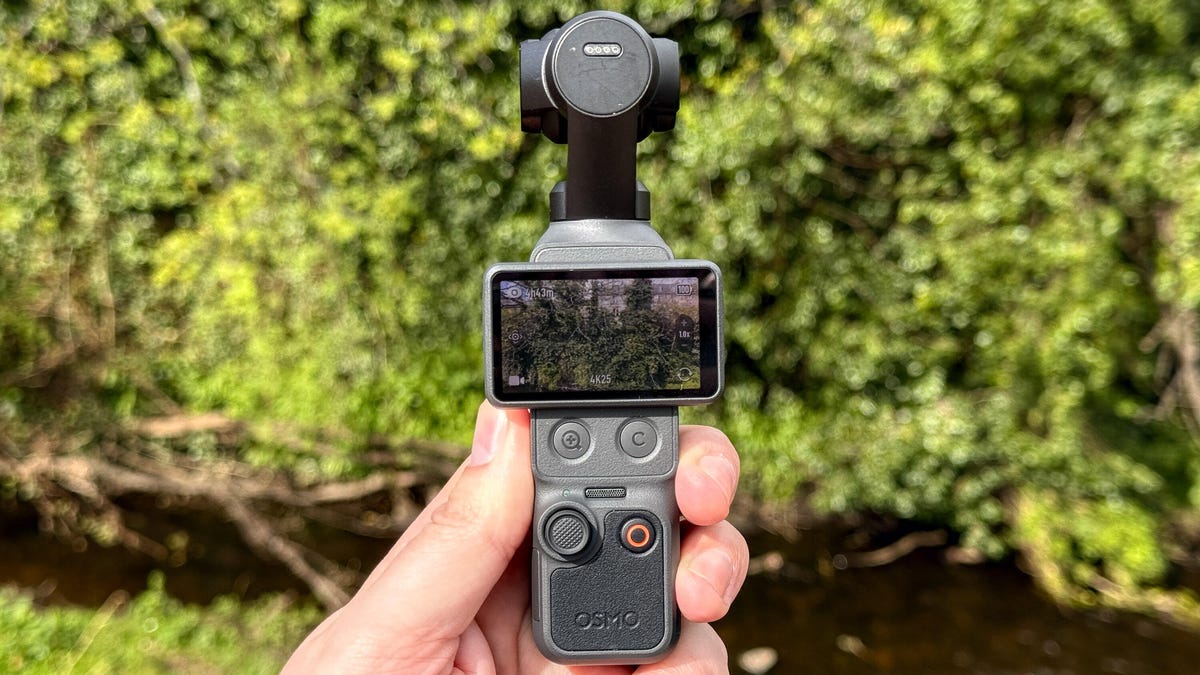
Physically, you’d struggle to tell the difference between the new model and its predecessor. It’s marginally bigger, but it maintains the 2-inch rotating LCD and the camera unit mounted on the gimbal above. The camera has the same 20mm field of view with the same f2 aperture. Beyond that, a lot has changed.
The camera still uses a 1-inch image sensor, but it’s a new version that offers up to 14 stops of dynamic range for better results in high-contrast situations. Its resolution maxes out at 4K (like before), but it’ll now shoot at up to 240 frames per second for silky smooth slow motion.
There’s a variety of new color profiles built in, designed to help you get a cool-looking filmic tone for your clips without having to apply filters or presets in post-production — just pick a tone and hit record. Or if you take your color grading more seriously, it’ll shoot in 10-bit D-Log for greater flexibility than its predecessor offered.
I’ve had a play with the presets and they’re fun. A little much for my tastes, though you can turn the intensity down to look more natural. I think these are great for quick footage, but if I were shooting a more involved project where I know I want the best possible quality, I’d shoot everything in D-Log to apply my own filmic tones later — and have full control over them as a result.
Despite the aperture remaining the same, DJI reckons the Pocket 4 has superior low-light performance, thanks to advances in image processing. I’ve not had a chance to take it out in the dark yet, but I’m looking forward to putting the old and the new side by side. There’s also a new slow-shutter video mode for creative nighttime shooting, which again sounds like a fun thing to play around with.
The Pocket 4 has a slightly larger battery than the Pocket 3 (1,545 mAh, up from 1,300 mAh), along with fast charging support, which will apparently take it from empty to 80% full in just 18 minutes. It also has 100GB of built-in storage, unlike the Pocket 3. I love this: I can’t remember how many times I’ve grabbed my camera for a day’s filming only to later realize I left the microSD card back in my computer.
DJI Osmo Pocket 4 Pro: Where’s the dual-lens model?
The Osmo Pocket 4 I’ve been testing is broadly similar to the Pocket 3, but with most specs bumped up slightly. But the rumor mill has been churning for months about a “Pro” version of the Pocket 4, which, according to alleged “leaked photos,” will feature a larger camera module with multiple lenses — likely including a telephoto zoom option, similar to the multilens setups seen on most phone cameras.
DJI has remained silent on the matter, with no mention of a Pro model in its launch materials; whether this more full-featured camera ever arrives remains to be seen. Personally, I’d love to see a Pro version feature an even bigger sensor and even interchangeable lenses, as DJI offers with its Ronin 4D. I won’t hold my breath, though.
DJI Osmo Pocket 4: Should you buy it?
If you already have the Pocket 3, I don’t think there’s a significant reason to upgrade to the new model (which is good news for potential buyers in the US). Sure, you might see marginal gains in dynamic range and perhaps battery life, but otherwise the video you’ll be capturing will be broadly the same.
However, if you’re still using the much older Osmo Pocket 2, or if you’re considering getting one for the first time ahead of your upcoming summer vacation, then the Pocket 4 has a lot going for it. I’ll be spending a lot more time testing it over the coming weeks and months to see how well it performs in both pro and enthusiast environments and how it compares with its new rivals, the Mission 1 series from GoPro.
Read the full article here


