



Pros
- Good selection of ports
- Respectable price-to-performance
- Windows or Linux
- Wide range of configuration options
Cons
- Loud fans under heavy CPU load
- No dust filtration
- Proprietary motherboard limits upgrade options (again)
The Tower Plus is Dell’s follow-up to what it once called its XPS desktop line, so even though the name has changed, the tower itself remains similar to the XPS 8960 desktop, albeit with new components. The XPS 8960 was an impressive enough machine, with solid performance that competed well with gamer-oriented PCs that had more robust cooling.
The Tower Plus doesn’t hold up in a similar way. Its performance is strong, but unlike its predecessor, it doesn’t punch above its weight. Its CPU doesn’t feel hamstrung, but the fan sounds like a vacuum when it’s running full tilt. The system will also almost certainly accumulate dust a bit like a vacuum, too. Worse, it has proprietary Dell components that will make upgrading difficult, if not impossible.
This might have been easier to stomach if the Tower Plus had a big price advantage, but it’s not driving as hard a bargain compared to something like the Lenovo Legion Tower 5 Gen 10, which costs less, has slightly easier upgradability and manages to trounce the Tower Plus in gaming performance in spite of an otherwise slower CPU. That said, the Dell isn’t a gaming PC and is meant for creatives and office workers, where a cleaner appearance might be preferred.
Dell Tower Plus (EBT2250) Desktop
| Price as reviewed | $2,700 |
|---|---|
| Size | 28 liter (16.8×6.8×14.7 in/427x173x373 mm) |
| Motherboard | Dell X5WC5 Custom |
| CPU | 3900MHz Intel Core Ultra 7 265K |
| Memory | 32GB DDR5-5600 |
| Graphics | Nvidia RTX 5070 12GB |
| Storage | 1TB NVMe M.2 PCIe Gen 4 SSD (boot) (Samsung PM9C1b) |
| Networking | 2.5GbE, Intel Wi-Fi 7 BE200 802.11be, Bluetooth 5.4 |
| Connections | Thunderbolt 4 (x1 rear), USB 3.2 Gen 2 Type-C (x1 front), USB 3.2 Gen 1 Type-A (x3 front, x2 rear), USB 2.0 (x4 rear), 3.5mm audio connector (x1 front, x2 rear), SPDIF, 2.5Gb Ethernet, SD Card reader, HDMI 2.0 (on motherboard)=, HDMI 2.1 (x1 on GPU), DisplayPort 2.1 (x3 on GPU) |
| Operating system | Windows 11 Home |
The Dell Tower Plus is available preconfigured starting as low as a “Dell Estimated Value” of $1,280 (actual pricing at the time of writing was $1,050) and as high as $2,980. You can also configure it however you’d like, topping out at $5,760. All of these prices are higher than they were at the start of the year due to the skyrocketing prices of memory, storage and graphics cards. The base configuration starts out with an Intel core Ultra 7 265 processor, 16GB of memory, 512GB of storage and runs Ubuntu Linux. The top version has an Intel Core Ultra 9 285K, 32GB of memory, 1TB of storage, an RTX 5060 Ti and Windows 11 Home.
Between those two ends of the spectrum, Dell offers multiple versions with different memory, storage and graphics cards (even offering an RTX 3050). If you want even more granularity, again, Dell has a custom configurator to allow extensive CPU, GPU, memory and storage options, including both much lower and much higher tiers than those available in their preconfigured options.
Our test unit came with an Intel Core Ultra 7 265K, RTX 5070, 32GB of memory, 1TB of storage (on a Samsung PM9C1b M.2-2230 drive), Windows 11 Home and a 750-watt power supply for $2,700.
Reined in, but not hamstrung
The Tower Plus does surprisingly well when it comes time to muscle up, as you’d hope, given the included hardware. Impressively, the limited cooling of the CPU and the tight confines of the graphics card didn’t result in major setbacks. The system actually passed 3DMark’s Steel Nomad stress test with over 99% consistency, though the CPU sags a bit in extended workloads.
In CPU benchmarking, the Intel Core Ultra 7 265K managed to pull away from the AMD Ryzen 7 7800X3D in the Lenovo Legion Tower 5 Gen 10 and even outpace the Velocity Micro Raptor Z95A’s AMD Ryzen 7 9800X3D in single- and multicore performance in Cinebench despite that latter system’s beefy liquid cooling. That said, when running Cinebench, the Dell threatens madness with the volume of its fans as it attempts to keep its cool. It also doesn’t clear the threat of other Intel-powered systems, even the older Lenovo Legion Tower 7i Gen 8 34IRZ8 with an Intel Core i9-14900KF that largely fell within 1-2% of the performance of the Tower Plus. With more powerful cooling, the Dell may have fared better. With a single pass of Cinebench’s multicore rendering, it scored 1,944 points, but after 10 minutes of rendering, its score dropped to 1,810.
Decent CPU performance doesn’t help make the Dell a sleeper gaming PC. That aforementioned Lenovo Legion Tower 5 Gen 10 with its AMD Ryzen 7 7800X3D generally kept pace with the Dell Tower Plus in 3DMark’s gaming benchmarks, despite both systems having an RTX 5070. However, the Lenovo ran away from it in actual gameplay, where it achieved an average of 289 frames per second in Shadow of the Tomb Raider (@1080p, Highest) to the Dell’s 227 fps. Even at 4K, where the systems are less constrained by the CPU, the Lenovo led 125 fps to 102 fps. For gaming, the Lenovo system simply makes more sense, especially with its quieter operation, lower cost and somewhat simpler upgrade options.
The Tower Plus may be a respectable workstation with plenty of performance and the ability to lean into gaming after work hours, but it’s not the most ideal in either respect for that either. The shrill sound and sheer volume of the fans when the CPU is under load are in harsh contrast to the silence it operates at most of the time.
A sleeper that may be worth sleeping on
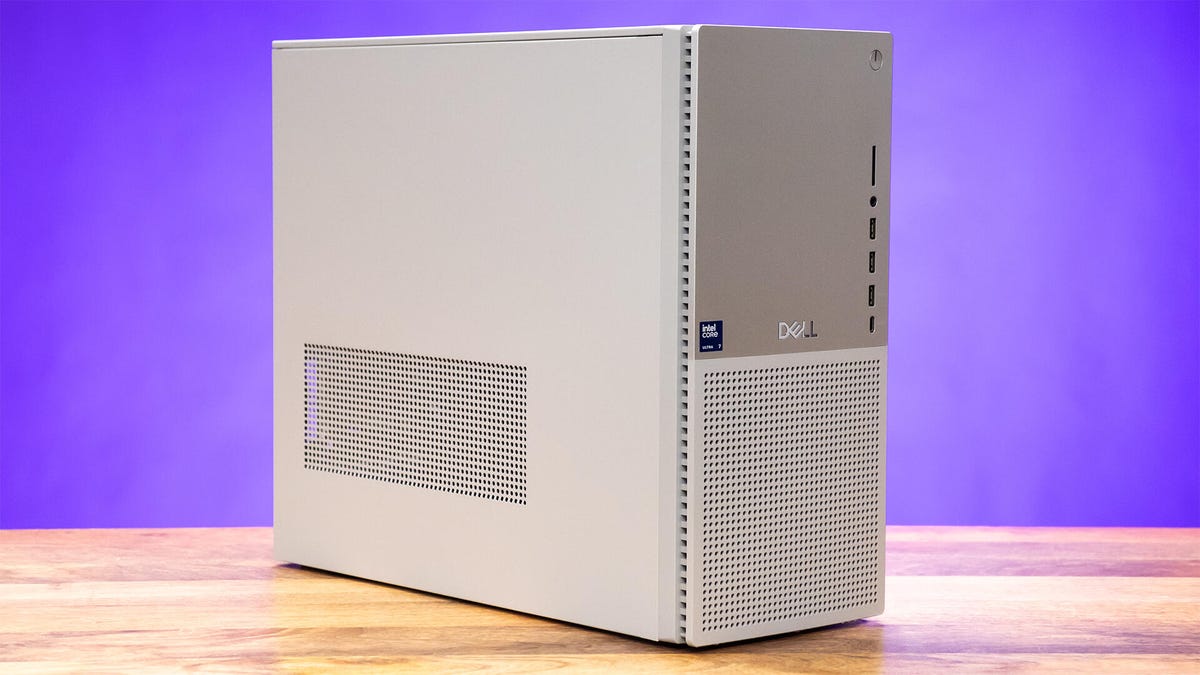
Looks-wise, the Dell Tower Plus isn’t a “cool” computer. It has a bland beige and silver design that harks back to the late 1990s. It’s a really simple box. The only bit of stylizing is on the front, where the panel extends from the case for some side air inlets, and how the grille at the bottom is contrasted by a silver upper section where the front I/O and power button live. While the design is sedate, to put it mildly, it doesn’t feel too cheaply built, at least. Most of the case is metal, with the exception of the front panel. It’s simple, flat and metal, but it’s metal.
The airflow is disappointing. A single intake fan sits behind the front bottom grille. This pulls in fresh air without any considerable dust filtration. That air is directed through a plastic duct inside the case that ensures some of the air flows to the graphics card’s fans. Most of that air, though, is directed around the card to simply enter the main cavity of the case. It doesn’t flow directly to the CPU cooler, which itself is a modest unit sandwiching a fan between its two fin stacks. The power supply has two fans pulling air from inside the case and sending it out the back. The removable side panel has another grille on it as well, which sits near the graphics card’s fans and serves as a source of fresh air for them. A single fan in the rear exhausts all the air.
Unless the system has some very odd fan controls, it’s likely to exhibit some negative pressure inside to draw air in through any gaps available. Because even the active intake lacks meaningful filtration, the system is all but guaranteed to clog itself with dust.
That poor consideration for dust is met by another choice that hinders serviceability: the motherboard. Like many other Dell systems, this one has a custom motherboard that doesn’t neatly occupy a standard footprint like ATX or mATX. For example, rather than wiring out to a separate daughter board for the front I/O, the motherboard simply extends all the way to the front panel and has the front I/O built onto the same PCB. So motherboard upgrades will likely be impossible, and even repairs that require a motherboard replacement could be difficult. The power supply also appears proprietary and could pose a similar barrier to upgrades.
It’s a shame, because the rest of the system seems to be far more considerate of upgrades and service. Dell makes it easy to access the inside of the system with a quick-release latch that pops the side panel loose. Two 3.5-inch drive bays at the top of the case are set up with sleds for easy installation. Dell even runs wires to one of them already. Some elements are also quick to adjust. The front fan duct and the GPU support bracket both have a simple, quick-release latch. The front fan itself has a quick release with just a single screw holding it in place.
Other upgrade possibilities are a bit more limited, though. Beyond the aforementioned drive bays, the motherboard has just one extra M.2 slot that can fit 2280 or 2230 solid-state drives. There are only two memory slots, and on my test unit, both are occupied by single-sided DIMMs without heat spreaders. Even the graphics card won’t be easy to upgrade. Anything bigger than a 2.5-slot thickness will see the cooling fans get very snug with the power supply shroud (unless using a rare blower-style card). Non-Dell cards may not interface well with the front-fan duct or support bracket, though the bracket itself has an interesting, auto-adjusting support. Even though my test PC’s motherboard has two extra PCIe x4 slots, they were both covered by the graphics card.
The system offers plenty of I/O connections, which is good. On the front, it has three USB-A ports, a single USB-C and an SD card reader. The rear has six more USB-A ports and another USB-C. The rear’s USB-C is Thunderbolt 4, while the front is 10-gigabits-per-second USB 3.2 Gen 2. The motherboard includes HDMI and optical audio outputs, while the graphics card offers additional display outputs. On my test unit, that meant HDMI 2.1 and three DisplayPort 2.1 ports. Networking is also a strong point with Intel Wi-Fi 7 and 2.5GbE as options.
So, overall, the Dell Tower Plus has a design that’s either a sleeper or boring, depending on your point of view, with reasonable performance, let down by some mediocre cooling. In other words, it’s perfectly fine as long as you’re not looking to grow much beyond what you get.
Geekbench 6 (single core)
Lenovo Legion Tower 5 Gen 10 2,729Dell Tower Plus 2,935Lenovo Legion Tower 7i Gen 8 34IRZ8 3,062Alienware Area-51 3,149Starforge Explorer III Pro 3,205Velocity Micro Raptor Z95A 3,303Corsair Vengeance A7500 Air 3,382
Cinebench 2024 CPU (multicore)
Lenovo Legion Tower 5 Gen 10 1,041Velocity Micro Raptor Z95A 1,321Dell Tower Plus 1,810Starforge Explorer III Pro 2,047Alienware Area-51 2,313Corsair Vengeance A7500 Air 2,256
Shadow of the Tomb Raider gaming test (1080p)
Dell Tower Plus 227Alienware Area-51 248Starforge Explorer III Pro 251Lenovo Legion Tower 5 Gen 10 289Velocity Micro Raptor Z95A 362Corsair Vengeance A7500 Air 397
3DMark Fire Strike Ultra
Lenovo Legion Tower 5 Gen 10 14,610Dell Tower Plus 14,646Alienware Area-51 21,463Velocity Micro Raptor Z95A 21,665Starforge Explorer III Pro 22,030Corsair Vengeance A7500 Air 33,075
3DMark Speed Way (DX12 Ultimate)
Lenovo Legion Tower 5 Gen 10 5,870Dell Tower Plus 5,894Lenovo Legion Tower 7i Gen 8 34IRZ8 7,425Alienware Area-51 8,717Velocity Micro Raptor Z95A 9,009Starforge Explorer III Pro 9,150Corsair Vengeance A7500 Air 14,536
The Rift Breaker CPU (1080p)
Dell Tower Plus 151Alienware Area-51 166Starforge Explorer III Pro 174Lenovo Legion Tower 7i Gen 8 34IRZ8 184Lenovo Legion Tower 5 Gen 10 201Corsair Vengeance A7500 Air 254Velocity Micro Raptor Z95A 268
Procyon Stable Diffusion XL
Lenovo Legion Tower 5 Gen 10 2,672Dell Tower Plus 2,846Lenovo Legion Tower 7i Gen 8 34IRZ8 3,444Alienware Area-51 3,814Velocity Micro Raptor Z95A 4,257Corsair Vengeance A7500 Air 7,144
Configurations
| Alienware Area-51 | Microsoft Windows 11 Pro; 3.7GHz Intel Core Ultra 9 285K; 64GB DDR5-6400; 16GB Nvidia GeForce RTX 5080 graphics; 2TB SSD |
|---|---|
| Dell Tower Plus | Microsoft Windows 11 Home; 3.9GHz Intel Core Ultra 7 265K; 32GB DDR5-5600 RAM; 12GB Nvidia RTX 5070; 1TB NVMe M.2 PCIe Gen 4 SSD |
| Lenovo Legion Tower 5 Gen10 | Microsoft Windows 11 Home; 4.2GHz AMD Ryzen 7 7800X3D; 32GB DDR5-5600 RAM; Nvidia RTX 5070 graphics; 1TB NVMe M.2 PCIe Gen 4 SSD |
| Lenovo Legion Tower 7i Gen 8 34IRZ8 | Microsoft Windows 11 Home; 3.2GHz Intel Core i9-14900KF; 32GB DDR5 4,400MHz RAM; 16GB Nvidia RTX 4080 Super graphics; 1TB SSD |
| Minisforum AtomMan G7 Ti | Microsoft Windows 11 Home; 2.2GHz Intel Core i9-14900HX; 32GB DDR5 5,600MHz RAM; 8GB Nvidia RTX 4070 graphics; 1TB SSD |
| Velocity Micro Raptor Z95A | Microsoft Windows 11 Home; 2.5GHz AMD Ryzen 7 9800X3D; 64GB DDR5 RAM; 16GB Nvidia GeForce RTX 5080 graphics; 2TB SSD |
Read the full article here


