







Unless you’ve been living under a rock for the past two years, you’re probably aware that smartphones all come with built-in AI these days — with the option to introduce more, in the form of various chatbots and apps. But not everyone in the world has a smartphone.
In fact, many people around the world rely on dumb phones, also known as feature phones, which offer basic connectivity and features without the demanding apps and intensive compute power we associate with smartphones. But even dumb phones are more sophisticated than they used to be. Originally, they were relatively simple devices offering calling and texting over 2G — and some still are — but now many offer something verging on a smartphone-like experience with the benefit of a 4G connection.
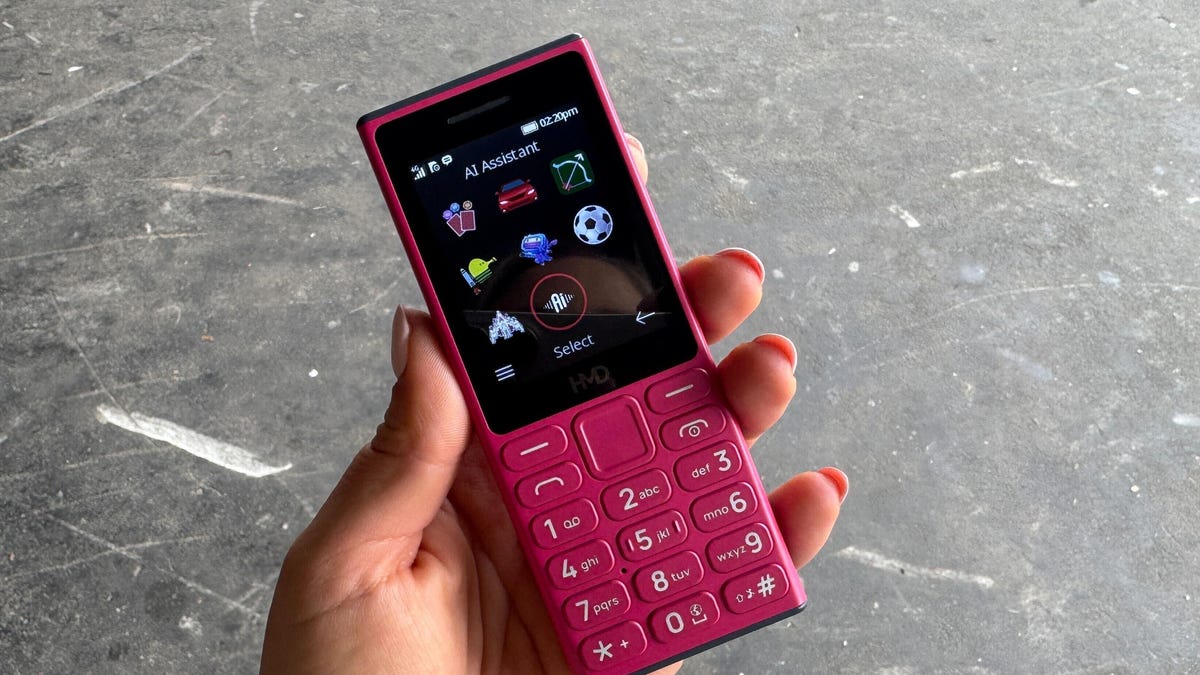
But how smart can a dumb phone really be? Smart enough to run AI, say? Popular feature phone-maker HMD, which for a long time made Nokia-branded dumb phones, says yes — and it showed me how at Mobile World Congress in Barcelona this week.
HMD had a demo at the show with AI running on one of its 4G feature phones. To activate the phone’s AI assistant, all you needed to do was select and hold its middle navigation button, and then you could ask it a question, such as, “What will the weather be like in Barcelona tomorrow?” to engage with the chatbot.
Unlike cutting-edge smartphones such as the Samsung Galaxy S26 Ultra and Xiaomi 17 Ultra Leica that pack the latest Qualcomm Snapdragon chips capable of running on-device AI, a feature phone will have to process all AI-based queries in the cloud. That means it won’t be as instantaneous as you might be used to, but a strong 4G connection will result in minimal time delay. In the demo I saw, it took only about 5 seconds to answer my weather query, which I didn’t think was too shabby.
When HMD starts introducing AI on feature phones in the coming months, it will use a range of large language models. In Europe, it will rely on OpenAI’s ChatGPT, in China, it will use DeepSeek, and in India, the company has a partnership with Sarvam AI. (HMD pulled out of the US market last year.)
(Disclosure: Ziff Davis, CNET’s parent company, in 2025 filed a lawsuit against OpenAI, alleging it infringed Ziff Davis copyrights in training and operating its AI systems.)
Many of the people who rely on HMD’s feature phones live in low-income regions where that phone might be the only device in the household, said Ming Li, HMD’s global head of marketing, during our MWC demo. In these regions, the profound negative impacts of the existing digital divide is only likely to be exacerbated by the fact that people are cut off from using AI. For some people, a dumb phone that’s able to run AI might be their first and only access to a technology that many of us take for granted.
The other group of people Li hopes will benefit from AI on feature phones is the elderly population. In another part of the demo, he showed me how AI can also be used to interact directly with the HMD phone. “It’s a bit dark in here,” he said while holding down the navigation button. He flipped the phone over, and the torch had turned on.
“Quite often, going through menus, it’s hard to see what you’re doing,” he said. Voice, on the other hand, is “super natural.”
These are relatively basic uses of AI compared to the more sophisticated agentic or photo-editing features we’re starting to see pop up. It’s certainly not Circle to Search. But that’s not to say this would be impossible in the future — after all, dumb phones are changing and improving just as smartphones are.
“Two years ago, we weren’t thinking about putting front-facing cameras on feature phones,” said Li. When it comes to AI, he added, things have developed so quickly that it’s hard to say right now what might be possible. The focus for HMD, though, is on adding things based on what its customers actually need, not just what might be technically possible.
“What we’re trying to do is to bring the services that we find are going to be most useful,” said Li. “The possibilities are endless … this is just the start.”
Read the full article here


