





Pros
- Great retro design
- As easy-to-use as you can get
- Lots of great color options
Cons
- Not as satisfying as you might expect
- Availability shenanigans
- Image quality isn’t great
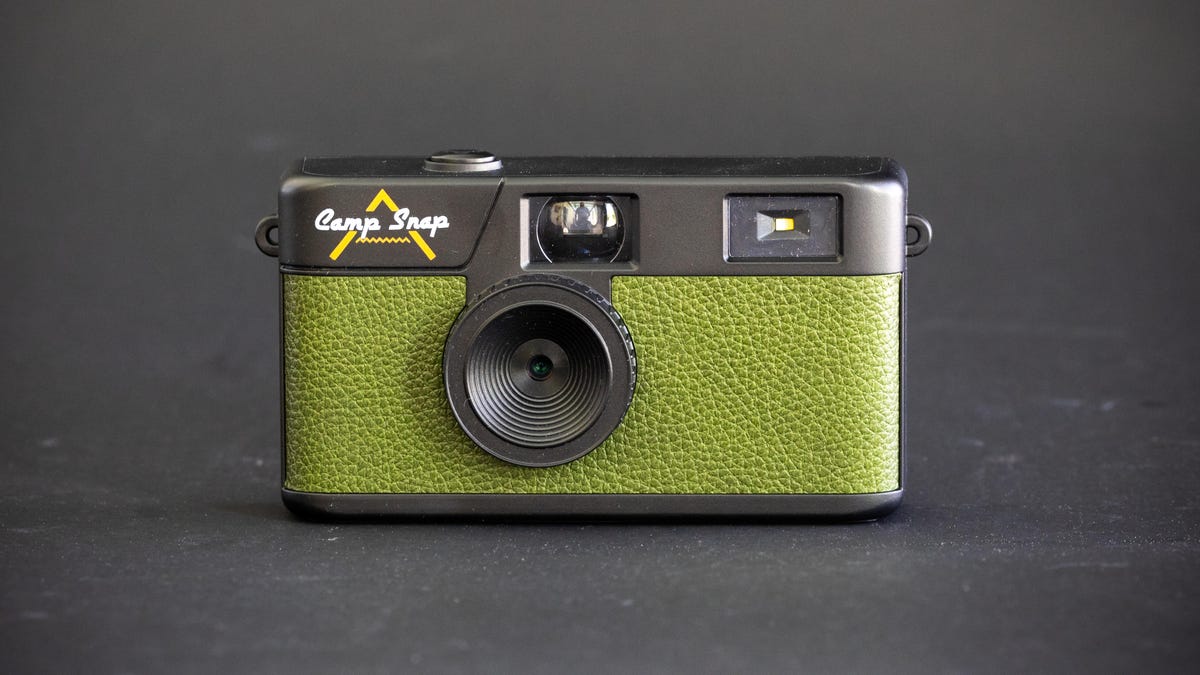
The Camp Snap is a digital pocket camera with the design of a retro-styled film camera. It’s extremely inexpensive and leans into the digicam trend that’s popular among 20-somethings and younger. It doesn’t quite succeed in the same way similar cameras do, like the Flashback.
Image quality is fairly mediocre, even for a budget camera, which, to be fair, might be what some people are looking for with the retro trend. However, spending even a small amount more can get you better images to start with, giving you more options for how the final photos look.
For the price, the Camp Snap isn’t bad. In fact, it’s better than some ultrabudget cameras I’ve tested, but beyond the overall design, the Camp Snap has less to offer, even compared to other cameras with similar vibes and style.
Camp Snap specs
| Photo resolution | 8 megapixels (3,264×2,448) |
|---|---|
| Video resolution | N/A |
| Sensor size | 1/3.2-inch |
| Lens | 32mm (35mm equivalent) f/1.8 |
| Image stabilization | None |
| Screen type | Monochrome LCD with image count only |
| Storage | MicroSD (4GB card included) |
| Weight | 97grams (0.2 pounds) |
| App | None |
The Camp Snap has fairly unimpressive specs, not too surprising for something that costs $70. The version I bought was V105, which overall looks the same as previous versions but has the ability to install custom filters for the photos and a slight redesign of the flash toggle.
The toggle also turns the camera on and off. Previous versions used the shutter button to do that. I can see why they made that change. It’s far less likely to take 50 photos of the inside of your bag with a physical power switch.
Surprisingly, the camera actually has a removable microSD card on the bottom under a door that’s secured with a screw. That’s not exactly the most user-friendly design, which I suppose is why Camp Snap recommends connecting the camera via USB and barely mentions the card.
Next to the card slot, hidden by the same door, are the extent of the Camp Snap’s settings: a mode button and two others for up and down. This is to set the date recorded in the photo’s metadata. That’s it. No exposure settings, modes, switchable filters, nada.
This camera was designed to replicate the feeling of using disposable film cameras. If you want more than that, look elsewhere.
You can install a filter for your photos, though this process also isn’t user-friendly. To switch filters, you need to plug the camera into a computer and download a .flt file from the Camp Snap website, drop it into the camera’s memory and all images taken after that will use that filter’s settings. You can’t change it on the go, and unlike the Flashback, you don’t get unfiltered photos to adjust later.
You can, however, design your own filter if one of the premade options on the website isn’t to your liking. It’s an easy-to-use interface, complete with a preview of your adjustments.
Most people buying the Camp Snap will probably stick with either the preinstalled “Camp Classic” or “Vintage” filter (it’s called both on different parts of its site) or choose one of the other premade ones that are available, but being able to design your own this easily is a great feature.
However, again, switching filters isn’t as simple as pressing a button or scrolling through menus.
Not having Bluetooth or Wi-Fi is likely one of the reasons the Camp Snap is so cheap. It’s also why spending a bit more on the Flashback is probably a wise investment. Not having to connect to a computer to do anything is definitely a bonus.
The other problem is that the base image quality isn’t great, limiting the effectiveness of the filters in general. I’ll get to that in the next section.
Usability and photo quality
Using the Camp Snap isn’t quite as satisfying as the Flashback either. First, it feels even more cheaply made. You wouldn’t think there’d be much of a difference between the Camp Snap’s 97 grams and the Flashback’s 147 grams, but it’s noticeable, and the lighter Camp Snap feels even more disposable.
There’s less tactile and audible enjoyment as well, with a cheap-feeling shutter button, extremely unsatisfying electronic shutter sound and none of the ratcheting click-click-click of the Flashback’s “film” advance dial.
That said, with a single button and no settings to adjust, the Camp Snap is obviously very easy to use. It doesn’t even have a screen, unless you count a small monochromatic LCD that shows the picture count. You can line up a shot with an optical viewfinder. These never worked particularly well, but it’s better than nothing.
Going for the retro aesthetic is one thing, but it invites the question: What’s retro? Does that mean the 2000s digital cameras? Or is it 90s disposable film cameras? Black and white?
Digital cameras have long had settings and “filters” that adjust how the final image looks. Some, like many Fujifilm cameras, have built a cult following around their filters (or, as we in the cult call them, recipes).
The Camp Snap’s preinstalled filter is alternately called Camp Classic or Vintage, which they describe as “that classic summer camp vibe.” But again, summer camp from what period?
The images with the preinstalled filter have an overly warm color temperature that wasn’t typical in-era, but some imagine it was. The images are noisy and oversharpened, looking vaguely like a budget 2000s digital camera or early camera phone. The camera also tends to blow out highlights. They look better than the Kodak Charmera, at least.
I can see what Camp Snap was trying for with the looks of some of the filters, but because the underlying images are mediocre, the filters end up looking like the kind of filters you’d get on a cheap digital camera that you never use after the first day.
Then again, that’s not entirely different than what Camp Snap says it’s going for with this camera. Such marketing just ends up feeling like “if you can’t fix it, feature it,” though. Or to put it another way, you could do what these filters are doing on a camera that produces better images, and the final result would overall be better.
Maybe I’m overthinking it. If people wanted “better” photos, they wouldn’t be looking to mimic old disposable cameras.
More camp, less snap
I’ve mentioned it a bunch in this review because I came away from my time with the Flashback rather enamored with it. It’s a nostalgia-induced dopamine hit for those who used disposable cameras and something delightfully retro for many (most?) of its potential customers that likely never experienced such things the first time around. That’s fine — every generation has that about something.
The bones on the Flashback were good, though. It took decent pictures for a $120 camera, and it was easy to use. I didn’t get that same warm feeling after my time with the Camp Snap. This is a very inexpensive camera that feels and performs like a very inexpensive camera, trying to mimic something it isn’t.
The Camp Snap has the added hassle of needing to connect to a computer to view your images. Not ideal. Even if you have a microSD card reader for your phone, you’d need to also carry a tiny screwdriver to get at the card. Also not ideal.
Then there’s the pictures themselves, which are retro but in a bad way. The Flashback presents images that are an idealized aesthetic of what once was. The Camp Snap is what was, specifically, the worst cameras of the era.
Physically, though, it looks great, and is available in a selection of colors I wish more products had in this era of grays on grays on grays. I don’t believe for a second they sell out of specific colors as often as its website says. That manufactured scarcity seems to be a trend in budget camera viral marketing.
For a little more, the Flashback is the better option. Also, for the same price as that camera is a step-up Camp Snap model, the CS-Pro, which has a 16-megapixel resolution and the ability to choose between four filters on the fly. Plus, it upgrades the flash from the base model’s LED to Xenon.
That latter feature should help get that 90s flashbang look when using it. Camp Snap’s marketing says it has better image quality, but it still doesn’t have Bluetooth or Wi-Fi. It also has a silver-on-black design that looks like SLRs from the 70s. To each their own, but I prefer the color options of the base Camp, snappy as they are.
Read the full article here


