


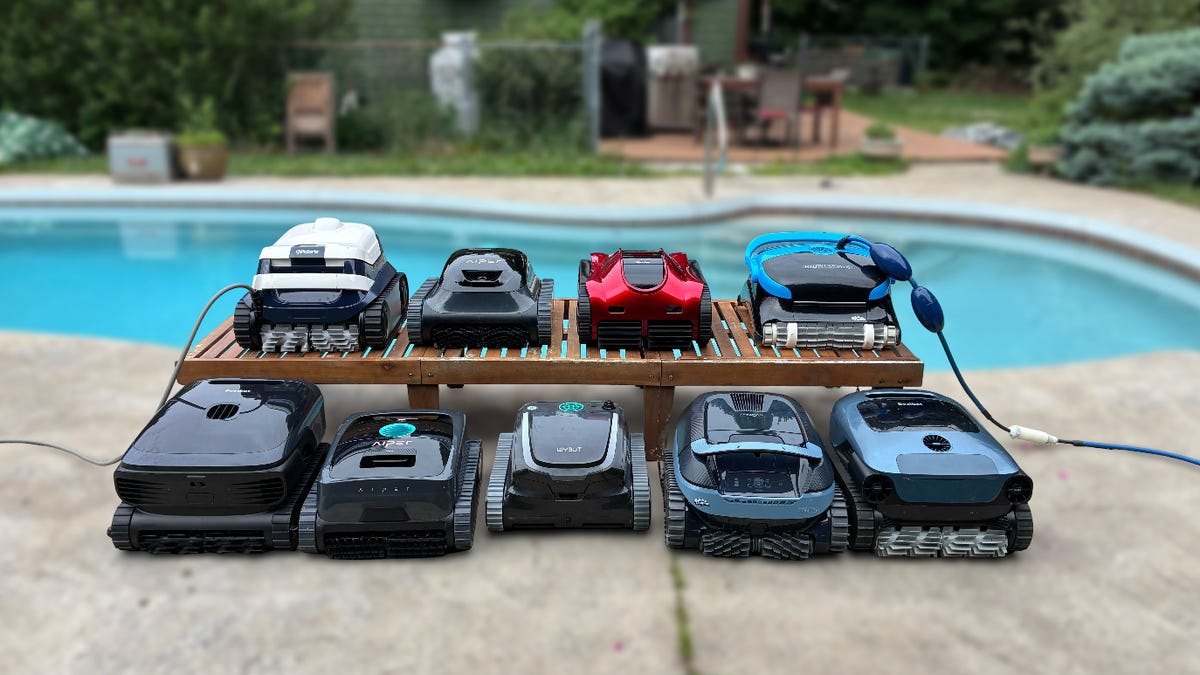
Corded vs. cordless
A corded robot vacuum offers some compelling benefits — chief among them is freedom from battery anxiety. You’ll never need to monitor charge levels or watch performance degrade as the lithium battery ages. For pool owners especially, corded models are often the safest choice: they’re more mechanically reliable, less susceptible to motor issues, and won’t need to be hauled out of the water for recharging after every single use — a chore that every cordless model on the market demands.
In our tests, cordless vacuums performed just as well as corded ones. We’ve been testing some of these cordless models for three seasons and haven’t noticed a decrease in battery life. Cordless robots are ideal if your pool isn’t near an electrical power source. Running a long extension cord through the yard, especially in moisture-prone areas, isn’t advisable in the long term. With its exceptional AI Patrol and lighter weight, the Aiper Scuba V3 cordless is our pick for the best overall pool robot vacuum.
Suction power and battery life
If you choose a cordless model, consider the battery life and suction power, as well as the size of your pool. A larger pool requires a longer cleaning session, so it might be worth splurging on a pricier model with a longer battery life and more power. Power is measured in gallons per hour that the vacuum takes in. Lower-end models start at about 3,000 gph, with the best pool cleaners topping out at about 7,000 or 8,000 gph.
Filter type
All robotic pool cleaners should catch large debris such as gravel and leaves. To sift out finer debris and keep your pool water from getting cloudy, you’ll need a nanofilter. Your pool’s main pump and filter are meant to catch much of this finer stuff, but a powerful robot with a nanofilter will help.
Size and type of pool you have
Pool robots come in a range of sizes — compact models built for smaller above-ground and in-ground pools, and heavy-duty units capable of tackling pools up to 40,000 gallons in a single pass. The right choice comes down to your pool’s size and how much debris it typically collects. Ideally, your robot should be able to handle the entire job in a single cycle without cutting corners. This matters for any pool robot, but it’s especially critical with cordless models, where a mid-job battery death means pulling the unit out, waiting for it to recharge, and starting the process all over again.
There are pool cleaners made specifically for above-ground pools. They’re typically smaller and less powerful because they have less ground to cover. An above-ground pool cleaner should also be lighter, because it’s more difficult to remove from the pool after use.
Sides, stairs and sun shelves
About half the models we tested could clean the sides of the pool, and some even had modes to clean stairs. This is a nice feature to have, but brushing the debris on the steps or side of your pool down to the floor, where it can more easily be cleaned by the robot, typically takes no more than a few minutes. For that reason, we weighted the robot’s ability to clean sides and stairs less heavily than its ability to clean a pool floor.
If you don’t want to do even that small brushing chore before activating your robot, choose a model that has a side-cleaning mode.
Overall cost and value
Reliable pool robots start at about $500 and go up to about $2,000. We found that robots between $700 and $1,200 were perfectly acceptable for cleaning a 14,000-gallon pool. Choose a robot above $1,200, and you’re mostly paying for special features that aren’t necessarily worth it.
For cordless robots, the battery life was superior on more expensive models but the cleaning performance was often similar to that of less expensive vacuums.
Read the full article here