

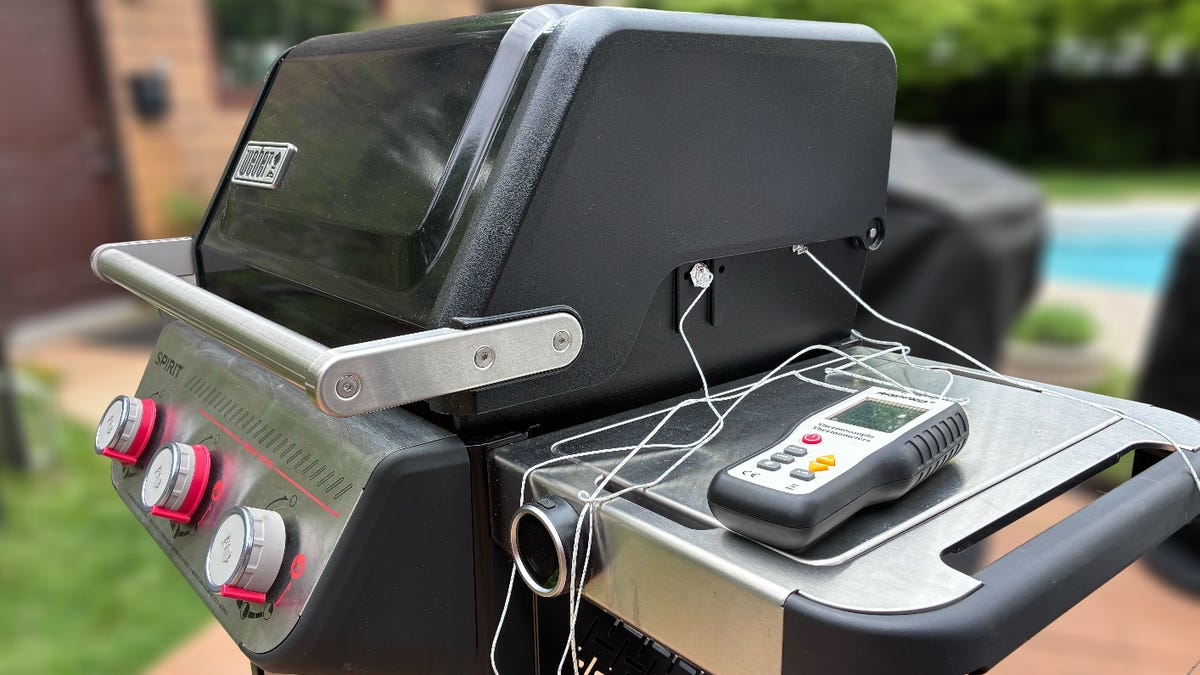
We’ve been testing grills at CNET for decades, and one thing has remained constant: Weber models reliably earn a spot on our lists, year after year. The brand’s sterling reputation is well-deserved — and our testing consistently backs it up. This year, the mid-priced Weber Spirit E-325 takes the top spot among gas grills. Of more than 30 models tested, it checks the most boxes without breaking the bank.
Performance alone doesn’t explain why Weber grills are so easy to recommend. Durability plays an equally important role and models we’ve used across multiple seasons tend to outlast the competition. There are subtler advantages, too: igniters that hold up over time, burners that respond predictably and accessories designed with genuine usability in mind.
And you don’t have to pay a premium for any of it — at least not by grill standards. Other brands offer some of Weber’s signature features, but none we’ve tested manages to bundle them together at a reasonable price. Broil King comes close in terms of features, but most of its lineup starts around $600 and climbs steeply from there.
Here’s what makes Webers unique and why they continue to keep earning the CNET stamp of approval year after year.
1. Cast-aluminum cookbox
One of Weber’s most meaningful engineering advantages is its cast-aluminum cookbox. The material checks a rare combination of boxes: it retains heat well, resists corrosion, and is light enough to keep the grill manageable — a practical choice that also happens to be durable. Budget brands typically cut corners here, relying on porcelain-enameled or thin stainless steel that’s far more vulnerable to rust and deterioration over time.
Weber’s commitment to durability goes beyond the materials themselves. According to Roberto Carvajal, the brand’s vice president of product management, Weber subjects its grills to a rigorous battery of tests — including salt-fog, impact, abrasion, chemical and weathering evaluations — to verify long-term performance rather than just surface-level quality.
The main alternative at the higher end of the market is heavy-duty 304-grade stainless steel, favored by ultra-premium and commercial-grade grill makers for its heat retention and toughness. It’s a capable material, but it comes at a steep price — one most backyard cooks won’t need to pay.
2. High-functioning burners
When moving through a cohort of grills, burner performance is one of the first things we notice — specifically, how quickly burners respond to dial adjustments, how evenly they hold temperature, and how reliably they stay lit throughout a cook.
Some brands chase headline BTU numbers, but Weber takes a different approach. According to Carvajal, the focus is on consistency and control rather than raw output. The result is a burner system engineered for precision — one that gives you repeatable, reliable heat session after session, not just an impressive spec on the box.
- Weber’s proprietary PureBlu burner design, found in the Genesis and Summit gas grills, allows gas and air to mix for a cleaner burn and higher energy transfer to the cooking surface.
- Weber gas grills use longer burner tubes with many ports along their entire length, from front to back, ensuring maximum heat coverage for even, consistent results.
- Precision valve control that allows for a linear, highly controlled heat curve rather than “low/medium/high jumps” when you turn the knobs on the grill.
- Reliable ignition that lights burners quickly; the system includes crossover and burner design for consistent flame stability even in real-world conditions.
Read more: You Know Your Grill Needs Cleaning. Here’s How to Do It Right
3. Heat retention
To evaluate performance, we insert temperature probes into every grill we test to measure how well each one distributes, retains, and recovers heat. Weber grills consistently outperform others in their price class across all three metrics. The difference isn’t just that they get hot — it’s that they maintain a stable, even heat environment, which translates to faster recovery times and more consistent results at the grate. Carvajal points to a few key factors behind that performance.
- Careful engineering for even heat distribution across the grate;
- Balanced heat system with a carefully tuned mix of conductive heat (grates), radiant heat (Flavorizer bars) and convective heat (airflow design).
- Closed-lid convection design popularized by founder George Stephen Sr., who brought closed-lid cooking to grilling and optimized circular airflow for even results.
- Thermal mass and component design: Weber’s signature Flavorizer bars and cast materials help store and re-radiate heat, aiding recovery after lid openings; porcelain-enameled cast iron grates retain heat for better searing and stability.
4. Overall value
For all that engineering, Weber manages to keep prices grounded. Having tested plenty of ultra-premium grills, I can say with confidence that most don’t offer meaningfully more than a $500 Spirit — at least not where it counts.
Some critics have noted that Weber moved much of its manufacturing to China around 2017. Previously, most grills were still made in the US. From our vantage point, that shift hasn’t produced any discernible drop in quality.
When I asked Carvajal how Weber delivers this level of performance without the luxury price tag, he came back to the brand’s discipline around focus.
“Weber prioritizes performance and longevity over specific features,” he said. “This means we focus on what consumers care about most. Our research shows that consumers desire even heat distribution, fast preheat, durability and temperature control. We offer long-term ownership value with durable materials, replacement parts and generous warranties that help extend the lifecycle of our grills — so there is better cost-per-use over time.”
5. Weber’s accessories ecosystem
Like its grills, Weber’s tools and accessories are always thoughtfully designed, soundly manufactured and rarely gimmicky.
“We are always thinking about how to make the entire experience even 5% better,” Carvajal explains. “A lot of the design ideas come from our own grilling experiences, as well as from customer research. The Weber accessory strategy succeeds because it’s functional, integrated, and cooking-focused, based on real consumer pain points. They enhance, not complicate, the grilling experience.
Some of Weber’s biggest product success stories include:
- Weber Crafted outdoor kitchen collection (2022): This cooking system was designed to bring versatility to outdoor cooking, with a frame that allows cooks to seamlessly drop in grillware accessories (griddle insert, pizza stone, wok, searing grate, grilling basket, etc.).
- Griddle inserts (2024): Weber introduced Weber Crafted griddle inserts in 2022 and launched a next-generation rust-resistant griddle insert platform in 2024 alongside the debut of the Slate griddle series. Griddle cooking was becoming more popular, so they gave consumers more choices by offering a free-standing, stand-alone griddle (Slate) or inserts made of the same material—to make just about any Weber grill a griddle.
- Weber Works drop-in and snap-on accessories (2024): Weber introduced the Weber Works interchangeable accessory system in 2024, debuting with the Slate griddle lineup and later expanding compatibility across multiple Weber grill platforms, including Genesis and Spirit gas grills, and the updated Performer charcoal grills. This modular accessory system turns the side shelf and prep area of compatible grills and griddles into a customizable outdoor workstation.
- Weber Connect smart grilling (2020): Weber introduced the Weber Connect Smart Grilling Hub at CES in 2020, bringing app-connected smart grilling technology and guided cooking assistance to virtually any grill. The system provides ways to seamlessly monitor food and/or grill temperatures and cooking times for flavorful results every time.
6. Some of the best warranties
Strong performance and durability are only part of the value proposition — Weber also backs its grills with some of the best warranties in the business. Most major components on its popular models are covered for 10 years, a level of protection that’s rare at Weber’s price points.
Broil King offers comparable coverage on select models, but it’s generally reserved for its higher-end lineup. Napoleon is the one manufacturer that consistently matches Weber on this front, with 10-year warranties across most of its series and lifetime coverage on major parts for its most premium grills.
Weber warranties
| Model | Warranty |
|---|---|
| Weber Spirit II | 10 years on all parts |
| Weber Genesis II | 10 years on all parts |
| Weber Genesis (2022+) | Up to 12 years on cookbox and lid, 10 years on major components |
| Weber Summit (2017–2023) | 10 years on all parts |
| Weber Summit (2024+) | Up to 15 years on cookbox and lid, 10 years on major components |
| Weber Charcoal Kettles | 10 years on bowl and lid |
| Weber Q Gas Grills | 5 years on major components |
| Weber Traveler | 5 years on cookbox and lid |
| Weber Pellet Grills (Searwood, SmokeFire) | 5 years on cookbox, 3 years on electronics |
Read the full article here