

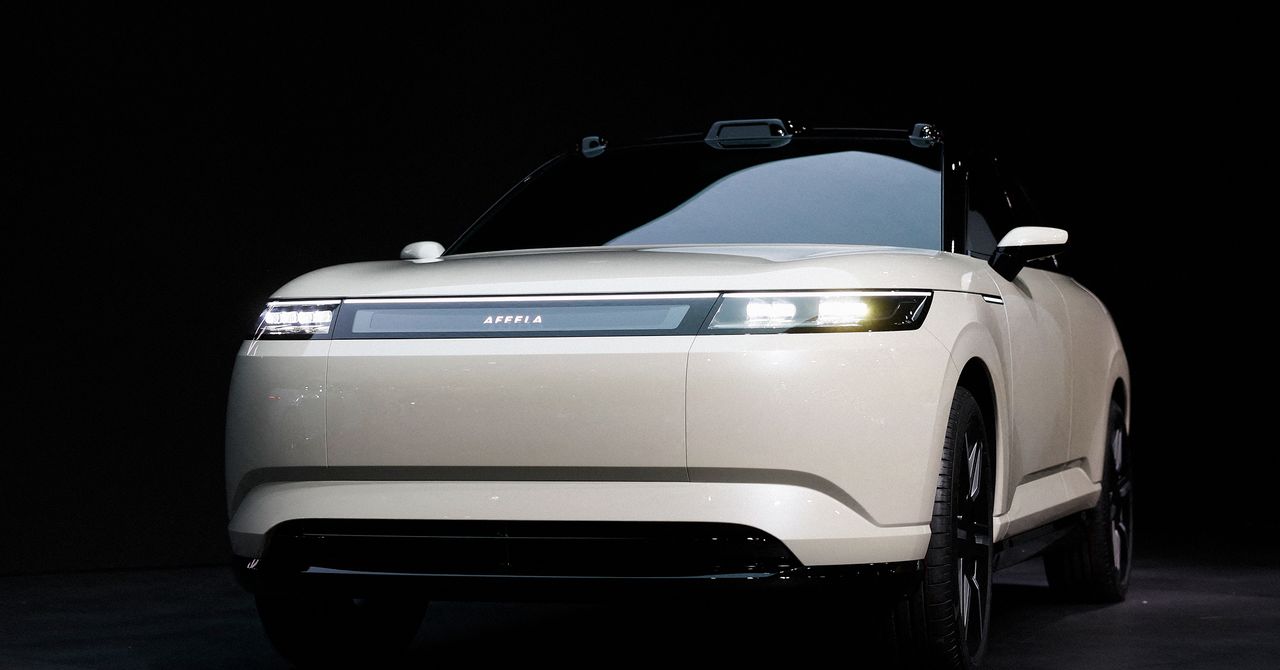
Sony-Honda is no longer Afeelin’ it. This week, the Japanese joint venture that for years had promised to bring a video-game sensibility to a digital-first electric car was abruptly canceled. The two companies snuffed out one vehicle, the Afeela 1, that was first announced three years ago, and also halted work on another model under development.
Sony Honda Mobility (SHM) pinned the blame on Honda’s larger EV pivot. Earlier this month, the automaker canceled its “0 Series” lineup of electric vehicles after posting a $15.7 billion loss amid bigger changes in the global EV market. Because of those shifts, the joint venture wrote in a press release, “SHM will not be able to utilize certain technologies and assets that were originally planned to be provided by Honda.”
Reservation holders will get full refunds, the company said, and “discussions” about the future of the Sony-Honda partnership “will continue.” So the PlayStation-first car of everyone’s dreams may still be far ahead on the horizon, maybe.
The Afeela, though, was a weird fit from the start. Let’s put aside the odd name and its cornucopia of associated pun opportunities. (We will accept late-breaking submissions in the comments.) For one thing, the Afeela 1’s release was interminable.
Sony first announced its precursor, then called the Vision-S, back in 2020. The Afeela itself was the star of the Sony-Honda show at CES four consecutive times. A “near production” refined prototype made an appearance in Las Vegas just this past January. But by then, the whole concept felt a bit stale. A “computer on wheels” was sort of novel in 2020; now, a “software-defined vehicle” is the assumed starting point for every new car.
Photograph: Tristan deBrauwere
The vehicle’s specs, once announced in 2025, didn’t do the brand any favors. The Afeela 1 was an electric sedan in the US market, where electric SUVs are the preferred profile. It had an estimated range of 300 miles, piddling compared to other new luxury EVs like the Lucid Air (420 miles), the Mercedes-Benz EQS (390 miles), and the Rivian R1 (410 miles). On that luxury point: The Afeela 1’s $90,000 price made it particularly uncompetitive-feeling as other automakers kept announcing new models. The Afeela 1 was slated for debut in late 2026, but only for buyers in California.
It’s an open question whether the Afeela 1’s entertainment selling point is something consumers want or need from a car right now. The sedan’s promised autonomous driving capabilities were supposed to be imminent, and so the car was stuffed to keep all nondrivers nice and distracted: screens on the dash and in front of passenger seats; built-in PlayStation Remote Play; visual “themes”; tons of in-car apps. True self-driving functionality, though, has yet to come to personal cars. Do people really want to sit in their stationary vehicles and game? Now it’s a question for the farther-off future.
But Sony-Honda’s greatest challenge may have been America’s stop-start approach to electric vehicles. Consumer uptake of battery-powered cars has stalled since the US federal government cut support for both EV-curious customers and those assembling EVs and their components in American factories. BloombergNEF, which estimated in 2024 that EVs would account for nearly half of new US car sales in 2030, reduced its projection to 27 percent last year—a cut of 14 million car sales.
Honda, already a late-bloomer in the EV space, clearly doesn’t believe that it’s worth spending gobs of money right now to catch up with the industry’s battery-powered leaders. The sad tale of the Afeela, then, is probably a C-plot in the darker story of the US EV market. We’re Afeelin’ blue, too.
Read the full article here