





Microplastics are a growing concern. With more and more plastic materials becoming integrated into our daily lives — often cheaply made — it is believed that humans are ingesting them at a higher rate than in years past. Some studies show the increase to be as much as six times what it was in 1990.
While microplastics may seem like a health buzzword, the studies are accumulating, and the scope of risk to our health is difficult to predict. Using a microwave isn’t unsafe, but chucking any old plastic container or food wrap into it could cause problems.
To find out whether microwaving plastic is a dangerous habit in need of breaking, I spoke with public health experts, toxicologists and other experts on the risks of exposing various kitchen containers and packaging materials to microwave radiation.
Here’s what they said.
Best practices for using containers in the microwave
Before we delve into the specific materials and their numerous variables regarding microwave suitability, consider the following.
Look for microwave-safe labels only as a starting point
“Microwave safe doesn’t just mean a container will not melt or warp, but it also means it will not release or leach harmful chemicals into our food when heated,” says Li Li, an associate professor at the University of Nevada, Reno School of Public Health, whose specialty is environmental health and exposure science.
While some materials are generally safe for microwave use, it’s still a good habit to look for a “microwave safe” indication of some kind. However, bear in mind that this designation doesn’t tell the whole story.
Similar to expiration dates on food, the microwave-safe label isn’t based on a federal certification program. “Manufacturers can use it if their own testing shows it meets the microwave-safe standards in their own minds. It is a helpful guideline, but not a guarantee,” Li says.
Additionally, that label doesn’t necessarily indicate any risks to human health.
Toss all damaged containers
Damaged containers can potentially lead to the leaching of chemicals or toxins in your food. They may also malfunction due to vibrations in the electromagnetic waves on which the microwave’s functionality relies.
Regardless of whether a container is labeled microwave-safe and its material, discard it if it’s not in good condition.
“If it’s scratched, pitted, cracked or otherwise damaged, then you can no longer assume that it is safe to use in a microwave,” says Kelly Johnson-Arbor, toxicologist for MedStar Health.
Don’t go from the freezer to the microwave
While moving from the refrigerator to the microwave is generally OK for most materials, you should avoid sudden temperature changes, says Li. Allowing a moment for a glass or ceramic container on the countertop can help reduce the shock once it’s in the microwave.
“Never move from the freezer straight to the microwave,” Li says. “Such major temperature changes can cause cracking,” which immediately compromises the food inside the container.
Be cautious with decorative elements
Even if you’re working with a microwave-safe material, be wary of containers or bowls that have excessive decoration.
Patterned conventional ceramics are typically fine, but “be cautious with decorative coatings or metallic trims, as they can spark or break down when overheated,” Li says.
The best microwave-safe options: glass and ceramic
Glass and ceramic containers are generally safe to use in a microwave oven, according to Johnson-Arbor.
“Both act as insulators, meaning that they are resistant to heat transfer,” she says, so the vessels themselves don’t get hot, while the electromagnetic waves work to heat the food contained within them.
In addition to tolerating high heat, “glass and ceramic containers usually do not contain organic chemical additives,” says Li.
Glass
While many glass storage containers have lids with a rubber or plastic element, these are generally fine as long as those elements don’t come into contact with the food. (But be sure to clean thoroughly so that rubber seals don’t develop mold.)
If you’re looking for the best possible option, casserole dishes with glass tops and no seals are ideal vessels for microwave cooking and reheating.
For safely nuking food, glass is your friend.
Ceramic
Commercial ceramics are generally microwave-safe and should be labeled as such, but be sure to double-check those that are more decorative or artisan-made.
“The glazes found on some ceramic products can contain heavy metals, including lead,” says Johnson-Arbor. “When these glazes are heated, the lead can leach out and contaminate food or liquids present in the ceramic container.”
Many ceramic food storage options also feature plastic or rubber lids, but here’s a ceramic/glass combo we love, complete with silicone lids that can be used in the fridge or for transport and swapped for glass in the microwave.
Ceramic food containers are typically microwave-safe.
Is it ever safe to put plastic in the microwave?
Naturally, it’s complicated.
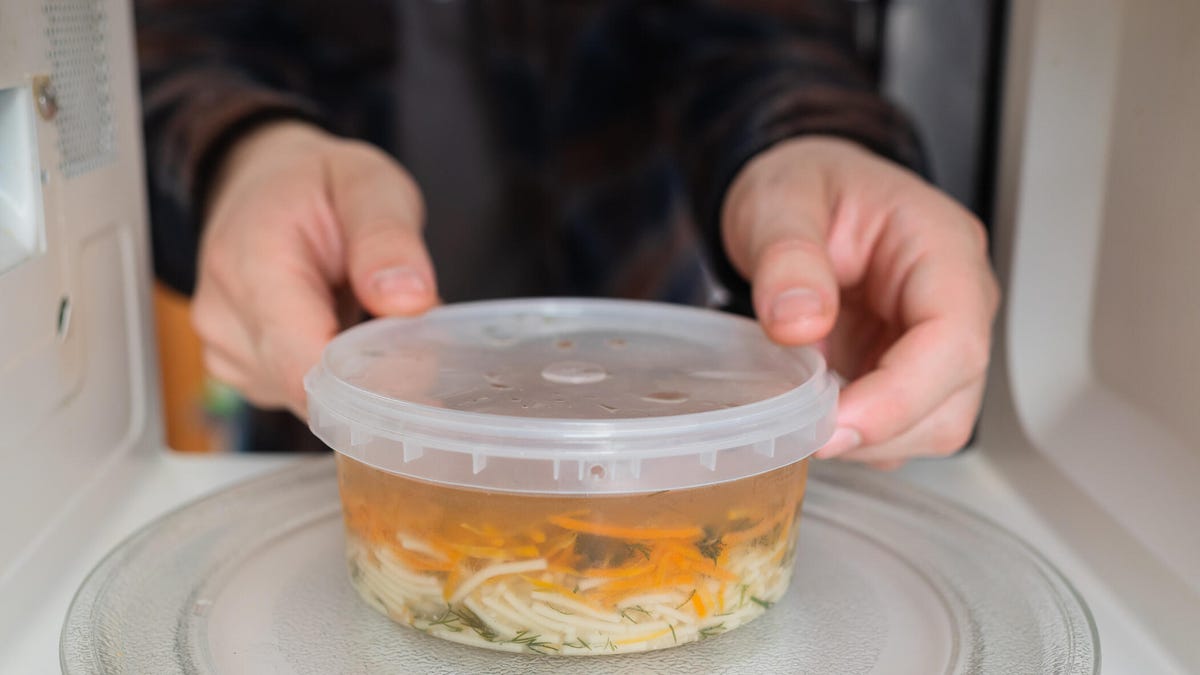
“Many plastic food storage containers contain ‘microwave safe’ labels or graphics to indicate that these products can withstand the high temperatures produced by microwave ovens,” says Johnson-Arbor. “But in recent years, scientists have discovered that tiny plastic particles, called microplastics, can leach out from food storage containers when heated.”
Since microplastics entered the conversation, many brands have claimed to be “BPA-free” to ease consumers’ minds.
“Polycarbonate food containers are made from a group of chemicals called bisphenols,” says Li. Bisphenol A is commonly referred to as BPA.
“BPA is known to interfere with hormones and has been linked to some endocrine-disrupting effects,” he says. “Even though polycarbonate can physically handle high temperatures, meeting the ‘microwave safe’ requirement for manufacturers, microwave heating speeds up the release of BPA, especially when the container is scratched, reused many times, or holds fatty or acidic foods.”
Read more: Microplastics Could Be Leaching Into Your Food if You’re Making This Simple Mistake
BPA-free containers are marginally better, according to the experts.
“Polypropylene, often called ‘PP plastic’ or labeled ‘#5 plastic,’ is generally a better option,” says Li. “It has good heat resistance and tends to contain fewer additives compared to other plastics. That said, fewer doesn’t mean none, and it still uses some chemicals like antioxidants or stabilizers during manufacturing.”
The safest possible stance? “Since the overall impact of microplastics on our health is still unknown, some people choose to entirely avoid using plastic food containers in microwave ovens,” says Johnson-Arbor, which is the safest possible stance, regardless of whether something is BPA-free.
Plastic wrap, which is generally approved for use in the microwave due to its heat tolerance, should never come into direct contact with food.
If you don’t want to give up the convenience and budget-friendly nature of BPA-free plastic storage containers (and you’re committed to taking responsible care of them and tossing them if they get scratched), here’s a set we have previously recommended.
Paper comes with a catch
You may have several types of paper on hand in your kitchen, including paper towels, wax paper, parchment paper, butcher paper and even a variety of paper plates for festive occasions. Should you put any of it in the microwave?
“For most everyday uses, plain white paper towels or paper plates are generally safe to use in the microwave,” says Li. A paper towel is a handy cover for reheating food on ceramic plates, helping to avoid splatter without resorting to plastic wrap.
But there’s also a catch.
“You should avoid microwaving colored or decorated paper plates, brown grocery or take-out bags, and any paper plates that have a water- or oil-resistant coating,” he says. “This is because we cannot exclude the possibility that they can smoke, melt or release unwanted chemicals when heated.”
The same holds true for wax paper, which can melt or degrade at high temperatures or when in contact with certain types of food. If a paper product has a shiny or smooth side, best to avoid it as a general rule.
Metal is never microwave safe
When it comes to microwave cooking, metals are unsafe not because of health or heat tolerance reasons. Stainless steel and cast iron are excellent materials for stovetop cooking, but they can’t be placed in the microwave due to the way microwaves operate. Putting them in the microwave is both counterproductive and dangerous.
“Metal reflects the electromagnetic waves,” explains Johnson-Arbor, which prevents them from actually heating your food. “This can cause heat to transfer to other surfaces in the microwave, potentially causing overheating or a fire.”
Read the full article here


