

Pros
- Sleeker design with slightly more comfortable, secure fit
- Excellent sound with upgraded drivers
- Top-tier voice-calling and transparency mode
- Built-in voice and touch controls work well
- Robust feature set
- Slightly improved adaptive noise canceling
Cons
- Noise canceling and battery life have room to improve
- Eartips have a proprietary design so you can’t swap in third-party tips unless they’re designed for the buds
- Some features are exclusive to Samsung Galaxy devices or Android-only
When Samsung released the Galaxy Buds 3 Pro in 2024, it got some grief for moving to an AirPods-like stem design. The new look was hard to stomach for some Galaxy Buds fans, who felt Samsung had caved to Apple’s design ethos. If you were hoping Samsung would return to its stemless ways with future Galaxy buds, sorry, that’s not in the cards. Its new flagship Galaxy Buds 4 Pro have a stick design. But if it’s any consolation, they look snazzier, fit a bit better and they have upgraded sound and slightly improved performance all-around. That’s why I awarded them a CNET Editors’ Choice.
Available for preorder now and shipping March 11, the Galaxy Buds 4 Pro come in black, white and a new pink gold color and cost the same as the Buds 3 Pro. They list for $250 while the new Galaxy Buds 4, which have an open design, cost $180. I haven’t tried the step-down Buds 4 yet, and while they look similar to the Pro model, they don’t have the same silicone eartips and likely won’t sound as good or have nearly as good noise canceling, based on my testing of the Buds 3. However, Samsung says their performance has been improved.
Read more: Best Wireless Earbuds of 2026
Now more blade-like
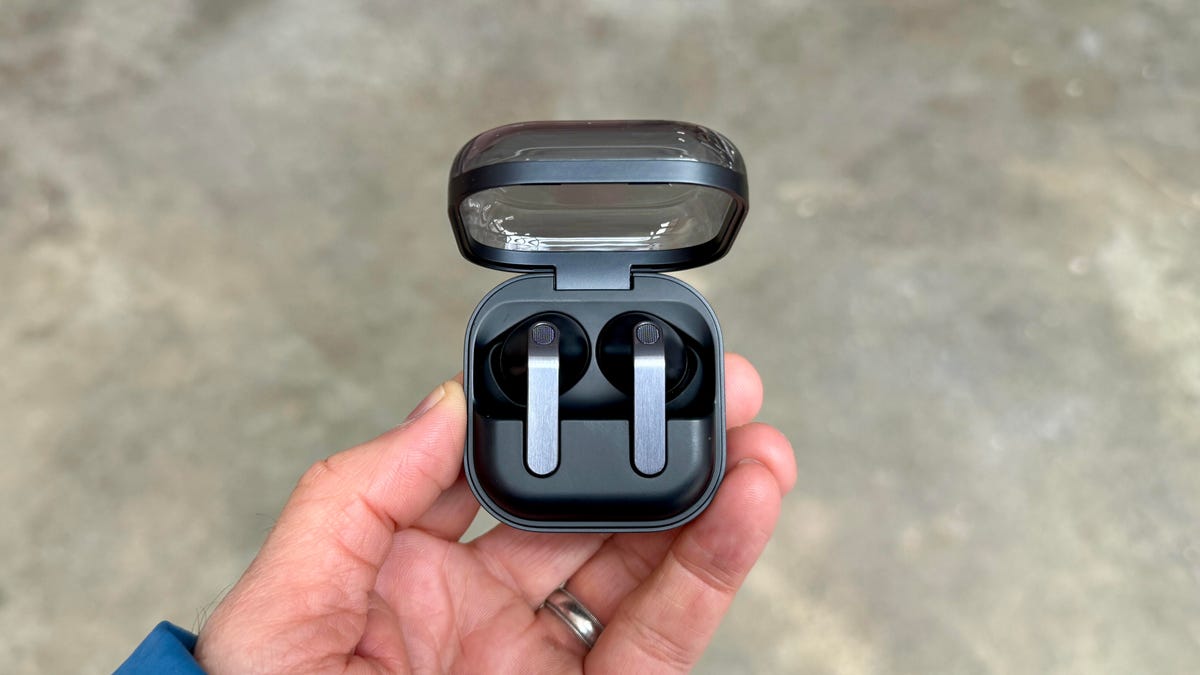
Samsung is once again referring to its stems as blades. Thanks to them being clad in metal, they now look more blade-like, though they also might remind some people of a pen clip. Either way, their design has been leveled up. Unlike the Buds 3 Pro, there’s no lighting element, which I don’t think too many people will miss, though I thought it was kind of cool.
The eartips are the same. Alas, like the Buds 3 Pro and AirPods Pro 3, they unfortunately have a proprietary design so you can’t swap in third-party tips unless they’re designed for the buds. But Samsung says it’s updated the buds’ shape with computational design to improve their fit. I did notice that they fit my ears slightly more comfortably and securely than the Buds 3 Pro, which fit my ears well. I also thought the buds’ new look, which is clean and sleekly metallic, gives them a more premium vibe than their plasticky predecessor.
Like the Buds 3 Pro, they have an IP57 rating, which means they’re dust-resistant and can be submerged in 3 feet of water for 30 minutes, though they’re not considered totally waterproof.
The Buds 4 Pro’s charging case is no longer rectangular but square-shaped and more akin to the earlier Galaxy Buds cases, though it isn’t quite as small. I found it slightly harder to open the Galaxy Buds 3 Pro’s case, mainly because I sometimes blindly tried to open it from the wrong side.
The case does support wireless charging, and both the case and buds have essentially the same battery life as the Buds 3 Pro — up to 6 hours with noise canceling on at moderate volume levels and an extra 20 hours of charging in the case. That falls short of the AirPods Pro 3’s 8 hours of battery life on a single charge, which is a bit disappointing, especially considering that once upon a time, the Galaxy Buds Plus offered 11 hours of battery life.
Like the Buds 3 Pro, the 4 Pro has pinch controls, with swipe controls for volume, and they work well. One of the more underrated features of the Buds 3 Pro was their built-in voice controls, and the Buds 4 Pro have them, too. You have to activate them in the Samsung Wearable app, but once you do, they work with whatever device you’re using them with, including iPhones. The commands include “Play music,” “Stop music,” “Next song,” “Previous song,” “Volume up,” “Volume down,” “Answer call” or “Reject call.” They don’t require a wake word.
Robust feature set
The Buds 4 Pro have a robust feature set, with the same features as the Buds 3 Pro. But instead of Bluetooth 5.4, they’re equipped with Bluetooth 6.1. In many ways, they mimic the AirPods Pro 3’s features, with a Voice Detect feature that’s similar to Apple’s Conversation Awareness and Sony’s Speak to Chat features. Voice Detect turns on an ambient mode and lowers the volume of your music when you start to have a conversation with someone. The buds can also detect sirens and make sure you hear them, switching out of noise-canceling mode and lowering the volume of your music.
The Buds 4 Pro have Samsung’s improved Adaptive Noise Canceling 2.0 that adjusts the noise canceling level based on environmental noise, along with an adaptive EQ mode and manual customizable equalizer settings in the app.
Samsung’s 360 audio with head-tracking is on board, though it’s exclusive to Android users as Apple’s spatial audio is exclusive to its users. While there’s no multipoint Bluetooth, the buds will automatically pair and switch between your Galaxy devices (you have to manually switch between non-Galaxy devices). Like the Buds 3 Pro, they support LE audio along with the Auracast feature, which allows you to hear Bluetooth broadcasts in public places like gyms. And the buds have live translation on compatible Galaxy devices via the Interpreter app.
Better clarity and bass extension
The changes to the sound and noise canceling aren’t huge, but they are noticeable, particularly when it comes to the buds’ sound quality. Like the Buds 3 Pro, the Buds 4 Pro are equipped with dual drivers that feature a separate 11-millimeter woofer and 5.5mm planar tweeter, but Samsung says both drivers have been upgraded, and highlighted the woofer as being “super wide” with improved bass performance even though it’s the same size as the Buds 3 Pro’s woofer (11mm).
I like the sound of the Buds 3 Pro and may even like the sound of the single-driver Galaxy Buds 3 FE even a tad more. With the Buds 4 Pro, you get a bit more clarity and bass extension, plus slightly bigger, more open sound overall with good separation between instruments. I also thought that out of the box, the mids were a bit more forward and the sound is slightly more balanced overall. The treble has some nice sparkle to it that you can really hear in tracks with high hats and tambourines (I didn’t notice any siblance, which can lead to listening fatigue), and the bass has plenty of kick and energy without being boomy.
Top noise-canceling earbuds, such as the AirPods Pro 3, Bose Quiet Comfort Ultra Earbuds (2nd Gen) and Sony WF-1000XM6, all sound good for Bluetooth earbuds. The Galaxy Buds 4 Pro can claim a spot among the best-sounding true-wireless buds. There are subtle differences in tonal quality, and I slightly prefer the sound of Sony’s WF-1000XM6 at the moment. The Sonys seem a tad more accurate and natural. But the Buds 4 Pro sound clean and dynamic with little to no distortion, and some folks could well prefer their sound.
Samsung talks about the buds supporting its Seamless codec, which compresses and encodes up to 24-bit/96kHz audio and is supposed to enhance sound detail. But I used the buds with a Galaxy Flip 6 and an iPhone 16 Pro streaming Spotify Lossless, and I thought listening with the iPhone 16 Pro, which uses the AAC codec, sometimes sounded a touch better.
Some of my test tracks include Spoon’s You Got Yr. Cherry Bomb, The Strokes’ The Adults Are Talking, Athletes of God’s Don’t Wanna Be Normal, The Doors’ Touch Me – Take 3, The Temper Trap’s Giving Up Air and Lucky Dimes, The XX’s On Hold, Taylor Swift’s Vigilante Shit, Prince’s Condition of the Heart, Jvke’s Golden Hour, Bjork’s Hollow, Red Hearse’s Red Hearse and The Police’s Spirits in the Material World.
Strong noise canceling, but not quite top tier
Samsung says it’s made some improvements to its noise cancellation, as the buds are more adept at muffling noise by 3 decibels. I felt the buds offered strong noise-canceling performance overall, with improved adaptive noise canceling, but they seemed a step behind the noise canceling from Apple, Bose and Sony.
The transparency mode — or ambient mode, as Samsung calls it — seemed natural to my ears with no audible hiss. It’s among the best out there, right there with Apple’s.
Impressive noise reduction during calls
Once again, I was mostly impressed with the voice-calling performance, particularly the noise reduction during calls, and I appreciate that there’s a sidetone feature that allows you to hear your voice in the buds. The buds have a voice pick-up unit and upgraded microphones, according to Samsung.
I made some calls in harsh conditions in New York with wind swirling and rain falling, and callers said they couldn’t really hear any background sound, though they said my voice warbled a little and sounded digitized, especially if I didn’t speak up a bit. But they were quite impressed that they couldn’t hear any traffic or wind noise.
Samsung Galaxy Buds 4 Pro final thoughts
Not only do the buds look more distinguished and fit slightly better, but they do indeed offer some performance upgrades, particularly when it comes to sound quality. Both their transparency mode and voice-calling performance are top-tier. And while their noise cancellation is a step behind Apple’s, Sony’s and Bose’s, it’s respectable.
The performance upgrades aren’t huge, and if you own the Buds 3 Pro, it’s probably not worth upgrading to the Buds 4 Pro unless you’re really smitten with their new look. But they’re easy to recommend to both Samsung Galaxy and Android users, especially if you can get a deal on them when you buy a new Galaxy phone or trade in some old buds.
Read the full article here