

Pros
- Fantastic size
- Fast and easy to use
- Takes great photos
Cons
- Only slightly different to the GR III
- Video is only 1080p
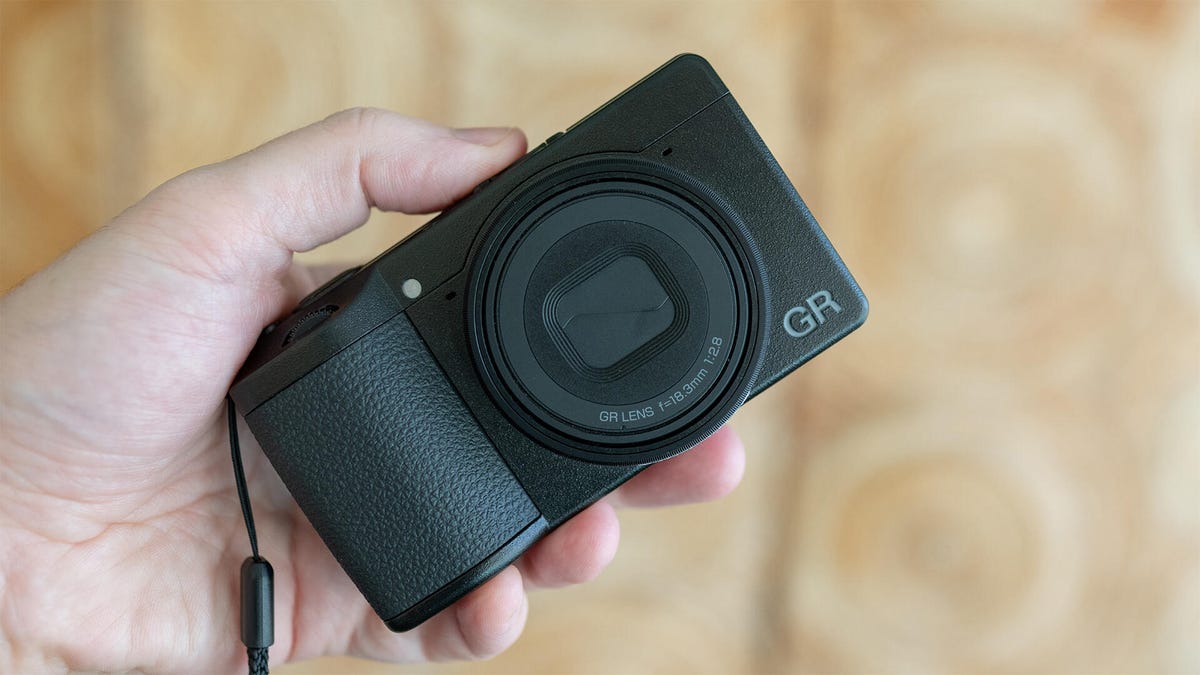
The Ricoh GR IV is an extremely compact, fixed-lens, point-and-shoot camera that’s perfect for travel or street photography. It has a big — compared with its physical size — image sensor (APS-C), which, in many situations, lets it take better-quality images than what you can get using your phone.
The GR IV is the 2025 update to the GR III, which was one of our picks for best point-and-shoot camera. The changes are minimal, with an updated but similar resolution image sensor and the same overall design, though it’s technically slightly smaller. Better image stabilization, updated processing and some other improvements all make for a better, more capable camera, just not a revolutionary one.
Overall, the GR IV excels in the same ways its predecessor did. It’s an extremely small camera with a big image sensor. It can easily fit in a pocket and be ready to take a photo by the time you’ve got it in front of you. It takes gorgeous photos that don’t require editing if you don’t want to spend the time. It’s not as versatile as Fujifilm’s X100VI or an interchangeable lens camera, but both options are bigger and typically cost more. For travel or street photography, the GR IV is a gem, which is why it’s an Editors’ Choice award winner.
Ricoh GR IV specs
| Photo resolution | 25.7 megapixels (6,192×4,128) |
|---|---|
| Video resolution | 1080p 60 fps |
| Sensor size | APC-C (23.3×15.5mm) |
| Lens | 28mm (35mm equivalent) f/2.8-f16 |
| Image stabilization | 5-axis in-body image stabilization (IBIS) |
| Screen type | 3-inch LCD touchscreen, fixed |
| Storage | 53GB (internal), microSD |
| Weight | 262 grams (0.6 pounds) |
| App | iOS/Android |
Ricoh definitely took an “ain’t broke, don’t fix” approach to the GR IV. While there are a variety of changes and improvements compared to its predecessor, they’re still very similar cameras. While each individual change is fairly minor, they add up to a decent evolution.
If you’re new to the GR line, the broad strokes are that it’s a highly portable and easy way to get better image quality than what you can get from the highly processed images taken by the small image sensors in all phones. The APC-C-sized sensor in the GR IV is what’s found in many entry-level mirrorless and DSLR cameras. At 25.7 megapixels (6,192×4,128), it’s lower resolution than some of its contemporaries, but that’s plenty for most uses, including if you want prints. Despite the similar resolution to its predecessor, this is a new, back-illuminated image sensor.
The lens, however, is the same 28mm (35mm equivalent) as the III (the IIIx had a 40mm equivalent lens). It adds an additional element for a total of seven in five groups that Ricoh says helps improve sharpness across the entire image. While f/2.8 is a full stop slower than some contemporaries, when paired with in-body image stabilization and a large image sensor, all but the lowest-light situations will be captured with minimal or no blur.
Video is definitely an afterthought, though. A “value add,” so to speak, the camera records at 1080p60, which is fine and enough for social media, but it’s clear Ricoh doesn’t intend for this camera to be used much for video.
Connecting the GR IV to my Pixel 9 Pro proved to be quite a hassle, with endless errors and an overall inability to connect. Sometimes it feels like 90% of my time reviewing cameras is trying to get them to connect to a phone via Bluetooth. I did manage to get it connected eventually and found the app to be fairly basic. You can use it to remotely control the camera and download images, but there’s no live view or any editing. You can’t even delete images from the camera via the app. I was able to connect easily to an iPad, so this is likely an Android issue (which is not uncommon among camera apps).
Usability and photo quality
To be honest, the only specs you need to know about this camera are size and speed. It starts up and is ready to take a photo in less than a second (0.6 seconds according to Ricoh), and at 109.4-by-61.1-by-32.7 millimeters, it can easily fit in a normal-size pocket. It’s narrower than many flagship phones, roughly twice as thick and 40% shorter. It’s adorably tiny. Technically, it’s smaller than the GR III, but only by a millimeter here and there. So it’s ready to go and captures beautiful images as fast as your phone, and can hide in your pocket when you’re not using it. It’s a camera that’s easy to just have with you, ready to capture a moment.
Speed and size are the GR IV’s biggest strengths, but those would be meaningless if the image quality were poor. But that’s not the case. The images themselves, with the stock settings, are detailed with accurate colors. There’s a naturalness to the images that photos from a phone can’t quite match.
The sensor has excellent dynamic range, capturing shadows and bright highlights with minimal noise or clipping. A built-in neutral density filter lets you slow the shutter speed and/or open the aperture in bright scenes for greater creative flexibility. The 28mm lens is roughly as wide as the main camera on many phones.
A dial on top lets you choose standard camera modes like aperture priority, shutter priority, full manual and program. A Snap Distance Priority AE mode lets you set a focus distance and depth of field for more rapid shooting in a similar setting. Selector dials near where your fingers rest let you quickly adjust aperture or shutter speed on the fly. A rocker button where your thumb rests lets you quickly increase or decrease exposure. It’s all remarkably natural and easy to use.
After reviewing the GR III and several other cameras for our point-and-shoot camera guide, I fell in love with and actually purchased one of this camera’s competitors, the Fujifilm X100VI. One of the main features of that camera is its extensive and easy-to-use image “recipes” where you can radically change how an image looks in the camera, minimizing time spent editing. To a lesser extent you can do the same with the smaller (and cheaper), GR IV.
Three user modes, accessible via the mode dial on top, can be programmed with adjustments to color temperature, saturation, hue, contrast and more to let you dial in a specific “look” to your images so you don’t have to do it in post. It’s not quite as extensive as what you can do with the X100VI, but unless that’s your specific reason to get a camera, what’s possible on the GR IV will work for most people.
Pocketable perfection?
After reviewing the GR III, already a bit long in the tooth, I was very interested in what Ricoh would do with a successor. The internet was rife with rumors, hopes and dreams about a potential future GR IV. Higher resolution sensor? 4K video? Built-in flash? Even smaller body? What we got was… none of that. No chances were taken with the GR IV, other than it just existing in a category that once had dozens of options and now has less than a handful. Or in the case of the IV, literally one handful, because that’s how small it is. Ricoh did improve the GR, but it was one step forward when many fans wanted a leap. So it goes.
The real question is whether it’s worth seeking out a used GR III. The answer is, oddly enough, “sort of?” The GR IIIs have held their value quite well, and given how similar they are to the GR IV, I don’t imagine those prices will change much. A recent perusal of the used camera shops KEH and MPB found cameras that cost only a few hundred dollars less than a new GR IV. Close enough that if it were me, I’d probably just get the new camera. There are enough improvements that it’s worth the premium. If you can find a GR III in great shape for cheap (unlikely), then sure, go for it, but for most people, the GR IV is the better option. This is from someone who loves spending way too much on used camera gear.
I’ve recently become a convert to the appeal of the small, high-quality, fixed-lens camera. I travel a lot, and on my last trip, I almost never used my big Canon; instead, I used my X100VI for nearly everything. There’s a huge size difference between those two, and yet the GR IV is even smaller. It can fit anywhere and still take fantastic, high-quality images.
Does it have the fancy sensor and recipes of the X100VI? No. Does it have the high-resolution, full-frame sensor of the Sony RX1R III? No. But it’s cheaper and smaller than both, basically the same size as the Panasonic ZS99, but capable of taking much better photos than that compact camera. I can see why the GR series has such a cult following. It’s perfect for having in your pocket, ready to take a great photo whenever you want. Please, someone, convince me I don’t need another camera.
Read the full article here