

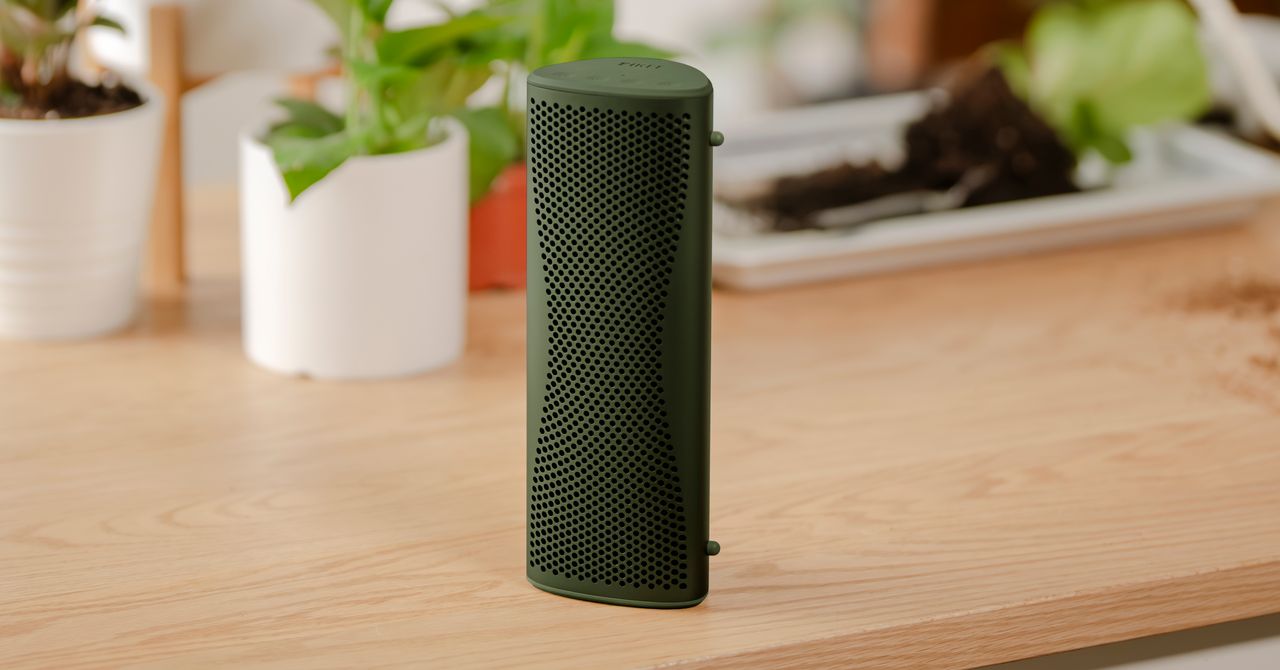
KEF recommend giving the Muo at least a 10-hour run-in period, much in the same way you would break in the surrounds on a serious pair of Hi-Fi speakers. True to their word, and after a night of running in, the Muo started to sound less like a Bluetooth speaker, and more like a compact hi-fi component.
Across some bombastic classical, and my usual mix of MF Doom, Waxahatchee, and Neil Young using Quobuz and Spotify from iOS devices and a Windows laptop, the Muo remains impressively composed. Definition between bass, mids, and highs gives your music the chance to breathe, while the balance avoids the hyped low-end tuning that tends to dominate Bluetooth speakers.
Turned up loud, I heard no obvious distortion, and it remained a more comfortable listen at volume than cheaper rivals. That doesn’t mean I think small speakers should ever be cranked up to 11, but if you do insist on partying with it, you won’t be left wincing.
Stereo pairing is also genuinely effective. Two Muo speakers widen the stage, sharpen left-right placement, and make the whole thing feel closer to a small hi-fi setup than I expected. It also highlighted just how important the speaker’s run-in period is to the audio quality. I only tried pairing my review samples after about a week of solo speaker listening, and the difference difference between it and the boxfresh speaker was oddly stark.
Stereo pairing is a great addition here, but if you are about to spend $500-plus on two portables mainly for home listening, you should ask yourself whether a dedicated two-speaker system would serve you better.
Fierce Competition
Photograph: Chris Haslam
You do not need to spend $250 to get excellent portable sound today. The JBL Flip 7 is $100 cheaper and remains WIRED’s favourite overall choice, and the Bose SoundLink collection has some bargains these days. Many alternative designs come with big batteries, booming bass, party-starting volume and extensive companion apps. But they can lack the same finesse.
Read the full article here