






Pros
- Excellent movie sound and decent music replay
- Dialogue enhancement is highly configurable
- Feature-rich
Cons
- $200 more than the original
- No dedicated app
- Subwoofer adds placement and configuration challenges
When I was a kid, I watched the post-Star Wars Disney movie The Black Hole, which featured a scary robot named Maximilian. The memory of this movie came to me as I was looking over the Scrabble jumble of letters that is the Polk MagniFi Mini AX. However, instead of a large, red killing machine from the movie, this Polk is a tiny black soundbar. It’s a Mini-milian. (I know, I know, I promise to do better.)
The Polk MagniFi Mini AX’s attractions extend beyond a compact footprint, with excellent sound quality, compatibility with Dolby Atmos and a wide number of music streaming protocols. If you want a compact system that can handle the latest movies in addition to streaming Spotify, this is a great option.
The biggest sticking point with the Mini AX is that it’s $200 more than the original Mini it replaces, and at its new $500 price, there are plenty of great soundbars. These include the Sonos Beam Gen 2, which is another teeny-tiny soundbar that punches well above its size.
As elegant as the Beam is, though, this Polk offers more, and it should be at the top of your list if you crave performance without the penalties on tabletop space. If you want to save some money, as of this writing, Polk has refurbished units for $325.
Also read: Best Soundbars of 2026
What’s in the box(es)?
Like the original MagniFi Mini, the updated AX is a micro soundbar-and-subwoofer combo designed to connect to your TV over HDMI. A couple of updates have been made in the 10 years since the first one, including Dolby Atmos and DTS: X decoding, and the removal of an Ethernet port.
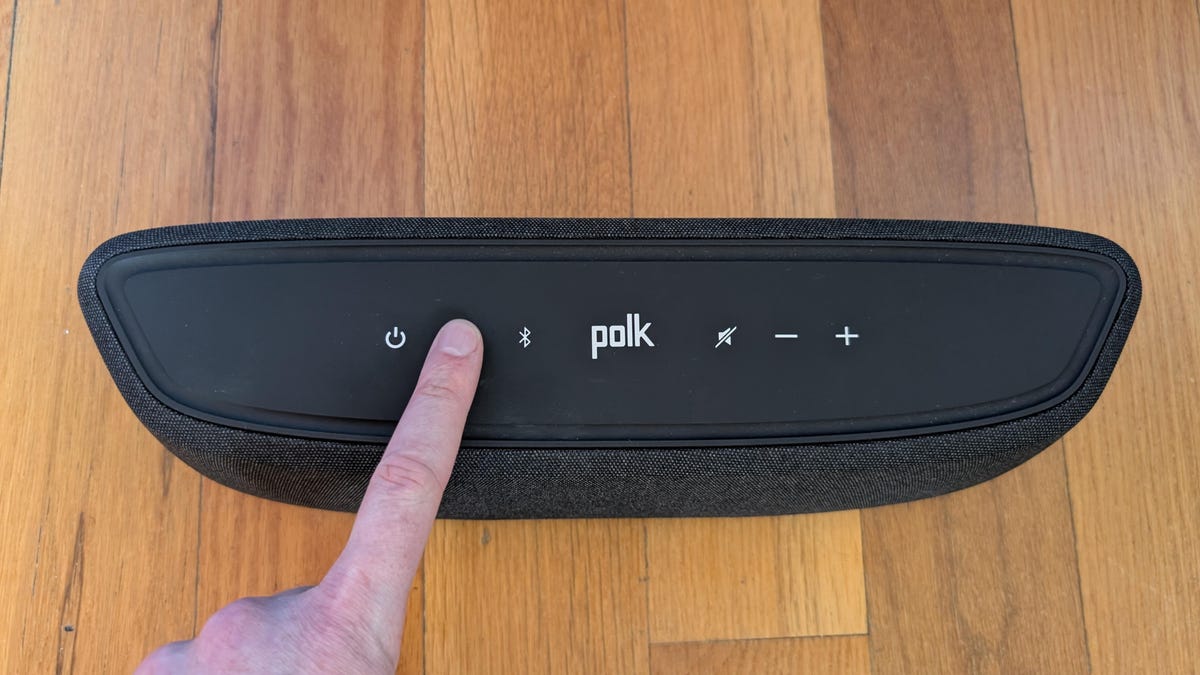
The AX also exchanges the ugly two-tone finish for a more utilitarian black, but it keeps the same dimensions. The main unit is plastic and covered with a gray fabric grille. The speaker is a little taller than most other soundbars at 3.1 inches high, but given that it’s also only 14.4 inches wide, it has much less likelihood of it blocking your TV’s IR port — just move it over a bit.
The soundbar features five drivers in total: three 2-inch drivers for left, right and center, plus two 0.75-inch tweeters for side-firing effects. However, it doesn’t add up-firing speakers.
While the main bar might be dainty, the subwoofer itself is more killer robot-like at 7.2 inches wide, 15.6 inches deep and 14.6 inches high. It includes a down-firing racetrack woofer, which is 5 by 7 inches. Though the resulting subwoofer/sub combo is not as stealthy as you might expect — you still need to hide that sub somewhere — the added bass power is worth it.
Yes, the Mini AX does have Dolby Atmos compatibility, but like the Beam Gen 2, it swaps dedicated height speakers for emulation — the Mini uses Polk’s SDA 3D Audio Technology to simulate Atmos effects.
Speaking of surround sound, I’ve listened to dozens of single soundbars over the years, which purport to give you surround sound effects (hear eldritch ghosts moaning from behind your head!), but none of them can. The best way to fix this is to put physical speakers behind the seating position. Now, with this AX version, you can buy an extra set of speakers, the Polk SR2 Wireless Surround Speakers for $199, and have true surround sound.
The soundbar’s connections include an HDMI ARC port, optical, analog 3.5mm and USB for firmware updates. While the original Mini had an Ethernet port, the new version doesn’t. Instead, it offers an 802.11ac Wi-Fi connection.
Things get interesting here because, on top of the regular Bluetooth 5.0 that most modern soundbars have, the Polk uses its network ability to add Google Cast, Apple AirPlay 2 and Spotify Connect. The Polk doesn’t have a dedicated setup or control app, though, and it requires you to use Google Home for setup and updates. Compare this to the $499 Sonos Beam, which has not only a rich ecosystem but also a sophisticated control app.
Yet one of the main reasons to choose this soundbar is that it has a dedicated voice-boosting mode called VoiceAdjust, which has over 10 levels adjustable from the remote control. The Polk joins the Zvox SB500 as one of the best soundbars to improve speech clarity.
The remote control itself is a candy bar-style remote and is pretty friendly to use. It has all of the controls you need for tweaking. If you don’t alter voice or EQ settings a lot, though, you can just use your TV remote.
Lending the Polk an ear
With an HDMI cable connected to the TV and the soundbar setup through Google Home, I was ready to test the Polk MagniFi Mini AX. I compared the Polk against the original Beam with a mix of streamed music and movies. (I didn’t have a Beam Gen 2 on hand.)
I was in the mood for a little bit of Queen, and so with Bohemian Rhapsody playing from both speakers, I found each demonstrated a similar sense of stereo. Both used their outward-facing speakers to project a much larger sound field than their dimensions suggested.
The difference between the two was in the way they treated Freddie Mercury’s vocals. The singer’s voice sounded like a single point source from the Polk as expected — Freddie could do a lot, but he still only had one mouth — whereas the Sonos made his voice sound more diffuse and even made it sound like it came from behind the speaker and, therefore, had less impact.
I listened to a couple more songs, beginning with Caught Up in the Past by Jeff Tweedy, which also sounded more immediate and intimate on the Polk. There, its sound was more “lean in” than the “lean back” of the Beam’s response.
Gorillaz’s track Feel Good Inc. on the Beam had bass-drum thump, but the individual instruments didn’t gel — it sounded less cohesive than the Polk. The Polk made it sound like a band was playing together. The downside was that the Polk sub was a little behind, and so it lacked a little punch.
While switching to watching a movie, one of the Mini’s quirks became obvious. If the soundbar is dormant for a while, the subwoofer can take up to 10 seconds to turn on when playing content, and it sounds weirdly tinny for a bit. It’s not a big deal, only annoying for a moment, and maybe it saves you a few cents on energy in the long run.
The post-apocalyptic “Mad Max: Fury Road” sounded more expansive on the Polk than on the Beam Gen 1. The speaker filled the room with the shouts of the War Boys and intensified the drama of the car-based combat. In comparison, the Beam was good sounding, too, but it lacked the Polk’s subwoofer, which gave that speaker’s bass effects more oomph and therefore an edge.
The two speakers were more evenly matched with 5.1 material, except for the ability to “ride the fader” on the Polk’s subwoofer control, which let me dial in more bass for the synth line in The Matrix’s lobby scene. The Polk had a little more sparkle and space than the Beam, but there wasn’t as much in it as there was with Atmos content.
Lastly, I tested both speakers’ voice improvement features. The Beam may have a Speech enhancement mode, but its effects were subtle; there were more sibilants in the speech, but it didn’t really aid intelligibility. On the other hand, the Mini was able to sharpen voices in a much more understandable way, and the slider was able to make the sound more or less sharp sounding, in accordance with need or taste.
Should you buy the Polk MagniFi Mini AX?
When the original MagniFi Mini came out, it redefined what performance you could expect from a small speaker and for an affordable price. While the MagniFi Mini AX isn’t as revolutionary — we’ve seen its tricks now — and it’s a lot more expensive than before, I still believe that it is a worthy speaker if your budget is around $500. It sounds better than its main Sonos rival; it has a better selection of features, too.
If you were ready to buy the Beam before reading this, then look at the Mini AX as well. It may not be perfect, but it’s still pretty great.
You need to excuse me now, as I’m going to catch up on a movie about a spaceship circling a giant black hole!
Read the full article here


