

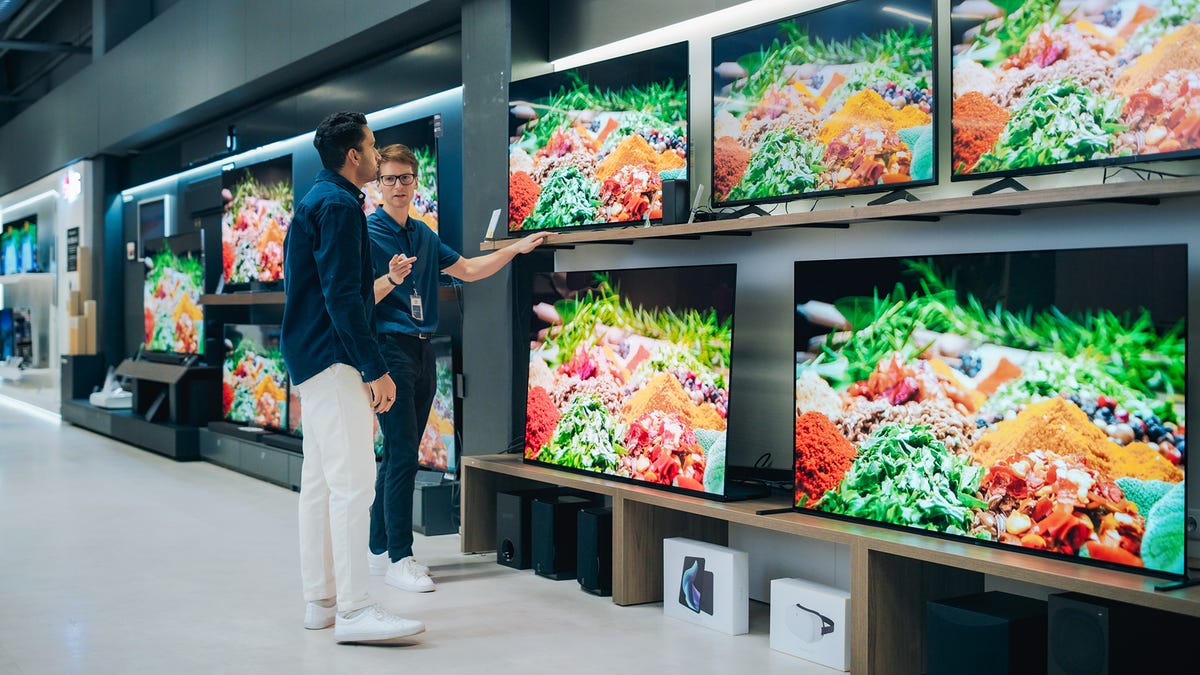
The two TV technologies that dominate our picks for the best TVs are OLED and mini-LED. There are incredible TVs using each technology. That said, each has strengths and weaknesses that might mean one suits your needs and home more than the other.
All TVs can show all kinds of content, but broadly speaking, OLED TVs have better, deeper black levels while mini-LED TVs are often brighter. Both will look better than older LED and even many modern QLED TVs. Weighing their pros and cons, and keeping price in mind, is key. This guide should help you figure out what’s best for you.
Black level
Winner: OLED and QD-OLED
Black level is one of the most important aspects of picture quality, as it lets the TV create a deep, natural image. OLED TVs are able to turn off individual pixels, something mini-LED TVs can’t. This means OLED has per-pixel perfect black levels. Mini-LED, like all other LED LCD technologies, can only dim large “zones” of pixels. While mini-LED has far more zones than older LED LCD technologies, they don’t come close to what OLED can achieve.
Check out the best OLED and QD-OLED TVs.
Read more: Putting the ‘Q’ in QLEDs: Where Quantum Dots Are Made
Brightness (light output)
Winner: Mini-LED
Both technologies are bright, but mini-LED TVs are typically brighter. Depending how you use your TV the most, this might be important. If you watch a lot of TV during the day, or in a room with big windows (and no curtains), mini-LED TVs can be easier to see. OLED TVs are by no means dim, all mid- and high-end TVs are brighter than the brightest TVs of a few years ago, but the brightest mini-LEDs are brighter.
Check out the best Mini-LED TVs.
Accurate, vibrant colors are a crucial aspect to any TV’s overall picture quality. Maintaining that accurate color through a wide range of brightness levels can be challenging for some TVs. OLED and mini-LED TVs tend to do better with different aspects of color reproduction, so it’s difficult to declare a general winner. It’ll come down to specific TV models.
What can be said in general is that the higher-end versions of each technology, especially 4-stack and QD-OLED, can have better color than the less-expensive versions.
When it comes to price per screen inch, mini-LED wins. For the same money, you can typically get a larger mini-LED TV than OLED TV, though there’s often some overlap. In the largest screen sizes the difference is huge. In smaller sizes, less so.
The winner: OLED (but it’s complicated)
Most TV experts, including CNET’s reviewers, agree that OLED offers the best picture quality overall. If picture quality is your number one priority, OLED is the way to go. This is especially true of Samsung’s QD-OLED, which pairs the emissive technology of OLED with quantum dots, and LG’s stack of 4 OLED layers. Both these techs improve brightness and color over simpler and older OLED designs.
On the downside for OLED, there’s the potential of image retention, also known as burn-in. If you watch the same thing all day (cable news, the same video game), the static parts of the screen can “stick.” Typically, this goes away when you watch something else, but if you only watch one channel for hours at a time every day, OLED’s not for you. Also, while the latest OLEDs are very bright, mini-LED is brighter. So if you regularly watch TV during the day in a brightly lit room, a TV based on that tech might be a better option. Lastly, there’s the cost. Per screen inch, OLED is usually more expensive than mini-LED at many screen sizes.
Which brings us to mini-LED. While mini-LED TVs can’t offer the perfect contrast ratios of OLED, they’ve gotten very good, with some models offering thousands of dimmable zones. That, paired with their exceptional brightness, means that in brightly-lit rooms mini-LED will often work better. Or, if you want a massive 100-inch TV, those are typically mini-LED as well. While there are OLED TVs that come in that size, they’re exceptionally expensive (10x more than some mini-LED models).
Looking ahead
Right now, OLED and mini-LED are the cutting edge of TV technology. They offer incredible image quality, but there are other technologies on the horizon that have the potential to be even better. The first is direct-view quantum dots, aka NanoLED. These skip LED and OLED completely, using just quantum dots to make up an image. The tech is promising, with the potential for incredible picture quality. It’s still in the development stages, though, so don’t expect it for a few years. We’ve seen some behind-the-scenes research as well as several working prototypes.
The other is MicroLED. Right now, this tech is almost exclusively in the giant display realm — and it is available now if you’ve got the cash. But it’s more of a projector replacement than a TV replacement. With typical LED LCDs, there are somewhere between a few dozen and a few thousand LEDs which create light to illuminate the image. With MicroLED, each pixel is an LED, so this means there’s millions of them. As the tech matures it’s possible we’ll see more TV-sized MicroLEDs (if “TV-sized” means 100 inches to you). In addition to being quite expensive, it’s also energy intensive. That means that, like NanoLED, you shouldn’t expect a 65-inch MicroLED to compete price-wise with OLED and mini-LED anytime soon.
In addition to covering cameras and display tech, Geoff does photo essays about cool museums and other stuff, including nuclear submarines, aircraft carriers, 10,000-mile road trips.
Also, check out Budget Travel for Dummies, his travel book and his bestselling sci-fi novel about city-size submarines. You can follow him on Instagram and YouTube.
Read the full article here