






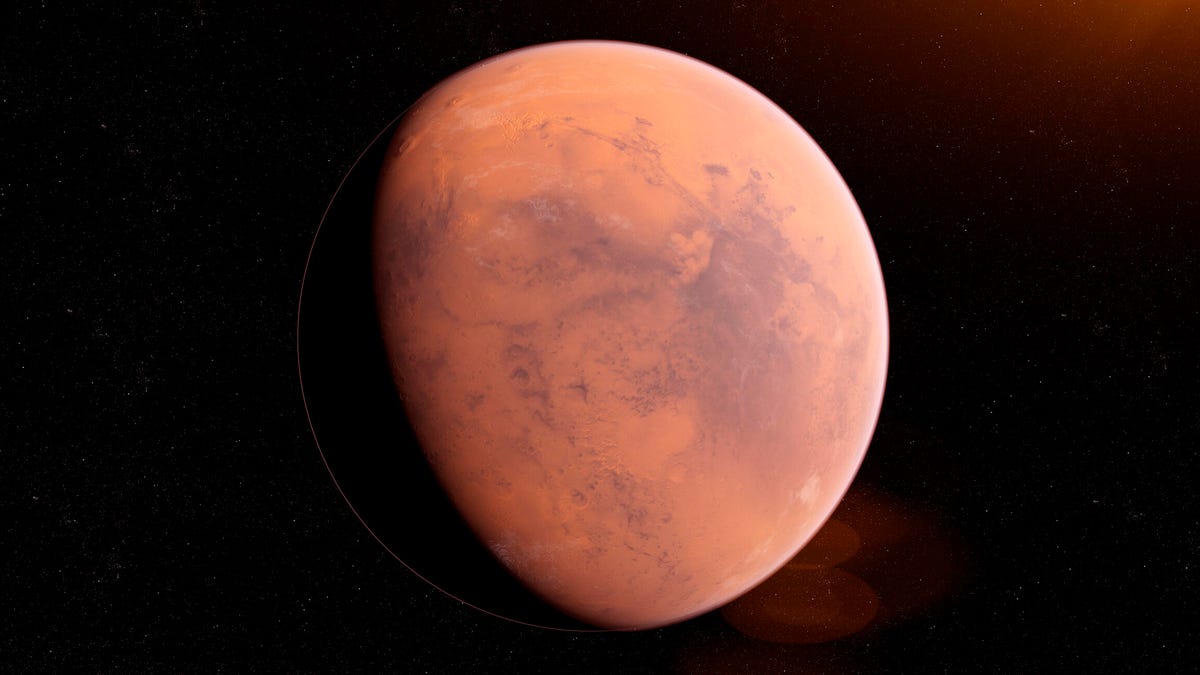
NASA is sending a nuclear-powered spacecraft to Mars. Alongside Tuesday’s announcement of its new Ignition program, which features a planned Moon base and a successor to the International Space Station, the agency revealed the SR-1 Freedom, set to launch in 2028 as the first nuclear-powered craft to leave low Earth orbit.
First, SR-1 Freedom will act as a tech demonstration to show that a nuclear-powered spacecraft is a viable option. If it works, it opens the possibility of deeper space exploration by addressing the range limitations imposed by solar power and liquid fuel.
SR-1 Freedom is also responsible for delivering the Skyfall payload to Mars. Skyfall is a team of helicopters that will scour Mars with sensors to find subsurface ice. It’s no secret that Mars harbors water far beneath the surface, but NASA aims to find a large enough pocket of ice near the surface to help sustain human life in future missions.
It’s not NASA’s first attempt to solve nuclear space travel. The agency has spent $20 billion over more than a dozen failed attempts with only one nuclear reactor to show for it, which is the SNAP-10A that launched into low Earth orbit in 1965. It operated for 43 days before a high-voltage failure shut it down. The SNAP-10a remains in polar orbit to this day.
What we know about the SR-1 Freedom
Steve Sinacore, NASA Fission Surface Power program director, told reporters in a news conference that NASA would select a launch vehicle from the available stock and that there would be regulatory and inspection proceedings with the Interagency Nuclear Safety Review Board before any selection.
NASA plans to begin developing hardware for the SR-1 Freedom once the design is finalized. This is expected to take roughly 18 months, with assembly beginning in January 2028. Reactor fueling, texting and assembly will continue until the SR-1 Freedom arrives at its launch site in October 2028.
SR-1 Freedom is targeting a December 2028 launch, as it’s the next available Mars launch window after the one opening in late 2026. The nuclear-electric engine is expected to produce over 20 Kilowatt-electric units and will be integrated with existing spacecraft technology to make the launch timing more realistic.
The reactor will be powered by high-assay, low-enriched uranium dioxide fuel and will transfer its heat via heat pipes, protected by a boron carbide radiation shield. The heat is converted to power using the Advanced Closed Brayton Cycle Power Conversion System, which then powers the electric propulsion system at the other end of the spacecraft.
Excess heat is handled with a massive heat sink made of composite materials and titanium. The spacecraft’s brain is located between the heat sink and the propulsion system, and will send data back to Earth.
Why nuclear power?
“Nuclear power in space doesn’t just enhance space exploration, it enables it,” said Sinacore during the press conference. “Through increased energy density, nuclear power will keep lunar bases operating through the 14-day, 354-hour night.”
One of the big problems with deep space exploration and long-term space exploration is power, and NASA hopes nuclear power can solve it. Solar power is a challenge on the moon due to its two-week-long night cycle. According to Sinacore, you would need “football fields of solar panels” to power a long-term base on Mars.
The next planet out is Jupiter, where solar panel efficiency drops to 4% when compared to Earth. Once you get beyond Jupiter, solar energy is negligible, making it a poor choice for deep space missions.
NASA currently uses liquid propellant for space flight. That doesn’t work for long-term missions and flights due to its mass fraction, which is fancy math that basically says it’s too heavy for long-term spaceflight. The spacecraft wouldn’t be able to move people and cargo efficiently. Sinacore says these are “physics constraints” rather than engineering problems, and that nuclear power solves them.
What comes after SR-1 Freedom
SR-1 Freedom marks the beginning of many more projects coming over the next couple of decades. Should the SR-1 Freedom prove successful, the next project would be the Lunar Reactor-1, a nuclear reactor that would serve as the power source for NASA’s upcoming moon base.
Having a nuclear-powered spacecraft and base on the books would open the door for more of both, including a potential human mission to Mars, bigger and more powerful nuclear reactors, and potential commercial participation from companies wanting to get in on the action.
Read the full article here


