

Ever wonder why your morning brew tastes disappointing while your barista’s coffee tastes like a warm, perfectly balanced hug in a mug? You’ve been drinking coffee since before you had a driver’s license, yet your “eyeball it” method keeps producing inferior or inconsistent results. Turns out, your vibes-based measurement system is the culprit.
Enter the “Golden Ratio” — which sounds like a pretentious coffee snob’s secret handshake, but is actually just the industry’s fancy way of saying “just use the right amount of coffee.” It’s a simple formula that prevents you from ping-ponging between coffee that’s too strong or too weak.
Ditch the guesswork, follow the ratio, and suddenly you’re not gambling with your morning beverage.
To learn more about the lauded ratio and whether it’s really the best way to brew with a drip coffee maker, French press, or pour-over system, I spoke with Kaleena Teoh, director of education at Coffee Project New York.
Here’s what she said.
Don’t miss any of our unbiased tech content and lab-based reviews. Add CNET as a preferred Google source.
What is the golden ratio?
The so-called golden ratio refers to the ideal proportions of water and ground coffee at the beginning of the brewing process, resulting in a full-flavored, balanced cup.
“The Specialty Coffee Association, an international organization that pretty much governs the guidelines that we use, suggests between a 15-to-1 to 20-to-1 ratio,” Teoh said. “It literally refers to the amount of water versus the amount of coffee grounds. And then the resulting volume at the end might vary entirely depending on what kind of system it is (whether automatic drip, French press, or pour-over).”
Applying the Golden Ratio (16:1)
| Water (volume) | Coffee grounds (weight) |
|---|---|
| 6-cup coffee maker (30 fl. oz.) | 1.9 ounces |
| 10-cup coffee maker (55 fl. oz.) | 3.4 ounces |
| 12-cup coffee maker (65 fl. oz.) | 4 ounces |
The golden ratio is based on weight, not volume
It’s worth noting that this ratio is based on weight, not volume. While coffee scoops may be calibrated for a particular grind size for a specific type of machine, the ratio’s effectiveness depends on more precise measurements. A tablespoon can hold different amounts of coffee, depending on whether you’re talking about fine espresso powder, conventionally ground coffee, or coarse cold brew grounds.
The goal of this precise ratio is flavor, with the appropriate strength to taste the actual coffee without elevated acidity, which reveals under-extraction, or astringency, which reveals over-extraction, and that can support additions like milk or sugar.
“Personally, I do a 16-to-1 ratio,” said Teoh, “which is frequently touted as the ideal within the 15-to-20 range. I think it’s nice, not too strong, and a good place to start.”
That ratio would ensure you taste the coffee even if you add stuff.
The higher the number in the ratio, which represents water, the gentler (or weaker) the resulting brew. So, if you take your coffee black, you may consider a slightly different ratio, like 18-to-1. If you drink it light and sweet, you might try a 15-to-1 ratio for a stronger coffee.
Other factors influence how effective the ratio is
The ratio alone isn’t enough to ensure an optimal cup. The following elements also play a significant role in the outcome of brewed coffee.
Grind size
The size of the grind plays a vital role in how coffee is extracted. Conventional, pre-ground coffee typically has a “medium” grind tailored for most drip coffee machines, but that isn’t always appropriate across all methods. According to Teoh, a French press typically requires a coarser grind, “like sea salt,” whereas pour-over can benefit from a slightly finer grind than what you can find on supermarket shelves.
Temperature
Temperature also impacts how coffee is extracted. “The moment the water hits coffee, it will start extracting, whether it’s cold or hot,” said Teoh.
Cold brew is its own magical thing, of course, but when it comes to hot coffee, there’s an ideal temperature range, and — news flash — it isn’t boiling.
The SCA suggests temperatures between 195 to 205 Fahrenheit, or temps allowing extraction to maximize certain flavor compounds in the coffee, while still maintaining an appropriate temperature to drink, she said.
Agitation
Agitation refers to the movement of the grounds during extraction. “The more agitation you give it when coffee is being extracted, the more concentration occurs during brewing,” said Teoh. Agitation is limited in standard machines for brewed coffee but plays a role in French press and pour-over methods.
Suppose you’ve experimented with various drip coffee machines and coffee grounds and have always been a little underwhelmed with the results. In that case, it may be time to consider getting nerdy with something like pour-over, which can be fussy, but can help with this aspect of the brewing process.
Filter
The filter you use is the final barrier between what’s happening during the extraction process and what arrives in your cup.
“Different filters have different pore sizes, allowing certain elements to pass through or not,” Teoh said. “Metal filters will allow for all solubles and some insolubles, while a paper filter will be able to hold back all of those insolubles, giving you a very clean cup.”
Insolubles may refer to minute granules of ground coffee and natural oils present in coffee.
One is not necessarily better than the other; it is a matter of preference. Oil can give coffee additional body, but it isn’t necessarily always desirable for everyone, either visually or texturally, she said.
Best practices from a coffee expert
To achieve the most out of the golden ratio, Teoh suggests practices that can make a noticeable difference in your daily brew.
Measurement
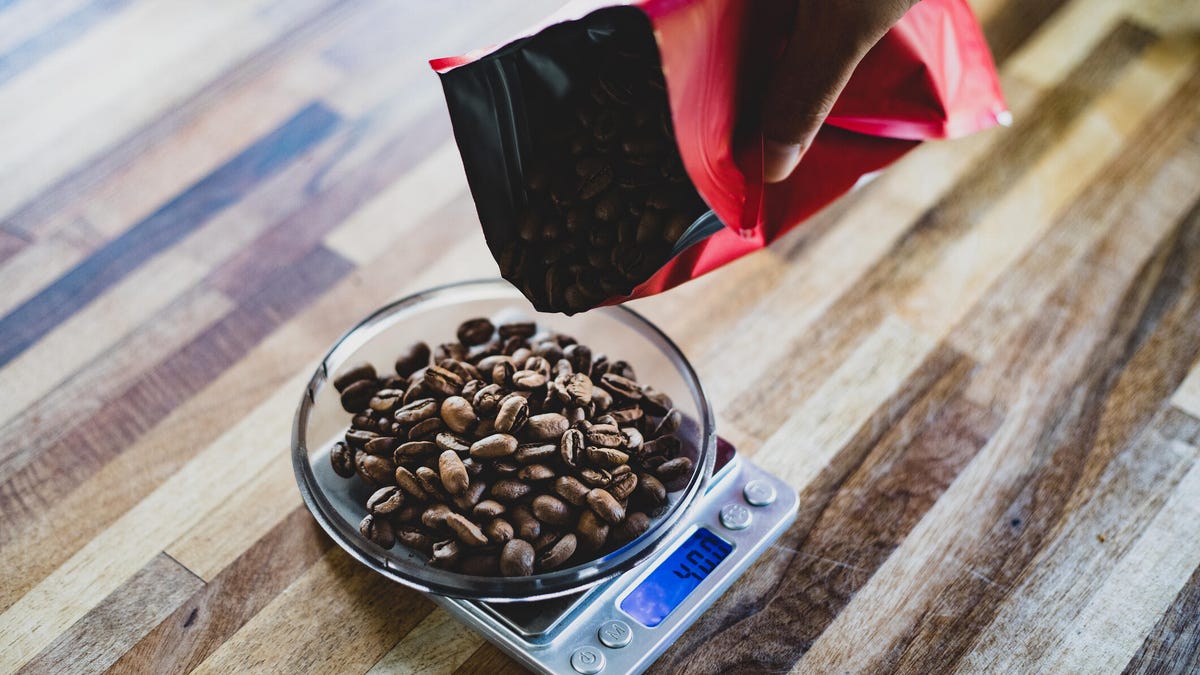
The golden ratio relies on weight, so a scale is recommended to achieve that ideal 16-to-1 water balance to coffee grounds.
“Everything is being weighed in most coffee shops to ensure that there’s some sort of consistency,” Teoh said, noting that applies to the grounds, the water and, in the case of espresso, the resulting brew.
If you’re serious about upping your coffee game, a scale is an essential investment, and it doesn’t have to be an expensive one.
Barring that, “any unit of measurement that makes sense to the brewer, to have some sort of consistency through the brew day to day is better than nothing,” Teoh said.
This is bad news for the “eyeball it” method, but good for those where a kitchen scale is just one gadget too many, she said. However, if you’re committed to measuring by volume, whether with a tablespoon or coffee scoop, Teoh advises experimentation and precision to determine the best outcome for you.
Coffee quality
Naturally, a better cup of coffee also starts with better coffee, no matter the measurement system.
“Fresh beans will always taste better,” Teoh said, advising care when getting freshly roasted coffee.
Look at tasting notes, speak to the roastery staff, and taste different blends to determine if you like something bright and acidic, as with a light roast coffee, or more floral and fruity notes, as with a darker roast, she said.
Grinder
More so than the scale, and even more so than the coffee maker itself, Teoh advises one device that can really affect the quality of your coffee.
“The best investment is actually the grinder,” she said. “Get a coffee machine that can do its job. It doesn’t have to be the most expensive one. But a burr grinder is actually an excellent investment.”
Ideally, as with a cheaper model, you want a grinder with settings that take the guesswork out of determining how fine the grind is.
“If you’ve just been buying pre-ground coffee, and you moved on to grinding it fresh, you will see quite a big difference in the cup,” Teoh said.
Consistency
Finally, the most crucial factor combined with all of the above is consistency, and not committing yourself to products or processes that you can’t follow through with regularly.
“Just use a method that is convenient to you, and that you’re able to use every day, because if it’s too much and too complicated, you’ll end up stopping,” she said.
“Pick something that you’re comfortable with and can do consistently,” whether with a particular ratio, particular beans, or particular devices, said Teoh. “And then play with it. Experiment with it until you find something that you like.”
Read the full article here