

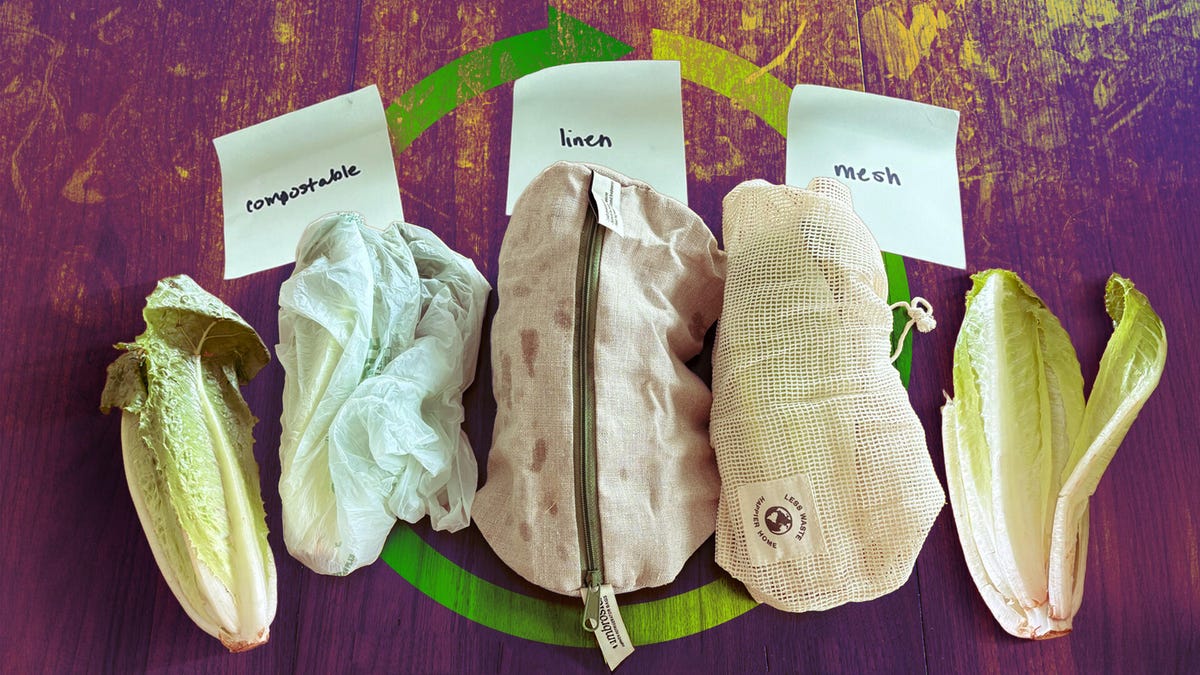
Every time I open my fridge, it feels like I find another fruit, veg or leafy green that’s spoiled just a few days after purchase. Tired of having to throw my produce into the compost bin, I decided to try something I’ve seen recommended countless times: produce bags that claim to keep food fresh for longer.
I put three different produce bag materials to the test: the free vegetable starch compostable bags available at my grocery store, Thrive Market’s mesh bags and Ambrosia’s linen produce bags.
For my experiment, I used red bell peppers and romaine lettuce, which I stored in these bags inside my refrigerator’s produce drawer. I did so for two weeks, which the USDA’s FoodKeeper app says is the recommended consumption limit for both peppers and lettuce when refrigerated after purchase.
Here’s how long the produce bags kept my food fresh, and which material performed the best in my test.
Don’t miss any of our unbiased tech content and lab-based reviews. Add CNET as a preferred Google source.
Day 1: A fresh start
I purchased my romaine lettuce and red bell peppers from my local Trader Joe’s. While there, I picked up the 100% vegetable starch-based compostable produce bags available for free in the produce section.
I washed all the produce, let it air dry and stored each in its respective bag. The Ambrosia linen produce bags for both leafy greens and vegetables state that the produce should be wet and that the bags should remain moist, so I followed these instructions. Then, I placed them all in the same produce drawer in my refrigerator.
Read more: These 8 Kitchen Gadgets Are Severely Underrated, According to Career Chefs
Day 4: The wilting begins
On Day 4, out of the three romaine bunches, all had begun to wilt, but the compostable looked the worst, as most of its outer leaves had lost their crispness. The mesh and linen looked about the same, but one of the outer leaves on the mesh romaine was more droopy than those on the linen.
As for the red bell peppers, all showed increased wrinkling. Both the mesh and linen peppers had stems, which were starting to show signs of spoilage. At this point, I couldn’t say which looked the least fresh.
Day 8: One produce bag takes the lead
By Day 8, the romaine lettuce in the compostable bag had shown clear signs of spoilage, which appeared to be penetrating its outer leaves. The mesh and linen contestants were also slightly browning on the outside, but this was more apparent with the mesh.
Again, all the red bell peppers showed signs of expanded wrinkling, but I can’t say whether one wrinkled more than the others. The stems on the mesh and linen peppers continued to show spoilage, which was more apparent on the linen pepper’s stem. However, that one was also longer and likely more prone to displaying flaws due to its larger surface area.
Day 13: The produce bag winner
To give myself a day to consume the produce, as I didn’t want it all to go to waste, I did my final check on Day 13, one day before the FoodKeeper app’s consumption limit. However, the romaine stored in the compostable bag was moldy and not fit for eating, so I disposed of it in my compost bin.
Between the mesh and the linen romaine, the mesh looked worn, with a few of the outer leaves completely wilted and bent. Although I was still able to eat both with the outer leaves removed, the linen seemed fresher.
As for the red bell peppers, I was finally able to notice differences. While all showed further wrinkling, the compostable pepper had the deepest wrinkles. Between the linen and mesh candidates, the mesh had more wrinkles than the linen, but only slightly.
Ultimately, I would say that the produce stored in the linen bags remained the freshest, followed by the mesh bags in second place and the compostable bags in last place. What could have affected the linen bags winning was the fact that Ambrosia specifically stated that the leafy greens and vegetables should remain wet inside the moist bag.
What experts say about produce bags
I asked Chef Vahista Ussery, a registered dietitian nutritionist and founder of the culinary nutrition consulting and education company To Taste, why the linen fared the best in my test. She said it’s not surprising that linen won because it offers multiple benefits for storing produce.
“Linen helps control moisture, absorbing excess that could cause produce items to spoil quickly,” Ussery said. “At the same time, it still allows air to circulate, providing the produce with the oxygen it needs, as well as allowing ethylene gas to escape.”
Certain produce, such as fruit, emits ethylene gas, which can cause the produce to ripen faster if the gas is trapped inside a produce bag.
Linen is also antimicrobial, meaning it prevents bacteria growth and the formation of mold. “Linen bags are truly the way to go for produce quality and environmental sustainability,” Ussery said.
As for mesh bags, they allow for more air circulation while absorbing less excess moisture. If you currently have mesh produce bags, Ussery recommends placing a paper towel in the bag along with the produce to help soak up moisture. You may also want to avoid storing leafy greens and fresh herbs in these bags, as excessive air circulation can cause dehydration, leading to increased wilting. That would explain why the romaine stored in the mesh bag wilted more than the romaine stored in the linen.
While compostable bags are better than plastic in terms of sustainability, they are designed to break down when composted. Excessive moisture can actually initiate this composting process while you’re simply trying to store your produce.
“Compostable bags also trap ethylene gas and provide no moisture absorption,” Ussery said. “They are better used just for purchasing versus storing.”
Ana Bueno, a holistic nutritionist and founder of BuenoSeeds Nutrition, further emphasizes the importance of learning about how each type of produce thrives when stored.
“The ‘one-size-fits-all’ approach rarely works,” she said. “Understanding how to store each type of food is key to reducing food waste and preserving nutritional value.”
Lesson learned. Next time you bring fresh produce home, taking just a few extra minutes to create its ideal storage environment can transform your salad from merely good to truly great.
Read the full article here