

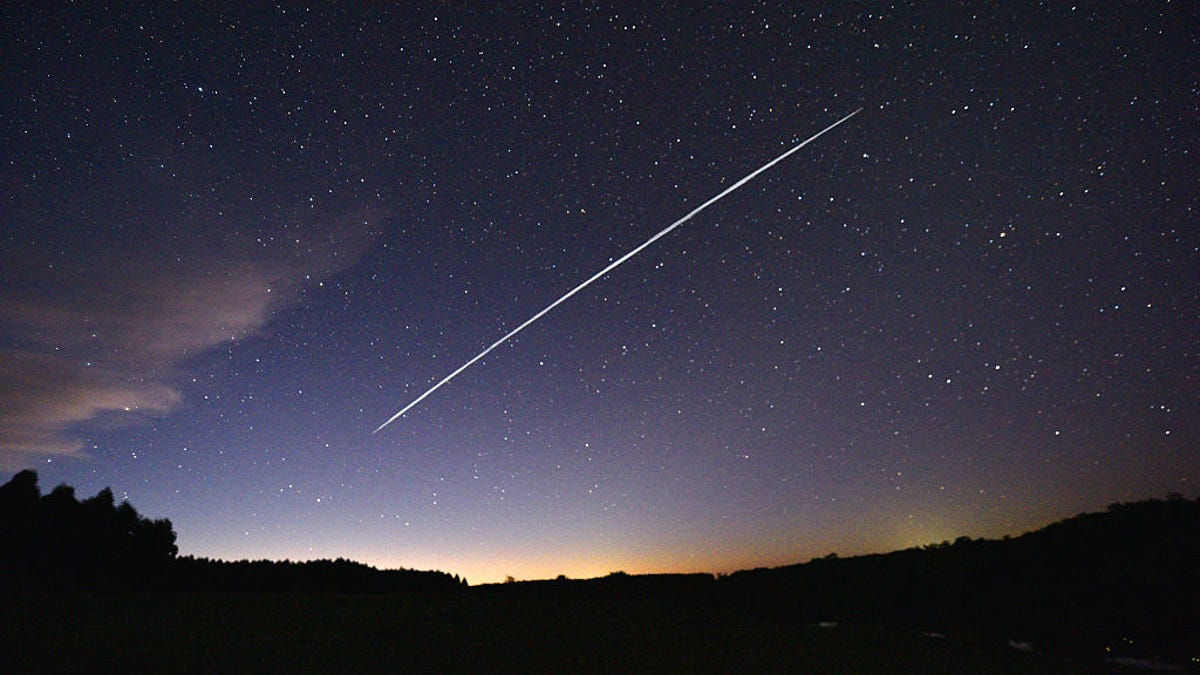
The Federal Communications Commission just gave Starlink the green light to vastly expand its mega-constellation of satellites, which could potentially bring millions of Americans faster internet. But the scientists I spoke with are sounding the alarm, saying that 7,500 more satellites in uncharted orbits could have wide-ranging consequences, including negatively affecting Earth’s atmosphere.
This approval for the deployment of more Starlink satellites was never really in doubt — Trump’s FCC has consistently sided with Elon Musk’s SpaceX — even though it was just half the number of satellites the company initially requested.
“I’m pleased to see the FCC didn’t just go, ‘Have as many as you want,’” Jonathan McDowell, an astrophysicist who tracks satellite launches. “The FCC is proceeding at least somewhat deliberately, although I still have concerns about the environmental impact of these constellations.”
The authorization will nearly double the number of Starlink satellites in orbit to 15,000 by 2031, raising familiar distress from scientists about the risk of collisions in an increasingly crowded stratosphere, as well as overreliance on satellite communications.
“This is a lot of satellites, but it’s only the beginning,” McDowell said. “They’ll ask for more. China will throw a lot up. Other companies and countries will throw stuff up. We’re going to pass the 100,000 mark most likely.”
While there are currently about 40,000 objects in space tracked by space surveillance networks like NASA and the European Space Agency, there are many more that aren’t tracked. The number of objects in space capable of causing “catastrophic damage” is estimated to be over 1.2 million.
“The challenge is not the big objects we keep track of. The challenge is always the sub-10 centimeter objects that we don’t keep track of,” Vishnu Reddy, a professor of planetary science at the University of Arizona, told CNET.
FCC applauds order
FCC Chair Brendan Carr said in a statement that the authorization of more Starlink satellites was a “game changer for enabling next-generation services,” touting the benefits to the American economy and broadband connections nationwide.
“President Trump is restoring America’s technology leadership,” Carr said. “By authorizing 15,000 new and advanced satellites, the FCC has given SpaceX the green light to deliver unprecedented satellite broadband capabilities, strengthen competition, and help ensure that no community is left behind.”
Buried in the actual order is far more measured language: “While SpaceX requests action on its entire proposed 29,988-satellite constellation, we proceed incrementally here.”
The FCC’s order predicts that the approval will “dramatically improve services to customers in America,” even going so far as to say it will deliver “speed service, including symmetrical download and upload speeds.”
The FCC is also authorizing SpaceX to move its satellites lower in orbit, which is expected to improve latency issues that have dogged Starlink for years, but could make them more susceptible to solar storms.
An increasingly crowded orbit
The doomsday scenario with all these satellites in motion is the Kessler Syndrome, a hypothetical scenario in which debris in space sets off a chain reaction: One space object crashes into another, which creates more debris until Earth’s orbit is so cluttered with space junk that satellites can no longer operate.
To make sure Starlink satellites don’t come into contact with this space debris, SpaceX requires that they maneuver whenever the probability of a collision is 3 in 10 million. That standard was actually new in Starlink’s July 2025 status report with the FCC; previously, it had been 1 in 1 million.
Despite that higher threshold, Starlink satellites performed 144,404 risk mitigation maneuvers in the six-month period ending in May 2025, an increase of about 200% from the previous six months. There were 148,696 maneuvers in an increase of about 200%.
That’s about one maneuver every 106 seconds, and that’s just for Starlink. The roughly 5,000 other active payloads currently in orbit don’t publicly report the number of maneuvers they make. This high number of maneuvers is both good and bad — they’ve managed to avoid collisions so far, but the increased movement makes it harder for other operators to know where satellites will be.
“If everybody on the street is trying to avoid getting hit, eventually, we’re going to have accidents,” Reddy told me in a previous interview.
This was described as an “orbital house of cards” in one recent paper, with researchers estimating that it would take 5.5 days for a catastrophic collision to occur if there were no maneuvers or a severe loss in situational awareness occurred. In 2018, the year before Starlink launched its first satellites, that number was 164 days. (The paper has not been peer-reviewed.)
“What happens if there’s a solar event where we’ve lost control of the satellites? It’ll be bad,” Reddy said.
The more satellites that are launched, the higher the stakes are. Events like a Starlink satellite explosion in December or the breakup of a Chinese rocket body in 2024 all tip the scales a little more toward those doomsday scenarios.
Effects on the atmosphere
Starlink’s satellites generally last around five years. After that, they’re “deorbited,” a nice way of saying that they’re steered into the Earth’s atmosphere to burn up. Since Starlink launched its first satellites in 2019, we haven’t yet seen the effects at scale.
“We don’t understand the reentry chemistry when they dispose of them, to what extent that’s affecting the atmosphere,” said McDowell.
But the early signs aren’t great. One 2024 study, funded by NASA and published in Geophysical Research Letters, found that a 550-pound satellite releases about 66 pounds of aluminum oxide nanoparticles during reentry. These oxides have increased eightfold from 2016 to 2022. The Gen2 satellites approved by the FCC weigh about 1,800 pounds.
“This is primarily a concern for the large number of satellites to be launched in the future,” Joseph Wang, one of the study’s authors, told CNET at the time. “We projected a yearly excess of more than 640% over the natural level [of aluminum oxide nanoparticles]. Based on that projection, we are very worried.”
Samples taken in 2023 by scientists with the National Oceanic and Atmospheric Administration found that about 10% of particle debris in the stratosphere contained traces of metals from rockets and satellites. They estimated this could grow to 50% or more “based on the number of satellites being launched into low-Earth orbit.”
What effect that will have is still something of an open question, but there’s no doubt that the massive increase in satellites — and their inevitable de-orbiting — will change the composition of the stratosphere significantly.
Solar storm risks at lower orbits
One factor that’s been underdiscussed in the latest FCC approval is the increased risk of solar storms wiping out satellites in lower orbit, according to Sascha Meinrath, professor of telecommunications at Penn State University.
Over the course of 2026, Starlink will lower 4,400 satellites from 342 miles above the Earth’s surface to 298 miles, according to a Jan. 1 post on X from Michael Nicolls, vice president of Starlink engineering at SpaceX. The new FCC order authorizes Starlink to move satellites as low as 211 miles.
“I’m more concerned just because we keep moving them lower and lower,” Meinrath told CNET. “There’s a reason why people are like, ‘Oh, wow, this has better statistics for their performance.’ There’s a reason why they’re empty. It’s because of the risk.”
The effects of solar storms on satellites in low-Earth orbit can range from network performance degradation to satellite deorbiting in extreme cases, according to researchers at the University of California, Irvine. Solar storms can trigger atmospheric drag, which prompts Starlink’s satellites to autonomously adjust their altitude in response. Neighboring satellites make their own adjustments, and it can take three to four days before they’re stabilized at their original positions.
“The self-driving algorithms, optimized for normal operations, may inadvertently amplify storm impacts by triggering chains of orbital adjustments,” say the UC Irvine researchers.
This is largely a concern for network performance, but if we’re increasingly relying on satellites to deliver essential services, the impact of solar storms could be incredibly serious, Meinrath said.
“In the same way that you have a wireline infrastructure strung up on poles, you need to pay attention to things like wind storms or ice storms. Solar storms are also an inevitability,” he said. “That very real problem remains, as far as I can tell from the filings, unaddressed.”
It’s not just Starlink
Having 15,000 new satellites in the sky is a big deal — it’s more than the number of active satellites currently in orbit — but Starlink is far from the only entity that’s active in space.
“The other really significant development was that China just filed for another 200,000 satellites with the ITU,” said McDowell, referring to the International Telecommunication Union, an agency within the United Nations that facilitates assigning satellite orbits.
Some observers are skeptical that the Chinese government will actually reach this massive number, describing the filing as more of a land-grab than a feasible plan. Under ITU rules, China would have seven years to launch its first satellite, then seven more to complete the constellation.
“SpaceX is not as big a concern as the Chinese constellations, which are worse on almost all fronts,” McDowell said.
China currently has over 1,300 satellites in orbit, according to a US Space Force fact sheet. Amazon’s Project Leo, formerly called Project Kuiper, has also launched about 200 satellites out of a proposed 3,236.
More satellites will improve connectivity for millions
While Starlink is often better than other options in rural areas, it has still never consistently met the FCC’s definition of broadband internet as 100Mbps download and 20Mbps upload speeds. It has also struggled on the latency front, with the most recent data from speed test site Ookla showing a median lag of 45ms — about 4 times higher than the average American gets. (Disclosure: Ookla is owned by the same company as CNET, Ziff Davis.)
Starlink has a good argument that it will cut latency by moving satellites lower. The approval will also address its other main hurdle: capacity. An analysis from Penn State University’s X-Lab found that Starlink’s satellites can handle just 6.66 households per square mile before service starts to dip below the FCC’s minimum.
“Moving all these satellites down in their orbital shells will cut latency, and it will allow for additional capacity,” Meinrath told CNET. “When you read between the lines, you’re like, ‘Oh, it’s a tacit acknowledgement that, in fact, there are some severe capacity limitations, and they’re trying to figure out how to solve for those.’”
While the concerns about increasingly crowded skies deserve to be taken seriously, so do the benefits of a modern high-speed internet connection. Agencies like the FCC and SAMHSA have even gone as far as to call broadband access as a “super-determinant” of health because of the impact it has on education, employment and health care access.
Over the past several years, I’ve talked to dozens of people living in rural areas who’ve described Starlink as an absolute game changer for them.
“You bring a Starlink dish out there and plug it in. Two minutes later, you’ve got the whole world again in the palm of your hand,” Eben Hopson, a photographer in Utqiagvik, Alaska, told me in a previous interview.
It’s not a stretch to say those Starlink connections are life-altering for millions of people around the world. But just because their satellites are floating in space hundreds of miles away doesn’t mean there’s no risk for us here on the ground.
Read the full article here