

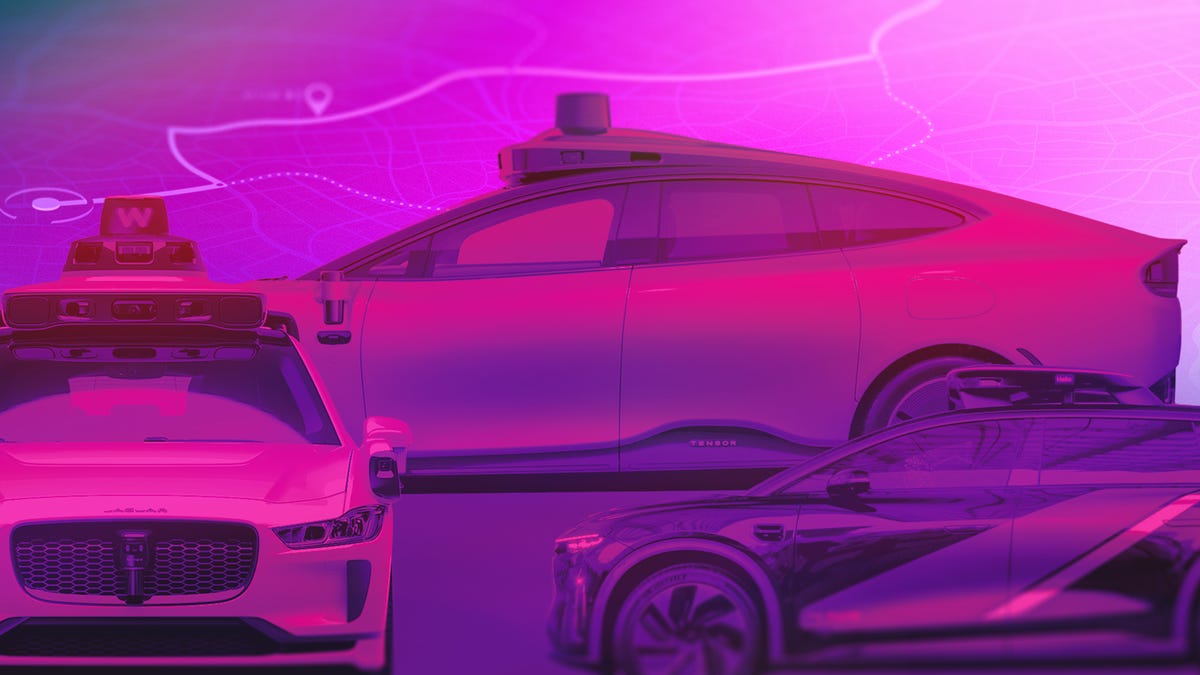
For decades, self-driving cars have featured prominently in our visions of the future. But at CES 2026 in Las Vegas, autonomous vehicles were presented as less of an emerging technology and more of an established one that’s shifting into high gear.
Companies like Waymo and Zoox have already deployed their autonomous fleets to a handful of cities and plan for accelerated growth in 2026. Crowds swarmed their massive booths at the Las Vegas Convention Center to get a glimpse of vehicles that looked straight out of a sci-fi movie. Weaving through the show floor, I got an idea of who else will be navigating the rapidly evolving AV space in the coming months.
Uber, along with autonomous vehicle company Nuro and electric vehicle maker Lucid Motors, unveiled the Lucid Gravity robotaxi at CES, which is slated to begin carrying passengers by the end of this year. Tensor showcased its self-driving car that you’ll be able to own, which is also scheduled to ship later this year. And during Nvidia’s keynote, CEO Jensen Huang presented Alpamayo, an open-source group of AI models designed to help AVs navigate complex situations “using human-like reasoning,” according to the company.
CES has also become a key forum for companies to discuss autonomy in public transportation. Last year, self-driving tech developer May Mobility teamed up with European electric minibus manufacturer Tecnobus to build an AV that can seat up to 30 passengers, which is slated to hit roads this year. And Holon, a subsidiary of autonomous fleet operator Benteler Mobility, has partnered with Lyft to deploy self-driving shuttles through the ride-hailing platform, starting at airports and select cities later this year. Industrial applications are also increasingly tapping into self-driving tech, from Caterpillar’s autonomous construction equipment to Kodiak and Bosch’s collaboration to scale autonomous truck manufacturing.
The prominence of autonomous vehicles at CES 2026, ranging from robotaxis to personally owned cars to public transportation and industrial vehicles, underscores the boom this sector is experiencing — and how drastically our transportation options are set to transform in the coming years.
“CES has always been an event that mixes technology that’s already mainstream, technology that’s ready to go mainstream and technology that’s interesting, quirky, weird or never likely to scale,” said Paul Miller, principal analyst on mobility at Forrester. “Autonomous mobility offers all of those.”
Autonomous vehicles on the streets of Las Vegas
Beyond the buzzing conference halls of CES, I caught glimpses of this autonomous future. The Las Vegas Strip was dotted with Zoox’s boxy robotaxis shuttling riders to and from mega-resorts. Waymo started autonomous testing in Sin City just before CES. And one day, as I was leaving the convention center, my curiosity led me to the Vegas Loop underground tunnel system, where I unexpectedly found myself aboard a Tesla vehicle with full self-driving technology — a precursor to the forthcoming Tesla Robotaxi.
Everywhere I looked, I found myself face-to-face with the transportation of tomorrow — and, increasingly, of today.
Las Vegas isn’t the only place you can get a peek at the roads of the future. The rollout of autonomous vehicles is still fairly limited, but Waymo, a subsidiary of Google’s parent company Alphabet, is set to expand its robotaxi service to more than a dozen new cities this year, adding to the handful of places in which it already operates.
Zoox, which is owned by Amazon, will likely open to all public riders in San Francisco in the coming months, growing beyond Las Vegas. And Uber, Lucid and Nuro are launching their autonomous ride-hailing partnership in the San Francisco Bay Area toward the end of the year, before eventually making their way to more locations.
Maintaining safety while expanding
Getting vehicles on the road is only the start of the journey, notes AV safety expert Phil Koopman. The next major challenge is to roll out the technology at scale and prevent major failures and risks.
We’ve already seen blunders both big and small from AV companies that have scaled their operations — and how that can affect public trust. Cruise, which operated a robotaxi service in San Francisco starting in 2022, was suspended indefinitely in California the following year, after one of its driverless vehicles struck a pedestrian who was initially hit by a human-driven vehicle. Owner General Motors shut down the venture before Cruise could make a comeback.
Waymo has so far dodged that level of scrutiny and scandal, despite some high-profile incidents of its vehicles failing to navigate construction zones, driving into places it shouldn’t and blocking roads during a recent power outage in San Francisco.
“Once you have thousands of vehicles on the road, things that used to be rare have a way of happening on a regular basis and need to be dealt with to achieve safe, reliable operations,” Koopman said.
With so much of the public already wary of self-driving vehicles, the stakes couldn’t be higher for AV companies to ensure rider safety.
“Regulators and the public are currently far less forgiving of accidents involving autonomy than they are of accidents involving human drivers,” Miller noted. “A serious accident involving a human-driven taxi is unlikely to destroy the taxi company, while an accident involving a robotaxi very well might.”
Figuring out the business model
Some AV companies’ business models can also appear somewhat aspirational and murky. Tesla and Tensor, for instance, plan to allow AV owners to send their cars out into the world when they’re not in use, so they can operate as robotaxis and earn them some extra money. (Tensor is teaming up with Lyft for this endeavor.)
“It’s not yet clear how this would work in practice, or how willing most people would be to let total strangers ride unsupervised in their expensive new AV,” Miller said of this general business model. “It is probably more plausible for fleet operators to finance, maintain and operate these vehicles in most cases.”
If the range of exhibitors at CES is any indication, we’re likely to see a continued mix of cars, vans and buses that can move passengers autonomously, especially as sensors and software get better and more affordable. In the meantime, Miller noted, driver assistance tools will also become more widespread as manufacturers work to build up their fully autonomous ventures.
As competition intensifies among AV companies, not all will be able to survive. Each will need to contend with high costs, new deployment environments and complex regulatory hurdles from different levels of government.
“I expect that most of them will fail, being acquired — or superseded — by the few that manage to combine safe operation with viable technology and business model,” Miller says.
As momentum builds, so, too, does the pressure to make it across the finish line.
Read the full article here