

Houseplants struggle during winter. Big temperature swings, including cold drops when you leave the house, can hurt them — as can the lower humidity and reduced sunlight.
Space is also an issue no matter the season since you only have so many windows to provide consistent natural light. Interior rooms and basements with limited sun aren’t ideal for plants.
According to Planta, light-deprived plants have fewer leaves, lack healthy coloration and grow spindly as they search for better light sources. Although it takes time for light-deprived plants to decline, they recover quickly when exposed to appropriate lighting.
Buying hard-to-kill houseplants is a good idea for plant newbies or those who tend to provide inconsistent care, but there are other ways to help your struggling indoor flora.
One of the quickest is a grow light if can’t provde the neccesary natural light for healthy winter growing. Tropical plants also require more light. If attempting to grow them in temperate regions you may need consistent artificial lighting to keep indoor plants healthy.
Here are a few tips for choosing and using indoor grow lights to help your plants thrive all year.
Choosing the right grow light
You can get a rough idea of a grow light’s effectiveness by examining its brightness, wattage, light color temperature and mounting options.
Brightness
There are multiple ways to evaluate brightness, but the most precise metric for houseplants is photosynthetic photon flux density, or PPFD. While lumens and lux are certainly more familiar, PPFD has the advantage of directly measuring how much light your plants can use. Even the brightest lights aren’t enough if they don’t benefit your indoor plants.
Another advantage is that a plant light with a PPFD rating is usually the real deal compared to generic products marketed as grow lights. (Don’t get me wrong, those lights can work for many plants, but your mileage may vary.) Likewise, there’s no need to guess the lighting requirements of your plants when you can look them up on pages like the Photone Plant Light Database.
Barrina grow lights are my latest upgrade — relatively affordable and super bright — and the first time I paid attention to PPFD. I linked a few 2-foot strips together to blast my carnivorous plants with a PPFD of around 200-500 μmol/s/m² as recommended by Carnivero.
Whether you use PPFD or another metric, be aware that light intensity decreases rapidly with distance. Grow light manufacturers usually list the distance where the PPFD rating was measured.
For example, an 800-lumen LED light bulb (60-watt equivalent) can be great for shade-loving plants but won’t sufficiently illuminate much space beyond a few inches — limiting the number of plants you can put under it. But a more powerful light can be much higher and cover a greater surface area.
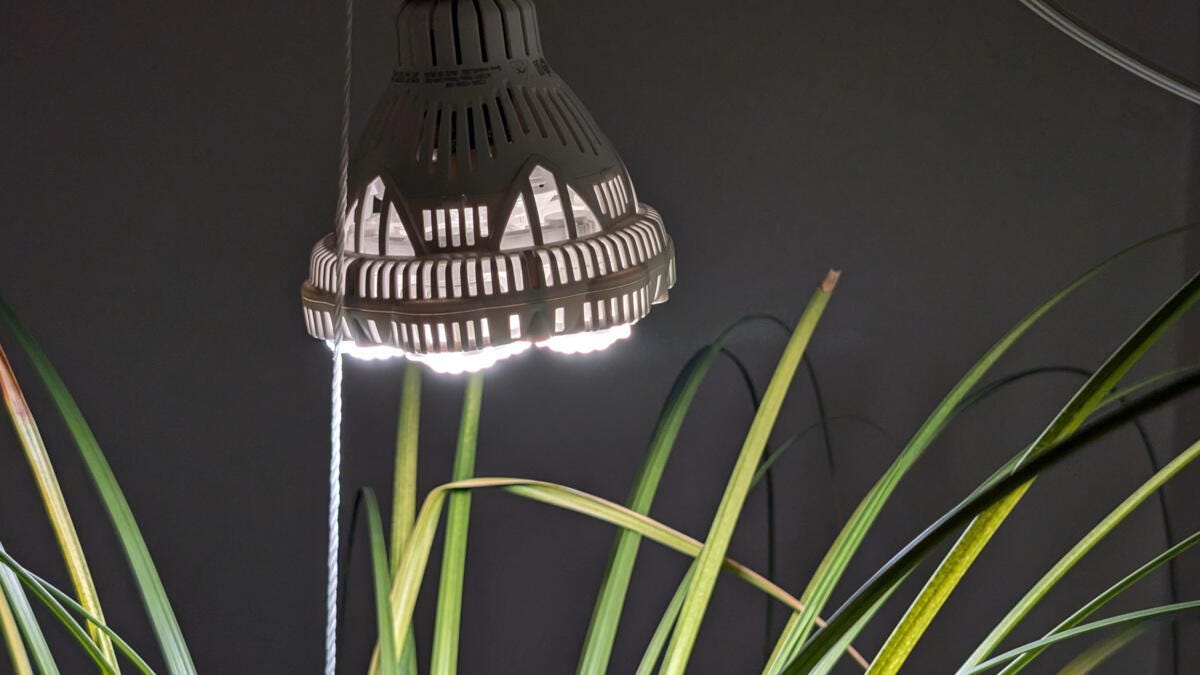
I’ve used a Sansi grow light bulb (400-watt equivalent) for over two years to provide plenty of bright light for my large ponytail palm. This means I can keep it out of reach of my cat, who loves to eat the leaves. It also helps supplement my patio citrus trees that overwinter by the front door.
You can measure a light’s PPFD rating with the free Photone app. It is surprisingly accurate with my lights, considering the alternative is an expensive light meter. I know that doesn’t help you choose LED grow lights online. Still, it can help you determine whether existing lights work for houseplants. In my setup, I use it to figure out the spacing between my LED lighting and plants.
Wattage
A fixture or bulb’s wattage is valuable for predicting your electricity costs. In terms of efficiency, an LED grow light delivers the biggest bang for your buck. I don’t recommend using any other type of grow light in a home setting if you’re trying to save energy.
Figuring out the cost of running a grow light is pretty easy with an online calculator. For example, my 36-watt Sansi LED bulb runs 12 hours a day, costing around $1.38/month in my region. While the cost of running a light or two won’t affect your power bill too much, it adds up as you increase the number of fixtures you run.
Light color temperature
Any sufficiently bright light can work as a grow light, but I prefer to use full-spectrum LEDs with a color temperature of 5000K or higher. This is common in shop lights at hardware stores, but you can also find traditional light bulbs in this style.
As you weigh your options for a new grow light, I generally advise against fixtures that use only red and blue LEDs. While these units target specific wavelengths of light that most plants use for photosynthesis, they’re impractical for a home setting. There are various reasons for this, but I ultimately land on three in particular:
-
Red-blue grow lights are unpleasant to look at. As much as I love colorful LEDs, the constant pink glow isn’t for human eyes, and many growers complain of headaches when using them.
-
They make it difficult to care for and enjoy your plants. Bathing your plants in pink light will change how they appear, making it hard to spot symptoms of disease and poor conditions that would be obvious under white lights.
-
Blue-red grow lights may be great for inducing vegetative growth and flowering, but they don’t cover a plant’s entire growth cycle.
This doesn’t mean you can’t use a full spectrum white grow light with additional red and blue LEDs, but you should treat them as secondary features rather than the main event.
Mounting options
Most plant lights work best when mounted a few inches above the plant’s top. You can attach them to a ceiling, overhead shelf, or hook. Just make sure that the appropriate mounting hardware comes with the light fixture.
Depending on your growing area, you can mount lights using a few zip ties and metal eye hooks from the hardware store. I like the clean look of hanging chains, which help me raise and lower my lights based on the plants below them.
Hanging your grow lights also helps with heat dissipation. Bright LEDs produce a hefty amount of waste heat that needs adequate ventilation. Too much heat can harm your indoor garden and reduce the lifespan of your light hardware. This is a major reason why many high-end grow lights have built-in cooling fans.
Pair it with a smart plug for effortless scheduling
Smart plugs were the best thing to happen to my grow lights. I can set up a 12- to 14-hour light cycle, commonly called a photoperiod, for my tropical plants and a sunrise/sunset cycle to simulate seasonal sunlight changes for my temperate plants.
Even if you use the same lighting schedule every day, a smart plug is more customizable than a mechanical timer or the built-in timers in some LED grow lights. This is especially true for smart plugs with an energy-monitoring function. I also link my smart plugs to a smart switch for easy manual controls.
Avoid built-in timers
Speaking of built-in grow light timers, my experience with them is a mixed bag. The preset intervals are helpful for simple photoperiods, especially if you need only a 12-hour day or night cycle.
The problem is that built-in timers on grow lights tend to have an unreliable design. If the power goes out, the timer resets and defaults to an always-off setting. This is an issue when the grow light is the only light source for a plant and may harm your plants if the power blips out while you’re on vacation for a few weeks.
Similarly, a built-in timer’s default setting is incompatible with smart plugs and external timers. This means you’re stuck with the preset lighting intervals and can’t customize for specific plants.
Want more home tech tips? Here’s how I made my home smarter without a smart hub and the 7 places you should never put a home security camera.
Read the full article here