

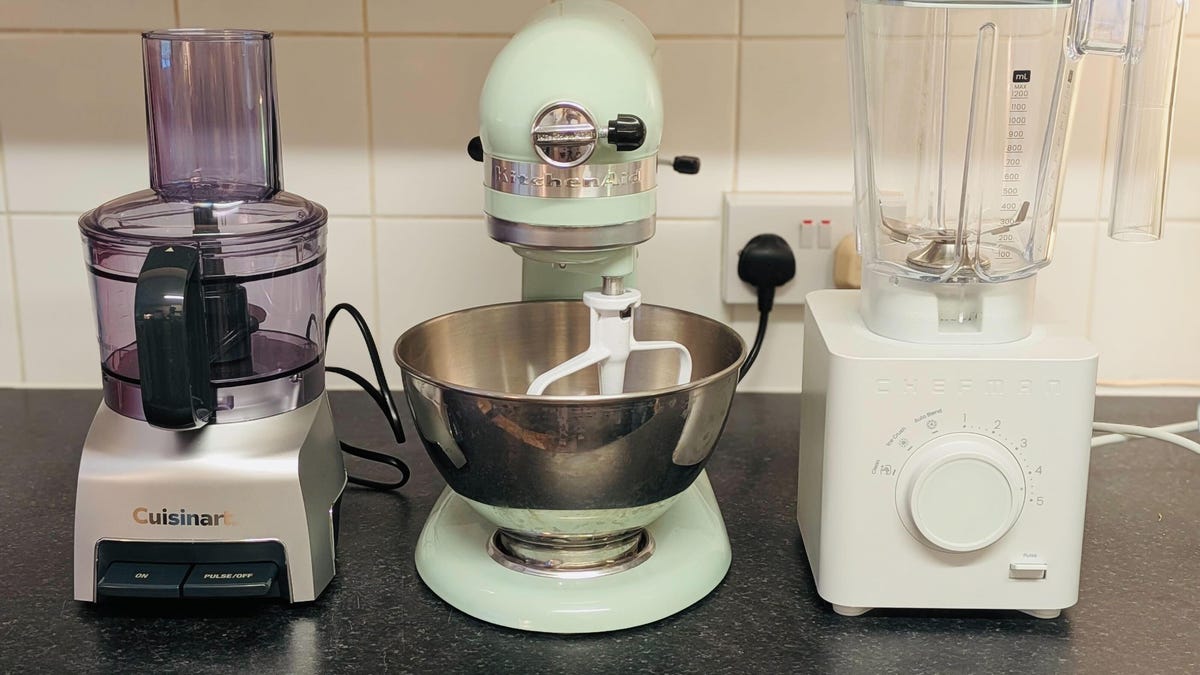
Blenders, food processors and electric mixers — freestanding or otherwise — are all small kitchen appliances whose core function can be distilled into a simple concept: to combine. Yet they all independently exist, with different designs and seemingly for different purposes.
If you found yourself eye-rolling at the headline here, ask whether you can actually delineate each of their unique characteristics and how they actually do what they do. And if you’re a cooking and baking newbie with little idea to begin with, welcome in.
If you’ve ever had to justify the need for myriad appliances (perhaps with someone like a roommate or spouse who shares kitchen space with you) or if you’re newly outfitting a kitchen and wondering what might be necessary and what might end up being merely decorative for your cooking repertoire, getting into the nuance of these appliances is important.
For the purposes of kitchen relationship harmony, then, or to enable you to justify another small appliance purchase — to yourself or anyone else — here’s an examination of the difference(s) between a blender, food processor and stand mixer.
Blender: How does it work?
Blenders typically consist of a heavy base with a motor and a plastic or glass jug with a set of rotating blades at the point where the jug connects with the motor. The blender combines whatever ingredients you add with a singular goal: to liquefy. The history of the blender, in fact, begins with its function as a milkshake maker. A vortex created by the rapid rotation of the blades creates a vacuum that pulls whatever is in the jug toward the blades, pulverizes it, then funnels it back up, ad nauseam, until you hit stop.
If you’ve ever put various components in the blender and had the mixture quickly come to a standstill, clinging desperately to the sides of the jug out of the reach of the blades, the catch-22 of a blender’s function is that it usually needs a little liquid to begin with in order to effectively kick off the liquefaction. Certain solid items that are light or have small pieces, such as nuts or bread cubes, can be put in the blender; however, in this case, the blender’s function is to grind.
Perfect for the blender: smoothies, shakes, cocktails, sauces, gravies, fluid nut butters, wet batters for pancakes, crepes or coatings.
Ideal foods to make in a blender
- Smoothies
- Protein shakes
- Frozen drinks
- Soups
- Sauces and dips
- Nut butters
- Baby food
- Pancake batter
Food Processor: How does it work?
Like a blender, a food processor often relies on blades, but may also employ discs or other inserts specific to the job you’re asking it to do. The container in a food processor is more of a bowl or cylinder than a jug, and liquid and gravity are less important to its proper operation. While it can be considered an appliance that combines various ingredients — as with salsa or hummus — it typically does so by chopping everything together, though not as finely as a blender, and can also be used strictly for that purpose on a single item.
Various food processor attachments may also allow you to shred, slice, julienne, or juice, with a wide entry channel that enables you to add ingredients and push them through the attachment, which is typically mounted at the top of the bowl. Some models may also include inserts that attach to the motor base that whip or knead. Though a blender typically results in more of a fine puree than a food processor can do, a food processor is more versatile in terms of the various shapes and textures that are possible with its use.
Perfect for the food processor: grating or chopping solid ingredients such as vegetables or cheese, chunky or thick sauces such as pesto, hummus, or salsa, thick nut butter, pasta or pastry dough.
Ideal foods to make with a food processor
- Chopped vegetables for sofrito, mirepoix, etc.
- Pesto and sauces
- Hummus and dips
- Shredded cheese
- Nut butters and nut flours
- Cauliflower rice
- Energy balls and no-bake treats
- Breadcrumbs
- Ground meat
Stand mixer: How does it work?
Stand mixers are strictly mixing devices that can combine ingredients, but don’t break them down into smaller pieces via blades. On a stand mixer, a heavy base holds a bowl in place while a motor rotates an attachment such as a paddle, dough hook or whisk. (Hand mixers perform the same function, but your hands are both the element that keeps the bowl in place, and that which holds the motorized attachments.)
At higher speeds, a stand mixer can also introduce air into the mixture. The action of a stand mixer is gentler and easier to control than that of a blender or food processor, making it ideal for cake batters that require minimal mixing, where the goal is simply to combine. Armed with a dough hook, however, the mixer can also strong-arm gluten development for crusty breads.
Stand mixers may also have various attachments available to increase their utility, including ice cream makers, pasta rollers, meat grinders, spiralizers, juicers, and even choppers that start to creep into food processor territory.
Perfect for the stand mixer: dough for bread, pizza, pasta, and cookies, all batters, icing and frosting, meringue or whipped egg preparations, whipped cream.
Ideal foods to make in a stand mixer
- Bread and yeast doughs
- Cake batter
- Cookie batter
- Whipped cream
- Meringues
- Frosting
- Mashed potatoes
- Pasta dough
- Shredded chicken or pork
- Pizza dough
Crossover use between them: The mashed potato experiment
Naturally, there are things that could be accomplished in any of these appliances, given desired outcomes. Egg whites or cream can be whipped, batters can be mixed, and certain doughs can be formed in all three of them. This is not a case against a stand mixer, however. Though its function tops out at “mix,” it is still the necessary appliance for certain types of cake or cookie doughs. Not to mention the lack of blades and its stainless-steel bowl, which makes it much easier to clean.
I made mashed potatoes in all three
To best illustrate the outcomes of these various appliances when given the same task, I chose mashed potatoes, which can be successfully achieved by either liquifying, chopping, or simply mixing its components. Potatoes were cubed and boiled, and then (because I’m not a monster) put to the test along with a splash of milk and a dab of butter.
- Food processor: required just a few pulses to turn cubed potatoes into mashed potatoes. I like them with a little texture, but a few more pulses would give you a smooth puree.
- Stand mixer: requires the most time but allows the most volume. You’ll never get a silky puree if that’s what you’re going for, and you may end up with some larger chunks, but this method could most easily feed a crowd without the elbow grease of hand mashing.
- Blender: required extra milk in order to get going, and in very short order turned cooked potatoes into something that more resembled pancake batter than mashed potato, a strong consideration if you’re actually making gnocchi.
Read the full article here