

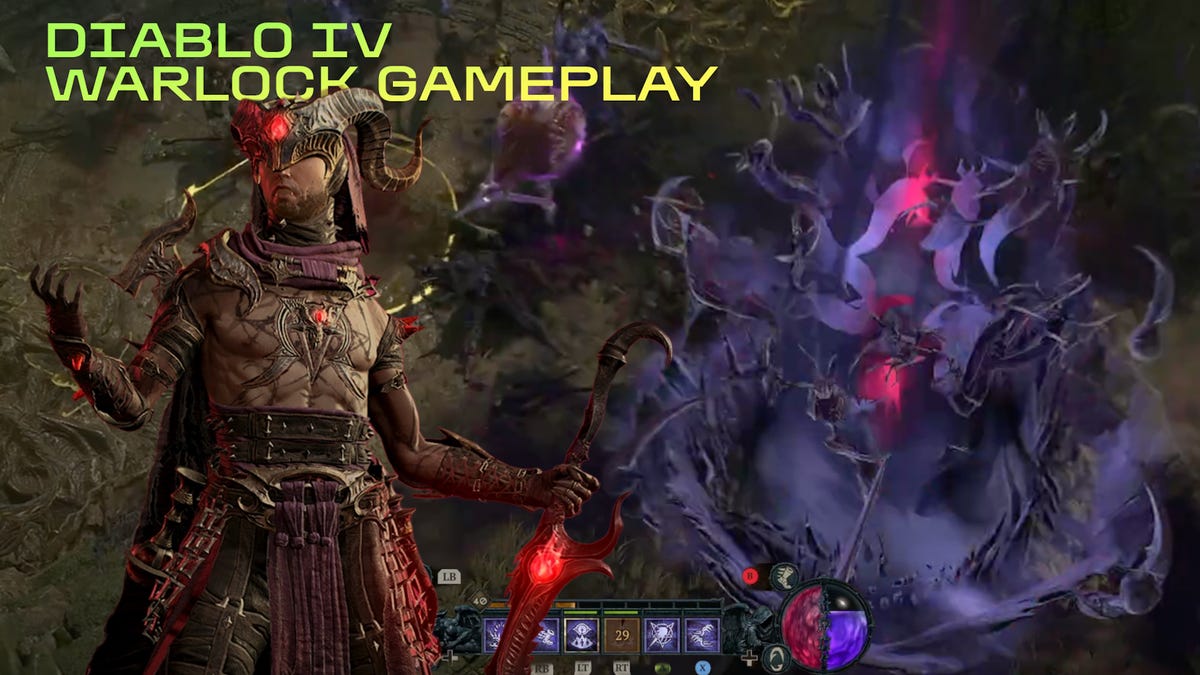
In the ruins of a city deep in the jungle, I’m searching for the source used to brew a deadly poison. I’ve been battling my way through waves of pestilent insects, humans and other creatures, summoning shadowy magic to carve through their forces. As I approach the fetid blooms used to create the poisons, I’m greeted by Darm, the Bloom Warden, a hulking figure wielding two axes, each one the size of my warlock.
The moment his health bar appears, I summon a wave of smoky claws from the abyss to tear through him. Though he’s hurt, he still lumbers toward me, raising his axes overhead before slamming them into the ground, producing three toxic blooms that separate us. I could take the time to remove each bloom, or conjure a demonic eye to fire at him from range. Both perfectly fine approaches. But neither quite as fun as what I had in mind.
Instead, I disappear into a flash of flame, flying forward as a shadow, dodging the plant toxins, until I rematerialize in a confluence of smoke and shadow behind Darm. There, I reach back into the abyss, dooming the Bloom Warden as another volley of claws send his lifeless body crashing to the ground.
My monster slaying happened at Blizzard’s California campus in late January, shortly ahead of Diablo’s 30th anniversary spotlight showcase. Media from around the world were invited to playtest the new warlock class in Diablo 4 before its official launch in the upcoming Lord of Hatred expansion on April 28.
While a warlock was just added to Diablo 2: Resurrected last month, Diablo 4 is getting a different version of the class, as will Diablo Immortal this summer. Collectively, the games intend to showcase the class’s evolution, beginning with its origins in Diablo 2.
I spoke with class designers Stephen Trinh and Bjorn Mikkelson at Blizzard in a group interview about the new heavy metal-inspired class. The core identity of the warlock is Hell and demons, Trinh said, “But I think what’s special about each of the warlocks is that they cater to each of the different games,” with each version of the warlock built around its game’s specific design philosophies.
Diablo 2’s warlock is a scholar just beginning to accept the role of outcast in order to defend the world, whereas Diablo 4’s version of the class is a powerful and experienced occultist on the frontlines, desperately summoning and spellcasting to turn back the tides of Hell, no matter the cost. These warlocks have spent many years in the fray, their clothes and armor scorched by the hellfire they’re summoning.
The warlock, showcased in a new developer update, is an important element in Lord of Hatred, one of two new classes being added along with a suite of other gameplay changes like deeper skill trees and overhauled endgame options. The expansion signals the end of the story about the conflict with Mephisto, the titular Prime Evil, and the concepts behind the warlock are a big part of its themes. I played a few different warlock builds at Blizzard, and while I didn’t get to see any of the upcoming Skovos setting from Lord of Hatred, I still got a feel for what players can expect from the expansion.
“One big demon sadness party”
The Diablo 4 warlock is for players who want to explore the dark, demony side of Diablo and to use those powers to their advantage. Warlocks use two resources in combat: dominance, which you use to summon demons, and wrath, the source of your spellcasting. It’s a great choice for players who spend the game wading through legions of demonic monsters and think, “This could really use more demons.” The devs described the class as “demon-first” with plenty of ways to customize how you use your demonic powers.
The warlock views those demons strictly as tools, Mikkelson said. “These demons are not your friends. They’re not your little helper pets. You do not like them. You are hurting demons with demons that you hurt. It’s just, like, one big demon sadness party.”
The specific ways you use those demons will differ according to the subclass you choose. If you want to maximize the number of demons on the battlefield, you can summon a major variety and use them to do your bidding. Or if you’re more interested in the power than the demons themselves, there are subclasses that keep the action focused on you, and others that let you control the demons directly. Or if you really want to feel the rush of power, why not just transform yourself into a demon?
I spent the most time playing the mastermind subclass, which allows you to micromanage your demons. For me, the appeal was more about the shadowy mage fantasy, summoning power from the abyss and gaining the ability to reposition or duck in and out of stealth. I cleared a stronghold with this build and enjoyed the gameplay loop of maneuvering myself around the battlefield to better position the next wave of dark magic I would use to besiege my enemies.
I made sure to spend a bit of time with each of the different subclasses and was surprised by how distinct they felt from each other. I haven’t played enough of the other classes to compare apples to apples, but these pre-loaded builds created by the Diablo team felt almost like entirely different classes from one another. The mastermind subclass made me feel like a mobile master of darkness who controls the battlefield.
The vanguard subclass lets you ride into the fray on a fiery hellsteed and summon brutal abilities like demon heads that spew flames. Or if you’re tired of demons having all the fun, you can make your inner demon your outer Demonform, powering up and transforming your abilities.
The legion subclass will appeal to people whose first question is usually, “What’s the max number of summons with this build?” If you’re the kind of person who enjoys conjuring a wall of demons to split up and attack enemy mobs, raining exploding demons from the sky or just pointing a huge demon in the general direction of your enemies, you’ll want to build into this subclass.
The ritualist subclass is for people who can’t get enough fire and explosions. Ritualists are all about using demons to empower calamitous abilities such as trapping enemies in dark prisons and then devastating them with lava-filled eruptions. You can also summon a demon to refuel your resources and overpower your abilities, using them as your personal wellspring of magical power.
For me, the warlock’s ultimate abilities were the biggest standout from the playtest. Even for abilities that are meant to represent the pinnacle of class strength, warlock ultimates felt particularly exciting and powerful.
When I asked about the design philosophy for warlock ultimates, Mikkelson said the process was “take the fantasies, the playstyles, the things we’re working into it and just asking ourselves what happens if we turn this up to 11.”
That power really came through in the gameplay. Whether it was the mastermind sending a roil of dark energy across the battlefield, the legion warlock summoning a kaiju-sized demon to slice through enemies or the ritualist scorching land and sky with its Apocalypse ultimate, casting an ultimate ability always felt like I was breaking the game, in the best way possible.
Raise your horns
While I enjoyed the heavy metal feel of the warlock, it isn’t the only class joining the roster in Lord of Hatred. The Light-wielding paladin is also joining the fight, and it unlocks immediately if you preorder the upcoming expansion.
The two classes have very different identities. Paladins are holy, martial warriors who act with certainty and fervor, while warlocks are spellcasters who tap into the darkness to defend Sanctuary.
That juxtaposition was intentional, Trinh said. Lord of Hatred is heavily focused on the themes of the Eternal Conflict between Heaven and Hell, and the devs wanted a chance “to explore that duality of the two different realms” with the two new subclasses.
The warlock and paladin open up lots of new gameplay options for Diablo 4 players. I enjoyed blitzing through the campaign with the paladin earlier this year, and I’m greatly looking forward to carving through the tides of Hell as a warlock later this year.
If you’ve ever thought the concept of fighting fire with fire should also apply to demons, I highly recommend the warlock class, which also benefits from the deeper, more customizable skill trees introduced in the expansion.
Mikkelson told me there is lots of space for players to come up with “wacky builds” for the warlock. The deeper you go into the customization, the more you’ll settle into how you want to play the class.
“It’s the demon class,” Trinh said, “so we wanted to really explore all the different ways that you can interact with the demons.”
Read the full article here