

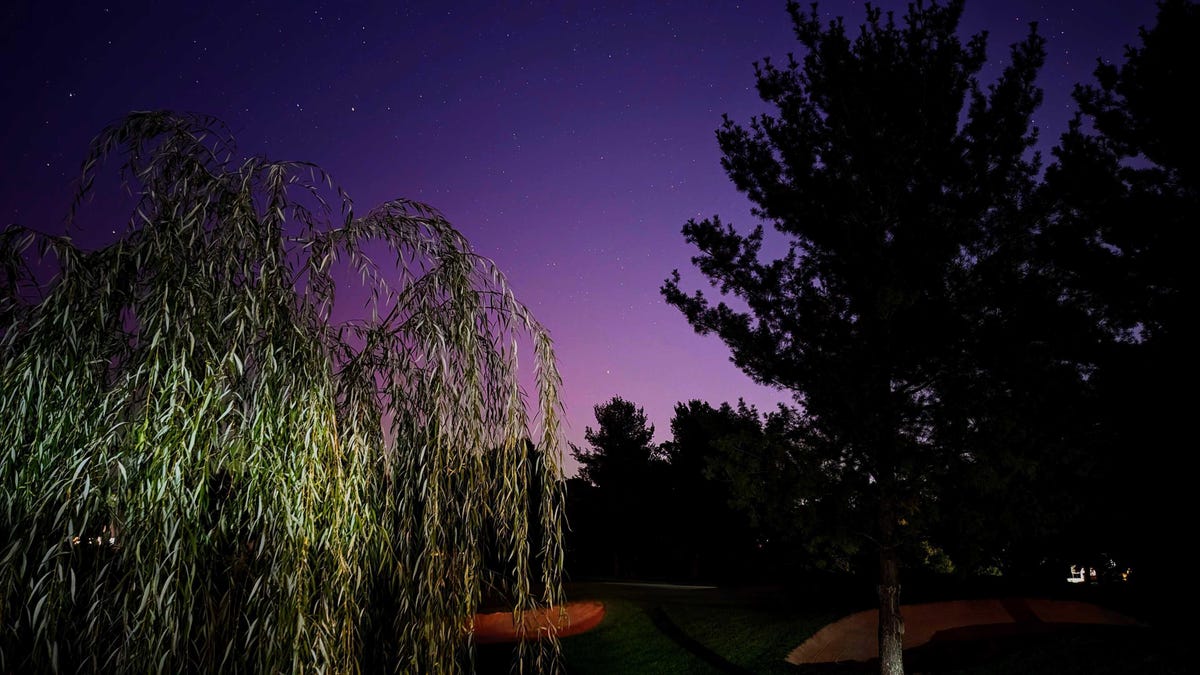
It’s the height of the aurora borealis season, but the skies have been relatively calm lately, with only a few mild auroras over the last month. Get ready, though. The northern lights may light up the skies over parts of the US over the next couple of days, giving people in northern states a chance to marvel at rainbow skies.
According to the National Oceanic and Atmospheric Administration, Monday and Tuesday’s auroras are brought to Earth by a rather large X1.4-class solar flare that erupted from the sun late on March 29 and was caught on video by NASA’s Solar Dynamics Observatory. The flare came from region 4405 of the sun, an area known to be magnetically complex and highly active. The flare lasted for hours and peaked at 11:19 p.m. ET Sunday night.
The flare also launched a coronal mass ejection, a large burst of plasma that can create auroras, and that ejection should at least partially interact with Earth’s geomagnetic field. Any auroras from the solar storm likely won’t be too strong, but NOAA did issue an R3-level radio blackout. High-frequency radio communications were affected for about an hour, and navigation satellite signal quality was degraded for a while. This primarily affected Australia and Southern Asia, which were the sunlit parts of the world when the solar flare erupted.
Auroras this week
Tuesday’s aurora is forecasted to be more of a show than Monday, with 15 states potentially in line to see the northern lights. Some people in Washington state, Montana, North Dakota, Minnesota and the northernmost reaches of Wisconsin should for sure see something. People who climb high enough and face north may see some northern lights on the horizon if they’re in Wyoming, South Dakota, Idaho, Iowa, Michigan, New York State, Vermont, New Hampshire and Maine. The 15th state is Alaska, which will have its usual outstanding view of the aurora across virtually the whole state.
Space weather is much like Earth’s weather, where predictions get you most of the way there, but there is always a chance for change.
“There is always an element of uncertainty with our forecasts, as we don’t have all the information needed to have a great handle on solar wind conditions for most of the 93 million miles between the Sun and the Earth, and in this case the anticipated CME arrival nearby Earth or with flanking influences is no different,” a NOAA spokesperson told CNET via email.
NOAA’s G2 storm prediction is holding for now; it is a significant storm, but not severe. The storm itself may be as powerful as a G3 if the sun’s CME hits Earth more than was expected. And the CME has a small chance of missing Earth completely, robbing the entire Northern Hemisphere of a good aurora on Tuesday night.
“We are seeing clues (observations of increases in lower energy particles) that a CME is moving through space,” the NOAA spokesperson said. “We will continue to monitor throughout the day for any possible shock (wave) arrival and can adjust our forecast from there based on strength.”
Tips on seeing the aurora borealis
The method for viewing the northern lights varies depending on how far south you are. Residents in Alaska, Washington, Montana, Minnesota, North Dakota and the northern half of Wisconsin will have a much easier time than everyone else. All they’ll need to do is go outside, get away from lights, and look up. The aurora should be all over the sky, so it’s pretty easy to spot once you get away from city and suburban lights.
Viewing will be tougher for the other states listed. The aurora borealis should be at least partially visible along the northern horizon of those states, which means the key to seeing them is getting up as high as you can. The higher up you can get, the better your odds will be.
Read the full article here